Did economics cause 2008?
In November 2008 the Queen of England visited the London School of Economics and asked the assembled academics one short question: why did nobody see it coming? It took the British Academy eight months to write back. The reply conceded “a failure of the collective imagination of many bright people.” That is the discipline, on the record, admitting the charge, and the argument over what the admission means has been running ever since.
Voir comme graphe de débat“Why did nobody see it coming?”
“Why did nobody see it coming?”
— Queen Elizabeth II, opening the New Academic Building at the London School of Economics, November 5, 2008
Six words from a non-economist became the discipline’s most embarrassing audit question. The British Academy convened senior economists and wrote a formal reply the following July, conceding “a failure of the collective imagination of many bright people… to understand the risks to the system as a whole.” The charge lands on that sentence: the collective apparatus had a blind spot the size of the financial sector.
Three years into the post-mortem, Paul Krugman gave the indictment its sharpest form in The New York Times Magazine: the profession had “mistaken beauty, clad in impressive-looking mathematics, for truth,” and worse, had developed a “blindness to the very possibility of catastrophic failures in a market economy.” The second clause is where the charge lives. The model class itself had no room for the event, no financial sector to seize up, no leverage cycle to crest, no bank run that could not be assumed away by representative-agent simplification.
The claim that economics caused 2008 is structural, about the mainstream apparatus — DSGE macroeconomics, efficient-markets finance, the “Great Moderation” reading of low volatility as deep stability — coupled with a policy claim that the apparatus supplied intellectual permission for the deregulation arc from Garn-St. Germain through Gramm-Leach-Bliley to the CFMA. Methodological commitments produced policy advice that systematically under-weighted financial-crisis risk.
The charge became unignorable when the credentialed mainstream conceded it. Krugman is a Nobel laureate and active New Keynesian. Joseph Stiglitz, also a Nobel laureate, told the Financial Crisis Inquiry Commission that the discipline’s frameworks “not only failed to predict the crisis but contributed to it.” Robert Solow testified before the U.S. Senate in 2010 that DSGE modeling had become an obstacle to thinking clearly about the crisis. Olivier Blanchard, then IMF chief economist, used the Fund’s house journal for a series of post-mortems whose titles tell their own story. This is the mainstream, decorated and inside the tent, conceding that the apparatus failed.
A preliminary verdict
That sharpens the question from “was economics wrong?” to “wrong in what specific way, and has the fix gone far enough?”
Pinning “what was missed” means walking into the workhorse model the central banks were running on the night Lehman filed. The trouble starts with an AEA presidential address from five years earlier.
DSGE’s blind spots
“My thesis in this lecture is that macroeconomics in this original sense has succeeded: its central problem of depression-prevention has been solved, for all practical purposes, and has in fact been solved for many decades.”
— Robert E. Lucas, Jr., Presidential Address to the American Economic Association, January 2003
Five years before Lehman Brothers filed the largest bankruptcy in U.S. history, the architect of rational-expectations macroeconomics, AEA president and Nobel laureate, opened his presidential address by declaring depression-prevention a solved problem. The sentence has aged into the discipline’s most-circulated piece of pre-crisis self-congratulation. The question is what the framework around it was built to do.
The central banks ran on DSGE models, dynamic stochastic general equilibrium, descended from Kydland and Prescott’s real-business-cycle program of 1982 and extended through the New Keynesian synthesis. Economics Ch.14 (Real Business Cycles) covers the RBC methodology; Ch.15 (New Keynesian Economics) covers the three-equation workhorse the ECB and the Fed used in policy analysis. By the mid-2000s the Smets-Wouters estimated DSGE was the policy standard at the major central banks, the Great Moderation in volatility, traced in Economic History Ch.18 (Globalization and the Great Moderation), read as confirmation that the framework had it right.
What these models contained on the night of September 15, 2008: a representative household optimizing consumption and labor supply under rational expectations, a representative firm producing under monopolistic competition with Calvo-style sticky prices, a central bank following a Taylor rule. What they did not contain was a financial sector. No banks intermediating credit; no leverage constraint that could bind and force fire sales; no interbank market that could freeze; no defaults, the representative agent does not default on itself. Ch.4 (Market Failures) covers the information-asymmetry and fire-sale-externality machinery (Stiglitz-Weiss, Shleifer-Vishny) the literature had developed but the workhorse policy models had not absorbed. Efficient-markets finance, the proposition that asset prices already embed all available information, supplied the other half of the permission structure; its apparatus (Fama’s EMH, the joint-hypothesis problem, no-arbitrage pricing) lives in Ch.24 (Finance Basics). The financial frictions were a research literature.
The canonical pre-crisis three-equation New Keynesian model is the IS-Phillips-Taylor system: an Euler-equation IS curve xt = Etxt+1 − (1/σ)(it − Etπt+1) coupling the output gap to the real interest rate; a forward-looking Phillips curve πt = βEtπt+1 + κxt linking inflation to output gap; and a Taylor rule it = ρit−1 + φππt + φxxt for monetary policy. The absent variables: no measure of bank leverage, no credit spread, no balance-sheet quantity, no probability of default. Financial intermediation is implicit in it and otherwise nowhere. The post-crisis Christiano-Motto-Rostagno and Gertler-Karadi extensions retrofitted financial-friction blocks — entrepreneurial net worth, balance-sheet leverage constraints, interbank spreads — onto this skeleton. In 2007 the major central banks were running the skeleton without them.
A workhorse macroeconomic model that has no banks in it cannot tell you what happens when the banks stop lending to each other. The model class the central banks ran on did not contain that machinery. When the interbank lending market froze in October 2008, the models had nothing to say about it because the equations had no slot for the variable.
Take the DSGE-failed case at its strongest. The model class that dominated central-bank macroeconomics for two decades structurally excluded the dynamics of the largest financial crisis in eighty years. This is a charge about a discipline’s methodological commitments. The RBC-then-New-Keynesian consensus was a deliberate intellectual project: rebuild macroeconomics from microfounded optimizing agents under rational expectations, in tractable equilibrium form, with finance relegated to a research literature on “frictions” the workhorse could abstract from. The bet was that financial intermediation was second-order. The crisis settled that bet decisively against the consensus. Robert Solow before the U.S. Senate in July 2010: a model built around a single representative consumer “does not even allow the possibility that, ten or fifteen years ago, dubious banking practices were sowing the seeds of a crash that came in 2007–8.” The model class made certain calls impossible to make from inside it.
“More important was the profession’s blindness to the very possibility of catastrophic failures in a market economy.”
— Paul Krugman, “How Did Economists Get It So Wrong?” NYT Magazine, September 2009
A model without banks cannot predict a banking crisis
The workhorse model class had no representation of the variable that drove the event. Asking pre-crisis DSGE to predict a banking crisis is like asking a thermostat to predict a fire. Fire was not in its specification.
Where this leaves the methodology charge
The DSGE-failed argument is largely correct as a description of the workhorse models circa 2007. The pre-crisis canonical New Keynesian DSGE did not contain the financial-sector dynamics that drove the crisis, and the choice not to contain them was a discipline-level commitment. History of Economic Thought Ch.10 (The Counter-Revolution) walks the lineage from Friedman through Lucas through RBC that produced the commitment; the chapter situates the methodological choice as a movement. Ch.12 (New Keynesian and the modern monetary-policy consensus) closes on the reckoning the financial-friction retrofits answer. The charge sticks. What remains is whether anyone, working from outside the consensus, did better.
Who saw it coming? Nobody could have named the week Lehman would file. The fair test is whether anyone predicted the kind of dynamic that took the financial system down. One name keeps coming up in the post-mortems, and he had been dead for almost a decade before the crisis began.
Minsky and the credit-cycle dissent
“Stability, or tranquillity, in a world with a cyclical past and capitalist financial institutions is destabilizing.”
— Hyman Minsky, Stabilizing an Unstable Economy, 1986
Hyman Minsky died in 1996. In the late 1990s the phrase “Minsky moment” was a niche curiosity passed around among post-Keynesians and BIS economists. By October 2008 it was on the cover of The New Yorker. The financial-instability hypothesis, that capitalism endogenously generates the leverage dynamics that destabilize it, spent four decades on the periphery and then walked into the post-crisis consensus by being uncomfortably right.
Minsky’s cycle runs in three stages. In a long expansion, lenders and borrowers learn to live with more debt. Cash flows cover principal and interest, hedge finance. As confidence builds, borrowers refinance principal at maturity while servicing interest from operating cash flow, speculative finance. Late stage, cash flows cover neither; the position is sustainable only by asset appreciation, Ponzi finance. When prices stop rising, Ponzi units fail; their failures pull down speculative units; the cycle reverses sharply. Each transition is rational at the unit level given recent history. Stability is destabilizing because the calm period legitimately argues for more leverage.
This sat uneasily next to the mainstream for the same reason DSGE excluded it: there is no representative agent in a Minsky world — the point is heterogeneity across hedge, speculative, and Ponzi positions — and no rational-expectations equilibrium. The fire-sale and information-asymmetry literatures in Ch.4 (Market Failures) contain pieces of the mechanism (Shleifer-Vishny on fire-sale externalities is the back end of a Minsky moment formalized), but the synthesis into a complete cycle was not on the pre-crisis policy-modelling agenda.
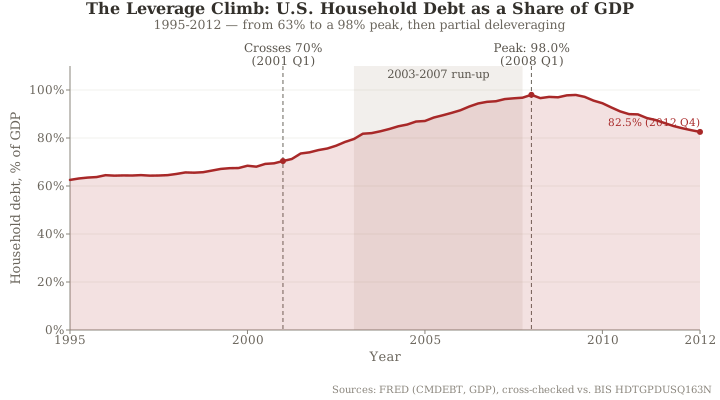
The Minskyite case starts with the data. From 2003 onward, U.S. household debt-to-GDP rose from below 70 percent to nearly 100 percent, the smooth ascent of leverage during the very window the Lucas address called depression-prevention solved. The financialization that drove it is the subject of Economic History Ch.18 (Globalization and the Great Moderation). Steve Keen, formalizing Minsky in nonlinear differential equations, publicly warned of an imminent crisis from December 2005. Adair Turner, who would chair Britain’s Financial Services Authority during the crisis, later said the 2007 financial system was “profoundly Minskyian in its essence” and that the mainstream had blinded itself by treating finance as a frictionless veil over the real economy.
Claudio Borio at the BIS spent the 2000s building a parallel research program around the “financial cycle”, medium-frequency cycles in credit and asset prices the standard business-cycle apparatus filtered out as noise. Borio kept the framework Austrian-adjacent rather than post-Keynesian, but the empirical regularity is the same: leverage builds during expansions, asset prices and credit move together, and busts look nothing like temporary deviations from a stable trend. The dissident tradition — post-Keynesian on the Minsky branch, Austrian-adjacent on the Borio branch — had been describing the kind of dynamic that took down 2008 for years, using frameworks the mainstream had ruled methodologically inadmissible. That gatekeeping is itself one of the things 2008 put on trial.
“The financial system as it has emerged in the past several decades has been profoundly Minskyian in its essence.”
— after Adair Turner, Between Debt and the Devil, 2015
Minsky was substantially right; absorption is partial
Post-2008 DSGE-with-financial-frictions absorbed the back end of the Minsky cycle — balance-sheet constraints, fire-sale externalities, credit-spread dynamics. It did not absorb the front end — the endogenous generation of the cycle from a stable starting point. The framework still treats financial stress as a friction on an underlying equilibrium economy. The absorption is real and incomplete.
Substantially vindicated, partially absorbed
The leverage-cycle dynamics were real, observable in the data from at least 2003, and being described by a non-trivial dissident tradition while the mainstream apparatus filtered them out. The post-2008 absorption — Christiano-Motto-Rostagno, Gertler-Karadi, the Bernanke-Gertler financial-accelerator literature upgraded from sidebar to mainstream — is the discipline conceding the substance. We hold that History of Economic Thought Ch.17 (Modern Pluralism) is correct to mark this as a structural shift in what the discipline takes seriously, and that whether the absorption is complete enough to handle the next crisis is open.
If Minsky-shaped warnings existed in the literature, they should also have existed in the public record, named economists, on the record, making specific warnings before the event. They did. Some of them got booed at conferences. Some of them got mocked on CNBC. The story of who warned, and why nobody listened, is the next stage.
The warnings that got booed
“Managers in the new financial system have an incentive to take risks that generate severe adverse consequences with small probability but, in return, offer generous compensation the rest of the time… The current incentive structure could lead to a greater (albeit still small) probability of a catastrophic meltdown.”
— Raghuram Rajan, “Has Financial Development Made the World Riskier?” Jackson Hole, August 27, 2005
Three years before Lehman, the chief economist of the IMF stood at the annual Jackson Hole conference, convened that year to honor the retirement of Alan Greenspan, and warned that financial-sector compensation was generating tail risk. Larry Summers rose from the audience to call the paper “slightly Luddite” and “largely misguided.” Donald Kohn defended the prevailing view. The minutes read like a documentary scene about a discipline talking past its most credentialed warning.
Other warnings ran alongside Rajan’s. Robert Shiller had been arguing in real time that U.S. house prices were a bubble from 2003. Nouriel Roubini gave the IMF a presentation forecasting a housing-led recession in September 2006. Peter Schiff spent 2006 and 2007 on CNBC and Fox Business predicting a housing crash; the compilation of his appearances, complete with hosts laughing on camera, accumulated millions of views once the crash arrived. Steve Keen started a public “Debtwatch” warning in December 2005. The warnings existed in the discourse before the event. Two channels explain why they did not become consensus: methodology (warnings from frameworks the mainstream had ruled inadmissible carried no institutional weight) and sociology (warnings from inside the institutions had to compete against the Great Moderation consensus and the academic-industry revolving door Inside Job later documented). The information-asymmetry apparatus the discipline would have needed to apply to its own profession lives in Ch.4 (Market Failures); the sharper machinery for a profession failing to police its own incentives, government-failure-style analysis turned on the discipline itself, lives in History of Economic Thought Ch.14 (Public Choice), which treats institutional failure as symmetric to the market failures economists are trained to spot in others.
The dissenting-voices case, at full strength, is that the warnings were present at every level, inside the IMF, in major journals, on cable news, in dissident literatures. A meaningful share of the discipline’s collective failure was institutional: status hierarchy, gatekeeping, and incentive structure suppressing the warnings the warning system did produce. Inside Job documented one piece: the Frederic Mishkin paper retitled on his CV from “Financial Stability in Iceland” to “Financial Instability in Iceland” after the Icelandic banking system collapsed, written on a $124,000 contract from the Iceland Chamber of Commerce. One paper is an anecdote; the pattern, senior macroeconomists earning fees from the financial sector while writing work that under-weighted financial-sector risk, was structural. The post-crisis journal disclosure norms the American Economic Association adopted in 2012 exist because the pattern was real.
John Cochrane and Eugene Fama in particular argue that most prediction is wrong, and that warnings that look prophetic in retrospect get filtered through hindsight in ways that distort the base rate. Schiff predicted a crash for years before one arrived and kept predicting crashes that did not; Roubini was bearish on essentially all assets through the post-crisis recovery, much of which was wrong. The policy question is not whether someone said something true about housing in 2005 but whether the apparatus could distinguish true warnings from noise at the time. Cochrane’s “How Did Paul Krugman Get It So Wrong?” (2009) rests heavily on this base-rate point.
Both sides hold something. Rajan was correct in a documentable, load-bearing way that survives base-rate adjustment. Schiff was correct about 2008 and substantially wrong about most of what followed. Forecasting is hard. The discipline-level failure was the failure to take seriously, at institutional scale, warnings from credentialed insiders through legitimate channels. Rajan at Jackson Hole is a sociology problem.
The institutional failure was real
The warnings existed, the channels for hearing them existed, and a meaningful share of the failure was institutional: the status hierarchy, the academic-industry revolving door, the methodological gatekeeping that ruled certain frameworks inadmissible in advance. The mainstream is right that retrospective selection inflates the prophet count. It is wrong to use that point to dismiss the specific names and specific institutional moments, Rajan at Jackson Hole in particular, that survive the selection adjustment. We hold that the institutional failure was a real component of the disciplinary failure, distinct from but compounding the methodological one analyzed in Stage 2.
Methodological failure and institutional failure both diagnosed, the closing question is what changed. The post-2008 consensus has moved. Central banks act differently, journals publish different work, and the next macro PhD writes a different dissertation than the one that would have come out of MIT in 2005. The question is whether the changes are deep or whether they are window dressing on a frame that still treats finance as a friction.
What changed, and how much
“We all knew that there were ‘dark corners’—situations in which the economy could badly malfunction. But we thought we were far away from those corners, and could for the most part ignore them… The main lesson of the crisis is that we were much closer to those dark corners than we thought—and the corners were even darker than we had thought too.”
— Olivier Blanchard, “Where Danger Lurks,” IMF Finance & Development, September 2014
Six years after Lehman, the IMF’s chief economist wrote what amounts to the discipline’s formal post-mortem in the Fund’s house journal. Blanchard is careful, institutional, and on the inside. If there is a defensible mainstream story about what 2008 changed, it is the one he tells. The dark-corners admission is the heart of it: mainstream macro had always known that badly-behaving equilibria were theoretically possible, treated them as too remote to matter, and 2008 showed the economy was operating far closer to those corners, and the corners were darker, than the consensus had assumed.
What is in the post-2008 consensus that was not in the 2007 one? Financial-friction blocks are now standard in policy DSGE: Christiano-Motto-Rostagno’s entrepreneurial-net-worth machinery and Gertler-Karadi’s interbank-leverage machinery are taught in graduate macro and used in central-bank policy analysis. Macroprudential regulation is a real policy instrument: Basel III capital ratios, countercyclical buffers, stress testing. The lender-of-last-resort function has deepened theoretically (the Bernanke-Gertler-Gilchrist financial accelerator upgraded from sidebar to backbone) and operationally (the Fed’s 2008 emergency facilities are now in the playbook). And BIS-pioneered financial-cycle work, the credit-to-GDP gap as a leading indicator, is used at central banks that twenty years ago would have filtered credit out as noise. Economics Ch.16 (Monetary and Fiscal Theory) covers the modern policy apparatus; Economic History Ch.19 (GFC and After) covers the institutional chronology, including the new monetary regime that crystallized after the crash.
The reorganization is real enough that the history-of-thought literature treats it as a structural shift. History of Economic Thought Ch.17 (Modern Pluralism) walks the post-2008 reckoning as the moment the New Keynesian / RBC consensus loosened into a more honest acknowledgement that financial-sector dynamics are first-order, short of pluralism in any strong sense. Ch.12 (New Keynesian) closes on what the retrofits did and did not repair. The deregulation arc traced in Economic History Ch.18 (Globalization and the Great Moderation), Garn-St. Germain (1982) through Gramm-Leach-Bliley (1999) and the CFMA (2000), is now read as part of the disciplinary failure the methodological consensus enabled.
The absorption is real but partial; the commitments that produced the failure are intact at their core. Financial-friction DSGE is still DSGE: it retrofits frictions onto a representative-agent, rational-expectations, equilibrium-machine skeleton. The frictions are load-bearing; the skeleton is not under reconsideration. A genuine Minsky-style account of endogenous instability — where stability itself generates the dynamics that destabilize it, where the cycle is the equilibrium — is still not the workhorse.
The mainstream defense, at its strongest, points to how much has moved. Macroprudential regulation exists where it did not. The Fed’s crisis-reaction function includes tools that did not exist in 2007. Demanding the discipline replace its core methodology in response to one event is asking more than any social science delivers; absorbing the failure into the existing methodology, expanding the apparatus to include what was missing, and revising policy around the revised apparatus is what the discipline has, broadly, done. Blanchard’s position — the apparatus is repairable, the repairs have been substantial, the deep commitments worth preserving because the alternatives are worse — is where that defense rests.
The verdict
Did economics cause 2008? Yes, partially, in a specific sense: methodological commitments, DSGE-centric modelling without financial-sector representation, efficient-markets finance, the “Great Moderation” reading of low volatility as deep stability, produced policy advice and regulatory frames that systematically under-weighted financial-crisis risk. The pre-crisis discipline cannot be cleanly separated from the deregulation arc its consensus supplied intellectual permission for. The institutional failures, the dismissal of Rajan, the conflict-of-interest pattern Inside Job documented, the gatekeeping that ruled Minsky-shaped frameworks inadmissible, compound the methodological failure into the reckoning the senior insiders themselves have made.
The response has been meaningful but partial. Financial frictions are in the workhorse; macroprudential regulation exists; the lender-of-last-resort function is deeper; the financial cycle is a recognized policy variable. History of Economic Thought Ch.17 (Modern Pluralism) is correct to read this as a real shift. The heterodox worry — that endogenous-instability frameworks are still not the workhorse, that the next crisis may again find the apparatus unprepared — is serious. The discipline should be graded on humility about what the current apparatus can foresee.
The defensible posture for 2026: defend the post-2008 reforms against the claim that nothing changed; hold onto the structural humility the heterodox critique calls for against the claim that the apparatus is now adequate. Economics did partially cause 2008 in the sense the senior insiders themselves conceded; the discipline has done part of the work; whether the core commitments can ever foresee the kind of crisis they are designed to filter out remains open.
The shape of this question, the discipline on the record about its own blind spots, recurs across the topic. “Was Marx right about anything?” runs the same kind of internal-reckoning question against a different target: what the discipline measures and what it methodologically rules out. “What did the Austrians get right?” runs it against what the discipline ignores. The three together engage the meta-question behind all the others: how the economics apparatus knows what it knows, and what it cannot see from inside itself.