Was Marx right about anything?
Thirty percent of American Gen Z reports a favorable view of Marxism, up from six percent in 2019. A million people have watched David Harvey’s lectures on Capital. Brad DeLong’s 600-page history of the twentieth century calls Marx the most-influential economic thinker after Adam Smith. What is in dispute is which Marx, and which claims of his, survive contact with the apparatus mainstream economics has.
See as debate graphWhy Marx, why now

“Marx had genuine insights, about the dynamism of capitalism, its tendency to create global markets and transform societies, its production of inequality, its disruption of traditional ways of life. He was also catastrophically wrong about what would replace it.”
— after J. Bradford DeLong, Slouching Towards Utopia: An Economic History of the Twentieth Century, 2022
DeLong is a Berkeley macroeconomist and roughly the median voice of credentialed American mainstream econ. His history of the century puts Marx alongside Hayek and Polanyi as the period’s load-bearing economic thinkers, and his verdict is a mixed one. It is where this argument lands too.
David Harvey’s CUNY lectures on Capital Vol. I have over a million YouTube views. They are the gateway through which most Western under-forties encounter Marx today, as a working teacher with a class.
The question is narrower than it looks. It is not “was Marx a good person” or “was the Soviet Union good” or “is socialism a good system.” It is: of Marx’s specific economic claims — about value, profit, class, crisis, the long-run trajectory of capitalism — which survive contact with the apparatus modern economics has built, and which do not? That split lets the dispute be settled in pieces.
Four things have stacked to revive the question. Piketty’s Capital in the Twenty-First Century (2014) produced wealth-concentration data on a scale modern growth theory had ruled out. Polling shifted: 62 percent of Americans aged 18 to 29 view socialism favorably; Gen Z runs 30 percent favorable on Marxism. A serious academic Marxism reorganized around Anwar Shaikh and Michael Roberts, doing quantitative work in a classical-Marxian frame. And the critical-theory stream — Harvey, Brown, Fisher, Graeber — rebuilt a public engagement with capital outside the value-theory weeds.
“Was Marx right?” gets answered as if Marx were one thinker with one set of claims. He wasn’t. There is Marx the value theorist; Marx the crisis theorist (tendential fall in the rate of profit); Marx the structural sociologist (class as relation to production); Marx the imperialism theorist (via Lenin and Luxemburg); and Marx the prophet of capitalism’s inevitable collapse. Five claims, five evidential records. Confusing them is what makes the public dispute stupider than it needs to be.
The generational data is the live-discourse hook. The 62-percent socialism-favorable-among-18-to-29 number isn’t a vote on the labor theory of value. It’s a vote on a vibe, a sense that the system is producing outcomes its defenders can’t justify, and that the structural-critique vocabulary closest to hand is Marx-inflected even where speakers disclaim him. Sanders is explicit that his democratic socialism descends from FDR and owes nothing to Marx. AOC calls herself a democratic socialist and rejects the communist label. The mainstreaming of the vocabulary — system, class, structural failure — is downstream of Marx whether speakers acknowledge the lineage or not.
Where this leaves us
The dispute is live, in the academy and in public. Split “was Marx right” into the five pieces above, run each piece against the relevant mainstream apparatus, and report what survives and what doesn’t. The verdict is mixed and partial, and both internet factions will dislike it.
The first piece to test is the one mainstream econ thinks it settled in the 1870s, value. Marginalism replaced the labor theory of value with something formally tighter. The displacement was decisive, and narrower than the textbook version admits.
Labor theory of value vs. marginalism
“A commodity appears, at first sight, a very trivial thing, and easily understood. Its analysis shows that it is, in reality, a very queer thing, abounding in metaphysical subtleties and theological niceties… That which determines the magnitude of the value of any article is the amount of labour socially necessary, or the labour time socially necessary for its production.”
— Karl Marx, Capital Vol. I, Chapter 1, 1867
The opening move of Capital. A coat is worth twenty yards of linen because both embody the same quantity of socially necessary labor time. This is the labor theory of value, inherited from Smith and Ricardo and sharpened into the analytical core of a critique of capitalism. The marginalist revolution of the 1870s replaced it.
Marx’s value theory says the long-run exchange ratio between two commodities is governed by the relative labor time crystallized in them. Marginalism says it is governed by the marginal utility of each to the consumer and the marginal cost of each to the producer, with prices emerging from the intersection. The marginalist account — Jevons, Menger, Walras — is what Economics Ch.5 derives from preferences and production functions, and what Economics Ch.11 formalizes via duality theory and the two welfare theorems.
The formal contrast: Marx’s value $\lambda_i$ is given by the socially necessary labor time embodied in producing commodity $i$, with prices supposed to be regulated by these values up to a transformation. Marginalist value is the equilibrium price $p_i$ that clears markets given utility functions $U(\cdot)$ and production functions $f(\cdot)$, with $p_i = \mathrm{MU}_i / \mathrm{MU}_{\text{num}}$ at the consumer optimum and $p_i = \mathrm{MC}_i$ at the producer optimum. The two welfare theorems then deliver Pareto-efficiency results that the labor theory cannot generate, because the labor theory wasn’t designed to answer allocation questions.
Marx asked: what determines, deep down, that this coat trades against that much linen? His answer was labor time. Marginalism asked a different question: given preferences and production possibilities, what prices clear markets and is the resulting allocation any good? Its answer was marginal utility and marginal cost.
The marginalist machinery that displaced the labor theory of value — the consumer’s problem, cost minimization, and the welfare theorems that grade the resulting allocation — sits one click away. Peek the apparatus, then watch it fail to answer the one question the LTV was built for.
The LTV is usually presented to undergraduates as something marginalism “disproved.” That is not what happened. Marx’s value theory does something marginalism explicitly does not: it offers an objective account of where surplus comes from in capitalist production. The wage-laborer is paid the value of her labor-power, what it costs to reproduce her, but produces more value than that during the working day. The difference is surplus value, and it is the basis of profit. Anwar Shaikh’s Capitalism: Competition, Conflict, Crises (2016) reconstructs this apparatus inside a modern empirical framework and argues it predicts wage-share dynamics, profit-rate dispersion, and crisis tendencies the neoclassical synthesis treats as anomalies. The LTV is a different kind of theory asking a different question.
The strongest contemporary version of “what survives of Marx after marginalism” is the analytical-Marxism move, which detaches exploitation theory from the labor theory of value entirely. G. A. Cohen’s Karl Marx’s Theory of History: A Defence (1978) reconstructs historical materialism as functional explanation: in his summary formulation, “production relations profoundly affect productive forces, and superstructures strongly condition foundations.” The mechanism is functional, weaker than the economic determinism usually attributed to Marx, and it does not require labor-values to do its explanatory work. John Roemer’s A General Theory of Exploitation and Class (1982) goes further: exploitation is redefined as a property-relations concept, the differential ownership of productive assets, and formalized in game-theoretic terms, with no LTV substructure at any point. The Roemer move is the cleanest mainstream-compatible answer to the LTV question. You can keep the exploitation diagnosis (some agents systematically work to enrich others by virtue of unequal access to the means of production) and drop the labor theory of value (commodities exchange at ratios determined by socially necessary labor time) without losing the substantive Marxian claim. The cost is that you also drop the self-understanding of Marx’s own apparatus. Cohen and Roemer are reconstructing Marx in machinery Marx would not have recognized.
The serious objection the LTV preserves is moral. Marginal-product theory tells you that under competition, factors are paid their marginal products and the allocation is Pareto-efficient. It does not tell you whether the distribution of factor ownership is just. If you own no capital and have only labor to sell, marginal-product accounting will explain your wage but will not address whether the world that produced your propertylessness is one you should consent to. The LTV refused to grant that the distributional question was outside scope. The marginalist revolution did, deliberately.
The verdict on value
Ladislaus von Bortkiewicz showed in 1907 that Marx’s Volume III equilibrium prices do not survive a consistency check if the Volume I labor-values are taken as binding. The system is over-determined, and the proposed transformation from values to prices does not close. That is the transformation problem, and Paul Samuelson’s 1971 Journal of Economic Literature survey, “Understanding the Marxian Notion of Exploitation,” restated it for the modern literature. Volume I values and Volume III prices are “mutually-exclusive alternatives,” and you cannot have both as the explanans of the same equilibrium. The modern result is that profit-price equilibrium is determinable from the production coefficients alone, with the value scaffolding doing no analytical work the price system does not already do. The Sraffian-Post-Keynesian and Temporal Single-System Interpretation (TSSI) reformulations, picked up in Shaikh’s reconstruction, answer the technical objection, but only at a cost in tractability that the marginalist allocation apparatus does not pay.
Marginalism is the right tool for allocation and welfare; the LTV is the wrong tool for those. The welfare theorems are genuine results, and the transformation problem is a real difficulty. But the LTV is a defensible tool for asking what economic value means morally, for treating the wage relation as something other than a voluntary exchange between equals. Mainstream econ replaced the LTV for technical reasons that are correct, and in the replacement quietly stopped asking the question the LTV was built to ask.
Three chapters carry the lineage here. Marx gets his own chapter in the history of economic thought, covering the labour theory of value, surplus value, and the falling rate of profit, read forward to the 2008 vindication moment. The marginalist displacement that retired it as an allocation theory is the next chapter. And the transformation-problem critique, with the Bortkiewicz-Samuelson machinery and the narrative of Marxian decline inside the formalizing mainstream, lives in the counter-revolution chapter. Peek any of the three.
Marx’s bigger claims, though, were about dynamics, about what capitalism does to itself over time. The clearest of those claims is the one neo-Marxist empirics keeps insisting has been confirmed, and that mainstream econ keeps insisting is measured wrong.
The falling rate of profit
“The world rate of profit has been falling secularly… On average from 1960 to 2019 the world rate of profit declined at about 0.5% a year… The main cause was a rise in the organic composition of capital. This is Marx’s law of the tendency of the rate of profit to fall, confirmed.”
— after Michael Roberts, The Next Recession blog, “world rate of profit” series, 2020–2022
Roberts is a Marxist economist working outside academia but quantitatively serious. His claim is the boldest one in contemporary Marxian empirics: the long-run rate of profit on capital has fallen, secularly, across the developed world for sixty years, and the cause is the mechanism Marx named in Volume III, a rising organic composition of capital. If true, it is Marx’s most precise dynamic prediction holding up against modern data.
The formal claim is sharper than the slogan. As capitalists accumulate, the ratio of constant capital (machinery, plant) to variable capital (wages) tends to rise, the “organic composition” rises, and since surplus value is generated only from variable capital in the LTV framework, the average rate of profit falls. The mechanism depends on the LTV. The pattern it predicts, a secular decline in the rate of profit on capital, does not. Other frameworks can predict the same pattern from labor-share dynamics, capital-deepening, declining marginal returns, or the slow exhaustion of catch-up growth.
Economics Ch.13 derives the Solow steady state with declining returns to capital deepening, but in the standard model the rate of return converges to a steady-state value rather than falling secularly. Endogenous growth models, the Karabarbounis-Neiman labor-share literature, and the secular-stagnation literature each capture pieces of what the neo-Marxists point at, without using the organic-composition apparatus. The two literatures look at adjacent data and disagree about what causal frame to put around it. Open the steady-state result and ask whether “converges” or “falls secularly” is the better description of the last sixty years.
Take the Shaikh-Roberts-Maito empirical position at its strongest. US, UK, German, and Japanese rates of profit on industrial capital show a downward secular trajectory from 1947 to 2019, punctuated by recoveries (1980s neoliberal restructuring) that didn’t reverse the long trend. The post-1970s wage-share decline that mainstream econ attributes to skill-biased technical change, globalization, and monopsony is, on the Marxist read, the system trying to restore a falling rate of profit by extracting more surplus per worker. The 2008 crisis fits. The post-2008 low-growth regime fits. The mainstream invokes a sequence of distinct shocks; the Marxist story invokes one mechanism.
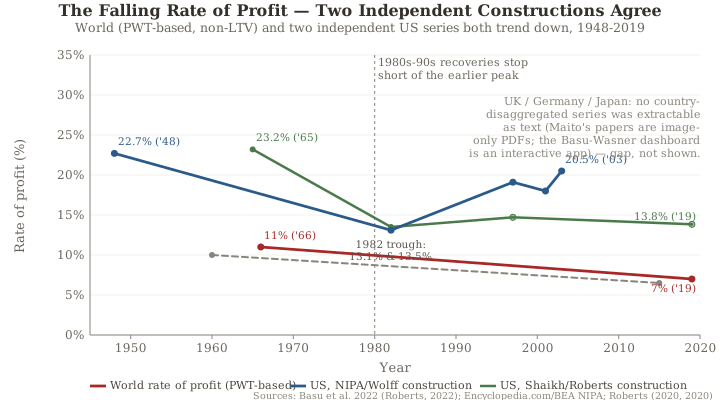
Shaikh’s further point: the neoclassical synthesis treats competition as “perfect” in long-run equilibrium, with profit rates equalized. The data don’t show this. Profit rates persistently disperse across firms and sectors. Shaikh argues competition is turbulent, profit rates oscillate around regulating averages, never reaching equality. The post-2008 mainstream interest in heterogeneous-firm productivity dispersion (Syverson and others) is engaging adjacent ground without naming the lineage.
The verdict on crisis
The empirical pattern, secular decline in the rate of profit on industrial capital across the post-war advanced economies, is real in multiple credible measures, including ones built without the LTV apparatus. Mainstream econ has its own version of this conversation (labor-share decline, secular stagnation, heterogeneous-firm dispersion). The mechanism, rising organic composition of capital driving the rate of profit down, is more contested, because the value-theoretic substructure is in genuine dispute. The pattern is partially confirmed; the mechanism is open. Marx pointed at a real thing without necessarily being right about why it happens.
The historical spine for this pattern is the GFC chapter, where the crisis reads as a vindication moment for some Marxists and the low-growth regime after it as the era where labor-share decline and the falling-rate-of-profit story meet. Peek the secular-stagnation debate that the mainstream and the Marxists are both circling.
Dynamics is one thing. The claim that does the most argumentative work in modern discourse is sociological. It is that class is the right unit for analyzing capitalist economies, ahead of consumption or skill or marginal product. That claim is the one mainstream econ has spent fifteen years absorbing.
Class as explanatory variable
“When the rate of return on capital significantly exceeds the growth rate of the economy… then it logically follows that inherited wealth grows faster than output and income… The past devours the future.”
— Thomas Piketty, Capital in the Twenty-First Century, 2014
Piketty is not a Marxist. He is a Paris School of Economics liberal who explicitly rejects Marx’s labor theory of value. But the title of his 2014 book is Capital, the central inequality $r > g$ describes a long-run wealth-concentration mechanism modern growth theory had treated as ruled out, and the reception, for and against, treated the book as Marx’s return through a side door. The most-cited mainstream economist of the last fifteen years now treats “capital owners vs. labor” as a useful unit of analysis. That is new.
When does mainstream econ use class? Usually implicitly. Factor shares, the wage share and the capital share of national income, are class variables in everything but name. Chetty’s intergenerational-mobility literature reads outcomes off parental income decile. The Acemoglu-Robinson institutionalist literature reasons explicitly about elite-versus-non-elite political coalitions and the institutions they build. Economics Ch.18 covers this institutionalist lineage; the history-of-thought chapter on the institutional tradition traces it from Veblen forward and identifies where it absorbs Marxian framing without naming the source.
What mainstream econ rarely does is treat class as the unit of analysis. The default modeling object is the representative consumer or the firm. When class enters, it usually enters as a distributional consequence of some prior allocation, downstream of the structure that shapes which allocations are reachable. Marx’s claim was the opposite: the wage-labor relation is structurally constitutive of capitalism, and ignoring it costs you most of the explanatory action. The labor-share decline literature carries the best contemporary evidence that the wage/profit split is moving in Marx-relevant directions, and it is where this charge lands. Peek the labor-share debate (technology vs. monopsony vs. globalization) and the institutions-and-inequality engagement that frames the contemporary fight.
Piketty’s $r > g$ is, on the mainstream side, the cleanest evidence in fifty years that capital-versus-labor does real explanatory work. Across advanced economies the rate of return on capital has exceeded the growth rate of output for most of recorded capitalist history, with the mid-twentieth-century exception (1914 to 1970) standing out because two world wars and a depression destroyed inherited capital stocks on a unique scale. In normal times, capital compounds faster than wages grow. That is a structural prediction about distribution from treating capital-owners and wage-earners as separate populations with distinct income dynamics, Marx’s move, executed inside a mainstream toolkit.
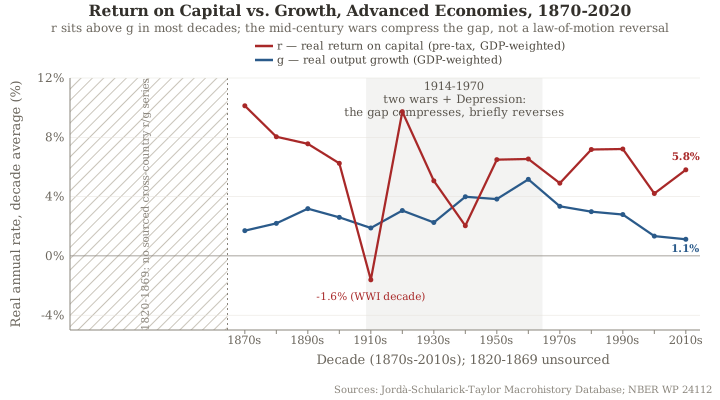
“I’m not a Marxist. I never managed to read Volume I of Capital. But the dynamics of wealth distribution we observe in the data show that the past devours the future.”
— after Thomas Piketty, 2014 interviews on Marx and Capital in the Twenty-First Century, 2014
What Piketty did and didn’t vindicate
Piketty’s $r > g$ data show a structural wealth-concentration mechanism modern growth theory ruled out. It does not vindicate the labor theory of value, the falling rate of profit mechanism, or the proletarian revolution. The Marx-was-vindicated headlines collapse five distinct Marxes into one. Piketty himself spent ten years insisting on the distinction.
The Harvey-Brown-Fisher-Graeber stream pushes further. Their claim: mainstream econ’s use of class as a derived variable is itself a methodological choice. Mainstream econ has the tools to measure GDP, productivity, inequality, and lacks the tools, by construction, to measure what capitalism does to human life as a totality. Treating that gap as “outside scope” is the move Harvey is calling out. It is the same measurement-gap argument the neo-Brandeisians ran on antitrust in the big-tech antitrust walkthrough, applied one level up.
The verdict on class
Class is a useful variable when capital ownership concentration is high, which it now is, at Belle-Époque levels in most advanced economies. Mainstream econ has been absorbing this slowly since 2010: Piketty, the labor-share-decline literature, Acemoglu-Robinson institutionalism, and heterogeneous-agent macro models that treat capital-owners and wage-earners as distinct populations all push the same way. The vocabulary is Marx’s; the tools are mainstream econ’s. The historical narrative, including the explicit modern-Marxian readings of analytical Marxism and Heinrich’s new reading, lives in the modern-pluralism chapter; the deeper inequality engagement is its own walkthrough. Peek the institutions-and-inequality turn where the discipline started taking class seriously again.
The deeper engagement with whether economics can even measure the thing, and what mainstream inequality work does and doesn’t capture, is the subject of the inequality walkthrough.
Five Marxes, four pieces tested. The remaining question is what verdict, exactly, is worth defending. The DeLong synthesis from Stage 1 is one option. The version that follows adds a few caveats DeLong leaves implicit.
The accounting
“The philosophers have only interpreted the world, in various ways; the point, however, is to change it.”
— Karl Marx, Theses on Feuerbach, 1845 (thesis 11)
The most-quoted Marx line in modern discourse, and the one that smuggles in most of the confusion. It splits Marx-the-positive-analyst from Marx-the-political-prophet. Any answer has to do its accounting on each side of that split separately.
Marx the positive analyst — class as structural variable, capitalism as a system with internal contradictions, exploitation as a measurable labor-capital relation — got several things importantly right that mainstream econ has absorbed since. Marx the value theorist got something wrong if “wrong” means “displaced for allocation and welfare,” and something defensibly different if it means “answering a moral question marginalism set aside.” Marx the crisis theorist got the pattern partially right and the mechanism contested. Marx the imperialism theorist has a record in the history of empire, where capital-export is one driver of late-nineteenth-century empire but not the only one. Marx the political prophet has the worst record of the five.
The most ambitious Marxian-tradition reframing of the imperialism question is Immanuel Wallerstein’s world-systems analysis. The Modern World-System, vol. I (1974), argues the modern capitalist world has been, since the sixteenth century, a single integrated system, one division of labor with structurally distinct roles. In his own definition: “A world-system is a social system, one that has boundaries, structures, member groups, rules of legitimation, and coherence.” The reframing’s central claim about the periphery: “It follows then that the world-economy develops a pattern where state structures are relatively strong in the core areas and relatively weak in the periphery.” The judgment here: world-systems is right that the modern world-economy is structurally a single capitalist system with persistent core / semi-periphery / periphery asymmetries; it is contested whether that structural reading dispenses with the proximate political-economic mechanisms (Lenin’s finance-capital export thesis; the colonial-state-as-economic-apparatus) or augments them. Here it counts as augmenting: Lenin and Luxemburg gave one mechanism; Wallerstein gave the system the mechanisms operate inside; both can be partially right at once. Peek the colonial state as an economic apparatus, the proximate-mechanism record the structural reading sits on top of.
Three political-prophet predictions failed at scale in the twentieth century. The immiseration thesis, that capitalism would systematically drive real wages down, failed; real wages in advanced capitalist economies rose four-to-six-fold between Marx’s death and 1970, and the standard-of-living debate that grounds that empirical claim is one peek away. The proletarian revolution thesis, that advanced industrial economies would overthrow capitalism, failed; revolutions happened in agrarian peripheries (Russia 1917, China 1949). And state planning as a superior production technology failed by margins so large no serious contemporary economist defends it; the production-technology record of the planned economies is the second peek. The most influential mainstream absorption of Marxian crisis thinking without the political-prophet baggage is Keynes’s demand-side engagement, in the Keynesian-revolution chapter.
What Marx got right. Capitalism is dynamic; it transforms societies on a scale earlier modes of production did not. It tends to concentrate wealth structurally, in ways mainstream growth theory before Piketty had ruled out and the data have now restored. The wage-labor relation is structurally different from owner-labor; treating it as derived costs the analyst explanatory power. The alienation diagnosis falls outside economics narrowly construed, and it has held up well enough that critical-theory descendants from the Frankfurt School through Brown and Fisher have built coherent research programs on it.
What Marx got wrong. The labor theory of value as the analytical core for allocation and welfare. The immiseration thesis as empirical prediction. The proletarian revolution as historical inevitability, and as a feature of advanced rather than peripheral economies. Central planning as a superior production technology. The deterministic historical-materialism that has each mode necessarily replaced by the next. The record refuses the necessity and produces multiple equilibria the theory can’t accommodate.
What Marx got partially right. The falling-rate-of-profit pattern (real; mechanism contested). Class as explanatory variable (sometimes decisive, Piketty $r > g$, the labor-share decline, Acemoglu-Robinson; sometimes not). Imperialism as capital-export (one mechanism among several; against Lenin’s claim that it was the master one), though Wallerstein’s world-systems reframing argues the more accurate description is structural: a single capitalist world-economy inside which capital-export and colonial extraction operate as proximate mechanisms.
The verdict, plainly
Marx was right about a meaningful subset of his economic claims — capitalism’s dynamism, its structural tendency to concentrate wealth, the analytical usefulness of class, the alienation diagnosis — and mainstream econ has absorbed those bits across the last fifteen years, often without naming the lineage. He was demonstrably wrong about others: immiseration as empirical prediction, proletarian revolution as historical necessity, central planning as viable production technology. He was partially right about the falling-rate-of-profit pattern while remaining contested on the mechanism. And the labor theory of value was asking a moral question that marginalism replaced with machinery for a different one, leaving the moral question unanswered.
The “is Marx vindicated” framing is too coarse for any of this. The answer is: yes, about more than the textbook version admits; and no, about less than the current revival hopes. The five-Marx split is what lets that answer be more than a slogan. Short reading list: the Marx chapter in the history of economic thought for the lineage (peek above), Piketty’s Capital for the empirical revival inside mainstream methods, Shaikh’s Capitalism for the most serious contemporary academic Marxism, Wallerstein’s The Modern World-System (1974) for the world-systems engagement with the imperialism question, Cohen’s Karl Marx’s Theory of History (1978) and Roemer’s A General Theory of Exploitation and Class (1982) for the analytical-Marxism reconstruction, and DeLong’s Slouching Towards Utopia for the calibrated mainstream read closest to the verdict here.
The closest in-mainstream engagement with Marxist concerns is the inequality walkthrough; the dynamics question intersects with the recessions walkthrough, where Marx’s crisis theory meets the mainstream business-cycle literature. The pattern traced here, mainstream econ absorbing a heterodox tradition’s empirical regularities while rejecting its analytical substructure, is visible in the Austrian engagement in what did the Austrians get right? and the Minsky revival inside post-2008 finance in did economics cause 2008? Together with this walkthrough, those two are the topic’s most direct engagement with the meta-question of how the mainstream economics apparatus knows what it knows, and what it cannot see from inside itself.
Where this leaves us
We started with a revival — Gen Z polling, a million views on Harvey’s lectures, DeLong placing Marx among the century’s load-bearing thinkers — and the way through it was to refuse the question as asked. “Was Marx right?” has no answer until you split the one Marx into five: the value theorist, the crisis theorist, the structural sociologist, the imperialism theorist, the political prophet. Each got a different verdict against a different evidence base. The value theorist was displaced for allocation and welfare by machinery that is genuinely better at those questions, and kept a moral question marginalism set aside. The crisis theorist pointed at a real falling-profit pattern and got the mechanism contested. The structural sociologist won quietly. Class is back as a useful unit, in Piketty and the labor-share data and heterogeneous-agent macro, in the mainstream’s own vocabulary. The imperialism theorist got one mechanism inside a world-system Wallerstein described better. The political prophet failed on immiseration, on revolution, and on planning, by margins no one defends.
Marx was right about more than the textbook admits and less than the revival hopes, and the people loudest on either side are usually arguing about a different one of the five Marxes than their opponent is. The next time a headline tells you Marx was vindicated, or a thread tells you he was discredited, the move is the same: ask which Marx, and against which evidence.