Is housing a market good or a welfare good?
Build more, says one half of the argument. Decommodify, says the other. They are looking at the same housing-cost record through two different machines.
The market-good frame, at full strength
“Rents in Auckland were 28 percent lower than they would have been without upzoning … upzoning generated an approximate 24 percent increase in long-run floorspace supply.”
— Ryan Greenaway-McGrevy & Yun So, Can Zoning Reform Reduce Housing Costs? Evidence from Rents in Auckland, 2024 (rents), and Ryan Greenaway-McGrevy, Regional Science and Urban Economics, 2025 (floorspace)
Auckland upzoned three-quarters of its residential land in 2016, and the rents fell relative to where they were heading. This is the cleanest natural experiment the supply argument has, and the frame that produced it is correct about a great deal.
The housing-as-market-good apparatus is the ordinary supply-and-demand machine pointed at one stubborn good. Land is fixed, but floorspace is not, and the binding constraint on floorspace in a productive city is almost never construction cost. It is the legal ceiling a city places on how much can be built. Zoning, height limits, minimum-lot rules, and historic-district designations function as a quantitative restriction: they cap quantity below where the market would clear, and the gap shows up as price.
Put the cap on a diagram and the consequence is mechanical. If demand for housing in a city is $D(q)$ and the regulatory regime caps allowable quantity at $\bar{q}$, the market price settles where the cap bites, at the height of the demand curve evaluated at the rationed quantity. The wedge between that price and the cost of building the marginal unit is a transfer: it accrues to whoever already owns the scarce, entitled stock. Incumbent owners capture it; renters and would-be entrants pay it. Nothing about this requires bad faith. It is what a binding cap does.
With the city's housing demand written as an inverse-demand function $D^{-1}$, a regulatory cap at quantity $\bar{q}$ pins the market price at
$$p_{\text{cap}} = D^{-1}(\bar{q})$$and the regulatory-rent wedge is the difference between that price and marginal construction cost $c$: $\;w = p_{\text{cap}} - c$. Every dollar of $w$ is income transferred to incumbent owners of the entitled stock, financed by everyone priced out below the cap.
Imagine a city that decides only a fixed number of apartments may ever exist. More people want to live there every year, but the number of homes cannot grow. The price of those homes climbs until enough people give up and leave. The owners of the existing homes get richer; everyone trying to get in pays for the privilege. The price is not high because building is hard. It is high because building is forbidden.
Two further pieces complete the apparatus. First, the wedge is a deadweight loss layered on top of a transfer, because the city forgoes the agglomeration gains that the missing residents would have generated. Productive cities run on increasing returns to density: workers are more productive near other workers, ideas circulate faster, specialized labor markets thicken. When zoning caps the population of a high-productivity metro, it shrinks the national economy by keeping people out of the places where they would have produced most. Second, the magnitude. Hsieh and Moretti argued in 2019 that misallocation of this kind cost US output something on the order of a third of GDP growth. That headline number is disputed. The 2024 Greaney correction found a coding choice that shrinks the estimate by roughly two orders of magnitude. The directional claim that supply constraints in productive cities bind, and that relaxing them lowers prices and raises output, does not depend on any specific magnitude. It survives the correction intact.
The formal home of the price-cap apparatus is Ch 2 §2.5 (Price Ceilings and Floors); the deadweight-loss-from-restriction logic and the externality framing sit in Ch 4 §4.1 (Externalities). Peek into either without leaving this page.
“The cardinal sin of successful cities is using zoning and historical-district regulations to artificially limit supply.”
— after Edward Glaeser, Triumph of the City, 2011
What the market-good frame gets right
Before we flip the frame, take it seriously. The urban-economics tradition has a real diagnosis and a real cure, and the evidence where the cure is tried is on its side. The question is not whether it is right. It is whether it is the only frame that applies.
The apparatus in its own voice
“There is no such thing as an affordable-housing problem that is not, at root, a problem of not building enough housing. The places that are expensive are the places that have stopped building. The places that build stay affordable.”
— the urban-economics frame, as Edward Glaeser argues it in Triumph of the City
Argued in its own voice, the market-good frame is the confident diagnosis of a discipline that has watched the same pattern repeat across decades and continents: cities that restrict supply become unaffordable, cities that permit supply do not. The frame does not deny that housing has a moral weight other goods lack, it argues that the moral weight is best served by abundance, and that abundance is a supply problem with a supply solution. The neoclassical-and-marginalist lineage this apparatus descends from, the move that turned housing into a clearing market with a price, runs back to the formalization of supply-and-demand in the late nineteenth century, traced in History of Economic Thought Ch.5 (The marginalist revolution and formalization).
Where this leaves us
Where supply is permitted to respond — Auckland after 2016, Tokyo across thirty years, Houston, every metro that legalized accessory dwelling units — the market clears and rents stop running ahead of incomes. Glaeser's diagnosis is right. The Hsieh-Moretti directional claim is right even after the magnitude dispute. The libertarian-maximalist version that promises to halve all prices through deregulation alone overshoots on magnitudes. The full within-market controversy, the Hsieh-Moretti dispute in detail, the homevoter politics, the rate at which new supply filters down to lower-income renters, is the subject of a different walkthrough, Why is housing so expensive?, which takes it on in full. The question ahead is whether it is the only apparatus that applies to this good.
But every country that has the housing-cost record we want — broad affordability, long-run cost stability, low rent burden across every income class — built something the US never built. Not a different supply policy. A different track entirely.
The flip, housing as a welfare good
“About 60 percent of Vienna's population lives in some form of publicly subsidized housing. Austria spends roughly 0.25 percent of GDP on housing subsidies, among the highest in the OECD, and Vienna's share of rent-burdened households is far below that of comparable high-income cities.”
— after OECD, Brick by Brick: Building Better Housing Policies, 2021
Vienna has run housing as a welfare good at scale for a century. Sixty percent of a major Western capital lives in housing the market does not price. This is not poverty housing for the indigent. It is universal-coverage, cross-class, middle-income housing, and the US housing discourse keeps misreading it.
The welfare-good apparatus does not start from the clearing market. It starts from a different classification of the good. Housing, on this frame, is a merit good with universal-coverage provision: a good whose social value exceeds what any individual's willingness-to-pay registers, and which a polity therefore chooses to provide to everyone as a matter of right. This is a different machine from Stage 1's. It treats the dwelling as shelter first and asset second, and it asks a question the market frame cannot pose: what share of the housing stock should sit outside the asset class entirely?
The institutional fact that distinguishes welfare-housing-at-scale from US-style public housing is decommodification: a large core of the stock is removed from the speculative market and let at cost-rent rather than market-rent, owned by public developers or non-profit limited-equity bodies, and made available across income classes rather than means-tested down to the poorest. Cross-class universal coverage is the political-economy mechanism that makes the system durable. A program that serves only the poor is a program the median voter has no stake in defending; a program that houses the middle class is one they fight to keep. Vienna's Gemeindebauten house teachers and tram drivers, not only the indigent, and that is why they have survived a century of governments.
The welfare-housing developer sets rent to recover cost: where the market rent is $p_{\text{mkt}} = D^{-1}(\bar{q})$, the cost-rent is
$$r_{\text{cost}} = \frac{C_{\text{cap}} + C_{\text{op}}}{H}$$amortized capital plus operating cost, spread over the housed units $H$, with no scarcity rent on top. The cost-rent stock acts as a price anchor: the larger its share of the total stock, the less of the city's housing is exposed to the speculative wedge $w = p_{\text{mkt}} - c$ from Stage 1.
Picture two tracks running side by side. On one track, housing is bought and sold like any asset; prices rise and fall with demand and supply. On the other track, a large block of homes is owned by the public and rented at the cost of building and maintaining them. The second track does not replace the first. It anchors it. When most of a city can fall back on cost-rent housing, the speculative track loses its grip on the whole population, because not everyone is forced to bid into it.
The cross-country pattern is the apparatus's empirical core. The systems that deliver broad, durable housing-cost stability all run a welfare track at scale: Vienna's century-old municipal housing; Singapore's HDB, which houses about 80 percent of citizens in a public-developer ownership model while running one of the most dynamic property markets on earth, a system whose developmental-state roots are traced in Economic History Ch.14 §14.3 (The East Asian Developmental State); the Netherlands, Denmark, France's HLM, and Finland's Housing First. The market-dominant systems — the US, the UK, Australia, Canada, Ireland — built only the first track, and the long-run affordability record divides cleanly along that line. The merit-good and public-provision apparatus has its formal home in Ch 4 §4.4 (Public Goods) and, in fuller form, in the public-economics treatment of what the state should provide and how it insures households against housing risk, Ch 25 §25.2 (Public Goods, Merit Goods, Clubs) and Ch 25 §25.4 (Social Insurance and the Welfare State).
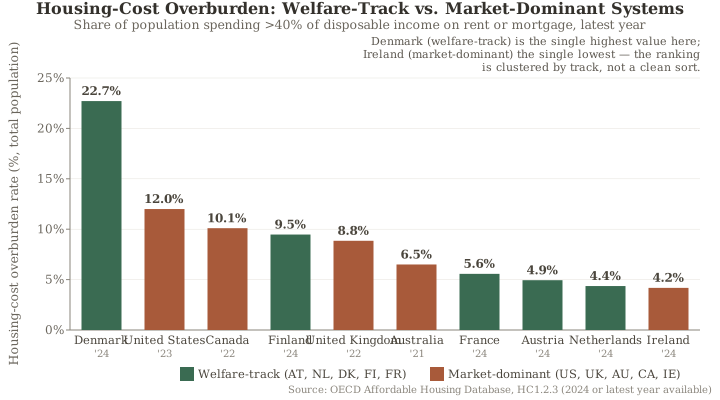
“The Anglo-Saxon homeowner societies and the Continental-European renter societies did not arrive at different housing-cost outcomes by accident. They built different housing systems, and the system, not the supply curve, is the explanatory variable.”
— after Sebastian Kohl, Homeownership, Renting and Society, 2017
What the welfare-good frame gets right
The welfare-good frame is not the market-good frame plus subsidies. It is a different classification of the good, and it explains a pattern the market frame cannot: why only the dual-track systems deliver durable cost stability, and why the US never did.
The apparatus in its own voice
“Comparing housing systems across the rich world, the persistent divide is institutional, not technical. Societies that decommodified a large share of their housing stock produced renter-majority cities with stable rents; societies that treated the dwelling as the household's primary asset produced the opposite.”
— after Sebastian Kohl, Konstantin Kholodilin & Florian Müller, The Rise and Fall of Social Housing? Housing Decommodification in Long-Run Comparison, Journal of Social Policy, 2022
Kohl is the comparative-academic voice for the welfare-good frame, and he argues it as a positive finding: the housing-cost record across rich democracies is best explained by the institutional choice of how much of the stock to decommodify. The Polanyian roots of this move, the idea that land and shelter are “fictitious commodities” that markets handle badly because they were never produced for sale, run through the institutional tradition traced in History of Economic Thought Ch.15 (The institutionalist tradition).
“Due to the financialization of housing, housing risks are increasingly becoming financial risks. Financialization refers to the increasing dominance of financial actors, markets, practices, measurements and narratives, and the resulting structural transformation of economies, firms, states and households.”
— Manuel B. Aalbers, The Financialization of Housing, 2016
Aalbers adds the critical-political-economy reading: the US did not arrive at its housing-cost record by failing to build, but by building only the asset track and letting financial actors come to dominate it. Decommodification is, at root, a property-rights move, it changes who holds the locational rent and on what terms, and the financialization lineage that explains how the dwelling became a speculative instrument sits in History of Economic Thought Ch.17 (Modern pluralism). In September 2021, Berliners voted 57.6 percent in a referendum to expropriate the largest corporate landlords. The full decommodification argument, and the same Vienna and Berlin evidence in shorter form, is taken up by the companion walkthrough Why is housing so expensive? (Stage 4: Berlin, Vienna, and the verdict); the question of which frame applies is the angle taken here.
Where this leaves us
Vienna houses 60 percent of its population in a welfare track that has run for a century and holds rent burden low at a quarter-percent of GDP. Singapore houses 80 percent of its citizens in a public-developer system that is also one of the most dynamic property markets on earth. The Netherlands, Denmark, France's HLM, and Finland's Housing First all run welfare tracks at scale and all deliver cost-stability outcomes the market-dominant systems do not. The cross-country evidence is unambiguous that welfare-track presence is the variable that distinguishes the durable-cost-stable systems from the rest. The strong-decommodificationist position overshoots in the other direction, abolishing the market track entirely produces its own pathologies, and Vienna itself runs a market track alongside its welfare track. But the apparatus is real and the evidence is in.
Vienna and Auckland are not arguing on the same axis. The question the discourse keeps missing, and the one the comparative housing-policy literature has actually answered, is what to do with two correct apparatuses at the same time.
The verdict, both apparatuses, missing track
“Well-functioning housing systems combine responsive supply with a substantial supply of social and affordable housing. The two are complements, not substitutes: countries that perform best on affordability do both.”
— after OECD, Brick by Brick: Building Better Housing Policies, 2021
The comparative-housing-policy mainstream has an answer, and it is not “pick one.” It is “build both.” This is the conclusion the discipline actually reaches, distinct from the strong-YIMBY-only and strong-decommodificationist framings the US discourse polarizes around.
The synthesis recognizes that the two apparatuses model different parts of the same housing economy and that a working system runs both. Step up one level, and the choice of which apparatus to build is an institutional decision a polity makes, a choice about the rules of the game that govern how a society houses itself, and like all such choices it is path-dependent. A country that has run a single track for a century cannot add the second cheaply, because the institutions, the fiscal commitments, the political coalitions, and the cultural expectation that the dwelling is the household's main asset have all hardened around the track it built.
The US chose its track, and the choice is legible in its institutional history. The FHA, the HOLC, the redlining maps, the postwar GI-Bill mortgage subsidies, Levittown, and the suburbanization machine of the mid-century all built the infrastructure of housing-as-asset, a vast, durable, mass-market apparatus for turning the dwelling into the median household's primary financial holding. In the same decades, much of Europe was building the parallel welfare-housing infrastructure the US never built. The path was set early and it compounded: the asset track created homeowner-voters with a stake in rising prices, who then resisted the supply and the welfare track alike. The post-2008 continuation of this story, the financialization that turned the asset track into a systemic risk, is the spine of Economic History Ch.19 (The 2008 crisis and after). The framing of apparatus-choice as an institutional decision about the rules of the game has its formal home in Ch 18 §18.4 (Extractive vs. Inclusive Institutions).
The US problem is a missing track
If both apparatuses are correct, the US framing problem is not picking the wrong one. It is that the welfare-housing track the comparative-policy mainstream treats as the other half of a working system was never built at scale.
Against the false dichotomy
“The most affordable and stable housing systems are neither pure markets nor pure public provision. They are mixed systems in which a responsive private market and a large decommodified sector each do the work the other cannot.”
— the comparative-housing-policy synthesis, as the OECD's Brick by Brick frames it, 2021
The synthesis is argued here against a single target: the false dichotomy that one apparatus has to win, which both US camps quietly accept. The comparative literature does not split the difference; it says the two apparatuses are complements, and the systems that perform best run both at scale. The most general version of this question — markets versus states across the full economic and political-theory frame, of which the housing case is one instance — is the subject of the broader walkthrough Markets vs. states; housing is the instance taken up here.
Where this leaves us
Housing is a market good and a welfare good. Both apparatuses model real features of the same housing economy. The systems that work — Vienna, Singapore, the European social-housing states — run both tracks in parallel and have for generations. The US framing problem is that the welfare-housing track the comparative-policy mainstream treats as the other half of a working housing system was never built at scale, and the discourse keeps debating which mono-track to run when the answer is to build the missing one. The political prerequisite, sustained fiscal commitment of roughly a quarter-percent of GDP for decades, plus the state capacity to administer a substantial share of the housing stock, plus the cross-class consensus that makes universal-coverage welfare housing politically durable, is itself the substantive question. The US has not built that consensus, and building it is the work the housing-policy discourse actually owes the country. The within-market controversy, whether supply alone could carry more of the load than this verdict allows, is taken up in full in Why is housing so expensive?
The move made here — asking not “is the market working?” but “what kind of good is this, really?” — does not stop at housing. It is the live question under the healthcare debate, where the US runs consumer-driven insurance markets while universal-coverage public systems abroad post better cost-and-outcome records by treating the good a different way; under the education debate, where school-choice and voucher markets argue with universal public provision; and under the climate-adaptation debate, where insurance markets and public-resilience infrastructure are two apparatuses for managing the same distributed risk. The nearest live instance is next door: Is healthcare a market? asks exactly this question of the next good over. What other goods are we currently mis-framing, treating as market goods because the market track is the only one we built?
The verdict
We started in Auckland, with the cleanest evidence the supply argument has, and took the market-good frame at full strength: housing is a market good with a regulatory disease, and where the cap is lifted, the market clears. Then we flipped the apparatus. Vienna houses 60 percent of its population at cost-rent, and the cross-country record says welfare-track presence is what sorts the durable-cost-stable systems from the rest. Two correct apparatuses, looking at the same housing-cost record through different machines. The third stage refused the binary the US discourse keeps reaching for, because the systems that work run both.
Housing is a market good and a welfare good, the working systems run both tracks in parallel, and the US's specific failure is the absence of the second one, the welfare-housing track the comparative mainstream treats as the other half of a functioning system, never built at scale, never given the fiscal commitment or the cross-class consensus that keeps Vienna's running. The supply fight is real and worth winning; it is also not the whole fight. The next time the housing argument collapses into “deregulate” versus “decommodify,” you have the apparatus to see what both sides are missing: that the country built one track, ran it for a century, and called the result a debate about which single track to run.