Markets vs. states, across economics and political theory
One discipline asks where the state should intervene. The other says the “free market” was a state project all along. They are not disagreeing, they are answering different questions.
Economics on the binary
“The kind of economic organization that provides economic freedom directly, namely, competitive capitalism, also promotes political freedom because it separates economic power from political power and in this way enables the one to offset the other.”
— Milton Friedman, Capitalism and Freedom, 1962
This is the answer most people are carrying when they hear “markets versus states.” The market is the default. The state has a short, bounded job: the rule of law, contracts, anti-fraud, and a narrow list of cases where markets genuinely fail. Everything past that list is overreach. It is a clean framing, and it answers exactly one kind of question.
For economics the binary is a question about a margin. Where, on the dial between pure laissez-faire and full intervention, should a given policy sit? The apparatus that answers it starts from the welfare theorems: under competition, complete markets, and no externalities, the market allocation is Pareto-efficient, you cannot make anyone better off without making someone worse off. The state's warrant to act is the list of conditions under which that benchmark fails.
That list is finite and well-catalogued: externalities (pollution, congestion), public goods (defense, basic research), monopoly power, and asymmetric information (insurance, used cars, financial products). Each is a place where private incentives and social value come apart, and each licenses a specific corrective, a Pigouvian tax, a subsidy, an antitrust suit, a disclosure rule. Intervention is justified case by case, sized to the failure, and presumed unnecessary everywhere else.
The first welfare theorem states the benchmark precisely. If $(x^*, y^*)$ is a competitive equilibrium with prices $p$, then the allocation is Pareto-efficient:
$$\text{Competitive equilibrium} \;\Rightarrow\; \text{Pareto efficiency}$$The theorem's power is also its limit: it holds only under its assumptions. Every assumption that fails — missing markets, price-making firms, private information, spillovers — is an entry on the state's to-do list.
A competitive market, left alone, squeezes out all the easy gains, there is no costless way to make one person better off without hurting another. The catch is the fine print: it only holds if competition is real, information is shared, and no one is dumping costs on bystanders. Wherever the fine print breaks, there is a job for the state, but only there.
Two moves sharpen this into the Chicago and law-and-economics tradition. Ronald Coase argued that the state's primary job is to define and enforce property rights cleanly; where rights are clear and bargaining is cheap, the parties resolve externalities themselves. Harold Demsetz added that property rights emerge when the value of internalizing an externality finally exceeds the cost of defining and policing the right. What a property right actually is, across law, economics, and philosophy, is the question Property, across law, economics, and philosophy takes up directly. The market-failure taxonomy lives in Economics Ch.4 §4.1; the property-rights and institutional-design apparatus lives in Ch.18 §18.1 and the Coase–Demsetz line in §18.2.
The Chicago framing at full strength
For Friedman, markets are the default because no central planner can assemble the information that prices carry for free. A million decentralized buyers and sellers encode preferences, scarcities, and tradeoffs into a single number that no ministry could compute. State action is warranted only where market failure is genuine and the state's capacity to correct it exceeds the market's capacity to self-correct, and the burden of proof sits on whoever wants to intervene.
Coase pushed the framing one level deeper. The choice between “market” and “state intervention” is usually misposed: if property rights are well defined and bargaining is cheap, the people affected by an externality will negotiate their way to the efficient outcome without any tax at all. The factory and the laundry downwind need a court that says clearly who owns the air. The state's job is upstream of the margin, defining the rights of the game. Demsetz completes the move: rights appear, sharpen, and dissolve as the value of internalizing a cost rises and falls.
The framing then turns its skepticism on the state itself. George Stigler argued that regulators get captured, because the concentrated firms being regulated have every incentive to invest in the rules while the diffuse public has almost none. Gary Becker formalized the contest: policy is the output of competition among pressure groups, and the group that can organize most cheaply wins more than its share. The state's intent to correct a market failure and its effect are different objects. A correction that looks welfare-improving on the whiteboard can, once it passes through capture and rent-seeking, push the allocation further from the optimum than the failure it was meant to fix. So even the licensed interventions on Friedman's short list are conditional on a state capable of delivering them as designed.
Put together: markets are the default coordinator; the state's first duty is the framework of rights; corrective intervention is real but narrow; and even the narrow corrections are discounted by the state's own failure modes. The intellectual lineage runs through the marginalist formalization that gave the welfare theorems their teeth (History of Economic Thought Ch.5), the counter-revolution that made Friedman, Stigler, and Becker the dominant voices of late-century policy (Ch.10), and the institutionalist line that carries Coase and Demsetz forward to Acemoglu (Ch.15).
What this framing actually settles
This framing is right for one kind of question: should the state adjust some specific intervention on some specific margin, given an institutional setup that is already fixed? Raise the carbon tax or hold it? Loosen occupational licensing or not? Tighten Dodd-Frank or ease it? On questions shaped like that, the welfare-theorem benchmark, the market-failure taxonomy, the Coase–Demsetz attention to rights, and the Stigler–Becker discount for capture are exactly the right tools. The framing has nothing to say when the institutional setup is not fixed, when the framework of rights, money, and contracts is itself the thing on the table. It has no question to ask there, because it treats the framework as already given.
Notice what Friedman, Coase, Demsetz, Stigler, and Becker all take as settled before they begin: the property rights, the contract law, the money, the courts. The framework is the given; the only question is how the state should act inside it. But what if the framework itself is the question? What if the “free market” Friedman defends had to be built, deliberately, by states, against resistance? That is the move political theory has been making for three hundred years.
Political theory on the binary
“The road to the free market was opened and kept open by an enormous increase in continuous, centrally organized and controlled interventionism. … laissez-faire itself was enforced by the state.”
— Karl Polanyi, The Great Transformation, 1944
Polanyi was a Hungarian economic historian and historical sociologist, and the line above is a structural claim about how market society came into being. The nineteenth-century “free market” was constructed, statute by statute, by an activist state. If that is true, the whole margin-choice question changes shape: you cannot ask “more market or more state?” about an order the state had to build in the first place.
Political theory reads the binary as a different kind of question, and the difference is in the conceptual register. Economics treats the state and the market as two separable institutions arranged along a dial; the question is where to set the dial. Political theory denies the separation at the root. On this view the state and the market are co-constituted, the market is an institutional artifact the state produces: the property regime, the money, the courts, the enforced contract are what a market is. The question that follows is “which configuration?”, what kind of state-market hybrid is this, and is it just, efficient, sustainable?
There is no formal model here, and no economics textbook chapter to point to: this apparatus is a tradition of political-philosophical and historical-sociological argument. Most of these thinkers are theorists of what a market is.
The constitutive framing at full strength
The lineage is older than economics as a discipline. Hobbes, in Leviathan (1651), made the state the precondition of any economic order at all: strip away the sovereign who enforces contracts and prevents the war of all against all, and there is no commerce to speak of, only plunder. Locke, in the Second Treatise (1689), held property to be natural in origin but located its standardization and defense in the state, the social contract exists, on his account, precisely to secure property. Rousseau, in The Social Contract (1762), turned the lens the other way: property and inequality are products of social development, and the state expresses the general will. Hegel, in the Philosophy of Right (1820), placed the market — civil society, the realm of needs and exchange — as one moment within a larger ethical-political whole that the state completes. Four thinkers, two centuries, sharp disagreements, and a shared premise the economics framing never assumes: the state and the market are entangled from the start. Every one of them is arguing about what property is, a question Property, across law, economics, and philosophy traces across all three registers at once.
Marx made the entanglement structural and historical. The state, on his account, is the apparatus that constitutes and enforces the market order itself: the legal regime that turns labor into a commodity, the property law that lets surplus value be appropriated privately, the coercive backstop that holds the wage relation in place. From here the question “more market or more state?” is malformed, because the market is already a determinate product of state action, a particular settlement of who owns what and who must sell their labor to whom. What governs whether that settlement is exploitative or emancipatory is the class relation beneath the exchange. The history of this tradition, and its continuation into modern readings of capitalism, runs through History of Economic Thought Ch.4 (Marx) and forward into the post-2008 revival in Ch.17 (Modern pluralism).
Friedrich Hayek is filed in popular memory as the prophet of leaving markets alone. The Hayek of The Constitution of Liberty (1960) and Law, Legislation and Liberty (1973–79) is a theorist of institutional design. The rule of law, the monetary order, the framework within which competition is even possible, all of these, for Hayek, have to be deliberately constructed and constitutionally protected, and getting their design right is the central political task. His complaint was against discretionary intervention on particular economic margins, the case-by-case adjustment that politicizes outcomes. Strip the caricature away and Hayek's position is precise: the state should be intensely active in designing the institutional framework and disciplined about not reaching inside it to pick results. That places him squarely on political theory's side of the framing question. This lineage belongs to the Austrian tradition, covered in History of Economic Thought Ch.6, with the rule-of-law and institutional-design facet adjacent in Ch.15. Whether the encasement of markets behind durable rules is liberty's guarantee or democracy's cage is the question Did neoliberalism actually rule? takes up directly.
Michel Foucault, in the 1979 lectures published as The Birth of Biopolitics, described neoliberalism as a technique of government, governing through the market rather than around it. The neoliberal state actively produces the conditions of competition and cultivates a particular kind of subject, the entrepreneurial self who treats their own life as a firm to be optimized. What looks like the state withdrawing is, on this reading, a specific and effortful state strategy. He was famously noncommittal about whether neoliberalism was good or bad in these lectures. The claim is a structural account of how a market-shaped order is governed into existence and maintained.
“The neoliberal project focused on designing institutions, not to liberate markets but to encase them, to inoculate capitalism against the threat of democracy …”
— Quinn Slobodian, Globalists, 2018
Is the “free market” always a state project?
The strongest version of political theory’s claim: there is no market without a state behind it, and the most “stateless” global market, the postwar trade order, was the most deliberately designed.
Which returns us to Polanyi, the modern anchor of the framing. The Great Transformation (1944) reads nineteenth-century “market society” as a historical anomaly, for most of human history, he argued, the economy was embedded in social relations. The transformation that disembedded it was the commodification of three things that are not naturally commodities: land, labor, and money. And each had to be forced into commodity form by deliberate state action, the enclosure of common land, the New Poor Law's discipline over the labor market, the construction of the gold standard. Polanyi's second move is the “double movement.” Society throws up spontaneous defensive responses to commodification, factory acts, trade unions, the welfare state, and, in its dark forms, fascism. On this reading the postwar settlement was the double movement landing; the neoliberal turn after 1980 was the market re-disembedding; and the years since 2008 are the next countermovement, still searching for its shape. The empirical record Polanyi reads — the enclosures, the new factory order — is the nineteenth-century industrial transformation chronicled in Economic History Ch.7, and the longer arc of state-built commercial orders before it runs through the Genoese, Dutch, and British mercantile states of Ch.5.
The history-of-economic-thought map covers economic thought, so Marx and Hayek sit inside it, and the post-2008 Polanyi revival appears there as a development in economic discourse. But Hobbes, Locke, Rousseau, Hegel, Foucault, Polanyi himself, and Slobodian are political philosophers, historical sociologists, and intellectual historians; they are not economists, and they belong to no chapter of an economics-thought map. They are cited here directly, from their own work, because the binary they illuminate lives across a disciplinary boundary the economics map does not cross.
What this framing actually settles
This framing is right, and the three-century tradition from Hobbes through Slobodian earns it, for the kind of question economics cannot pose: what kind of state-market configuration exists, or should be built? When the institutional frame is itself on the table, the constitutive view is the load-bearing tool, because it is the only one that treats the frame as a choice rather than a given. The Hayek complication is what keeps this from collapsing into a left critique of markets: the century's most celebrated free-market thinker was, on the constitutive question, a political theorist who argued for active state design of the market's institutions. The point is that “more or less state” is the wrong axis once you are designing the order rather than tuning it.
The two framings do not contradict each other so much as miss each other, one tuned for the margin, one for the frame. That sounds like a tidy truce until you watch them collide in real policy. Stage 3 walks four arenas where the binary is breaking down in front of us — industrial policy, central banking, platform power, and the design of the financial system — and where every participant is making constitutive choices whether they admit it or not.
Where the binary breaks
“The iPhone … is held up as a triumph of private-sector innovation. Yet every technology that makes it smart — the internet, GPS, the touchscreen display, the voice-activated assistant — was funded by the state.”
— after Mariana Mazzucato’s argument in The Entrepreneurial State, 2013
Mazzucato is an institutional economist in the Veblen-to-Acemoglu line, and the iPhone example is doing more work than it looks. The touchscreen, GPS, the internet protocols, the Siri precursor, each came out of state research budgets (DARPA, the DoD, the NSF, SRI) before any market commercialized it. Read through the binary, you have to ask whether the state “intervened” in the phone market. Read the other way, the question dissolves: the state was constitutive of the technologies the market then sold. The four arenas below all have this shape.
Everything below turns on a single distinction. A margin-choice question asks how to adjust an intervention given a fixed institutional frame, how high the subsidy, how tight the rule. A constitutive-design question asks which institutional frame to build in the first place, which configuration of state and market to bring into existence. The four domains below are routinely debated in margin-choice language (“should the state intervene here or not?”) while actually being constitutive-design questions (“which state-market configuration are we constructing?”). The formal policy tools sit elsewhere: central banking in Economics Ch.16 §16.3, the institutional-design frame in Ch.18 §18.1.
Four arenas, one structure
Industrial policy. Mazzucato's iPhone decomposition is the wedge: touchscreens from DARPA, GPS from the Defense Department, the internet from ARPANET, the Siri precursor from a DARPA-funded SRI project. The state produced the technologies the market then packaged. Dani Rodrik generalizes the point into a framework, the right question is “what configuration of public capability and private execution produces the industrial capacities we want?” The 2022 CHIPS Act and Inflation Reduction Act, the EU's industrial-policy turn, and China's state-capitalist model are all read through the margin frame (“is this too much intervention?”) when each is a constitutive choice about what kind of productive order to build. The adjudication of whether that turn is justified belongs to Is industrial policy back, and is it justified?; here it is one instance of the pattern. Mazzucato's lineage sits in History of Economic Thought Ch.15 (Institutional tradition), Rodrik's in Ch.17 (Modern pluralism); the historical pivot they write against is the neoliberal turn of Economic History Ch.16, and the state-capitalist comparison runs through Ch.17 (China’s reform and the Asian century).
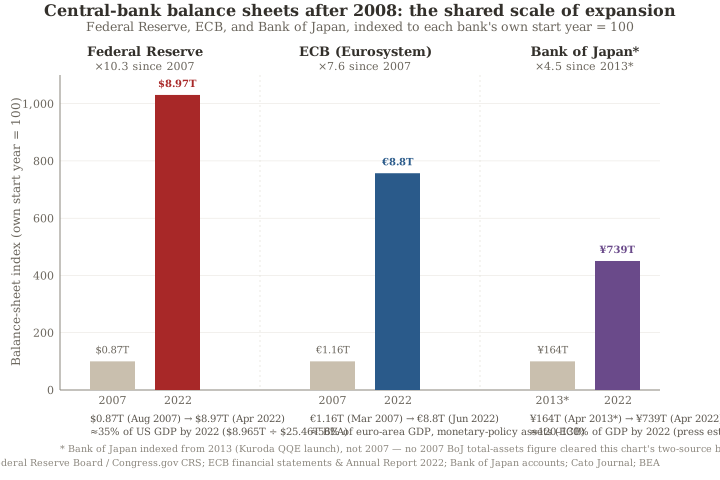
Central banking. Between 2008 and 2022 the Federal Reserve's balance sheet went from under a trillion dollars to roughly nine; the ECB and Bank of Japan followed parallel trajectories. In doing so, central banks stopped merely setting an interest rate and started buying corporate bonds, sovereign debt, and mortgage securities at a scale that structures credit conditions across whole asset classes, they became quasi-fiscal actors, deciding which assets get bid up and on what terms. The traditional framing treats this as monetary policy operating on a margin (how much money, what rate). It is closer to constituting the financial-market architecture itself. The CBDC question makes the shift unmissable: whether a central bank should issue digital currency directly to households is a question about what kind of monetary system to have. The formal apparatus and the post-2008 history live in Economic History Ch.19 (The 2008 crisis and after) and the financialization backdrop in Ch.18; the stimulus, ZLB, and MMT/FTPL edges get deeper treatment in Can central banks control the economy? and Does government spending help or hurt?
Tech-platform governance. Google, Apple, Amazon, Meta, and Microsoft operate markets, they set the rules under which billions of transactions clear, run the dispute resolution, the payment rails, the identity checks, the ranking and ad-auction mechanisms that decide who is seen and who sells. Those are functions that historically belonged to states. The debate is usually framed as a margin question (“should the state regulate Big Tech, yes or no?”), but the question underneath is constitutive: when a private firm runs the substrate that other markets sit on, what state-market configuration have we already built by treating that substrate as just another company? The EU's Digital Markets Act and Digital Services Act, the long fight over Section 230, and the antitrust cases against Google and Meta are all moves in a constitutive contest dressed in margin-question clothing. The break-up-or-not question gets its full treatment in Should Big Tech be broken up?
Financial-system design. The post-2008 regime, Dodd-Frank, the Basel III capital requirements, the central-clearing mandate for derivatives, the stress-test apparatus, the resolution authority for failing institutions, constituted a different financial system. And the question that organizes all of it is constitutive by construction: where do you draw the regulatory perimeter? What sits inside the rules and what gets pushed into the shadow-banking dark? Drawing the perimeter is the policy, it decides what the financial system is. Debated as “more regulation or less,” it reads as a margin choice; done honestly, it is a design choice about the shape of the system. The crisis that forced the redesign, and what the redesign actually looked like, is the spine of Did economics cause the 2008 crisis?
What the four arenas share
Run the four side by side and the common structure is hard to miss: each is a constitutive-design question being argued in margin-choice language, and the mismatch has real costs. It makes the choice invisible, the question is always “which configuration,” and the margin framing hides that. It cedes the design to whoever already thinks constitutively — the central-bank technocrats, the platform engineers, the treaty drafters — while public debate argues about the wrong axis. And it produces policy fights where the participants talk straight past each other, because one side is asking a margin question and the other a constitutive one without anyone naming which. The diagnosis is the same in every arena; Stage 4 asks what to do with it. The varieties-of-capitalism framing that would let you compare these configurations directly is the work of Is capitalism one system or many?
Two framings, four arenas where they collide. The temptation now is to crown a winner, declare economics right, or political theory right, and go home. Stage 4 does the harder thing: it names which framing is operative for which kind of question, and turns that distinction into a tool you can carry out the door.
The synthesis
You are now carrying two framings that disagree, and there is an easy way out and a hard way out. The easy way is to pick one — decide that economics has it right and political theory is overreaching, or that political theory has it right and economics is naive — and discharge the tension. That move loses everything the walk just bought. The hard way is to notice why the framings differ, and to turn that difference into an instrument: a way of reading the next markets-vs-states claim you meet, sharper than the slogan it arrives wrapped in.
The tool for this is a habit of asking, of any disagreement, which layer it lives on. Some disputes are about the frame, what question are we even asking? Some are about method, given the question, how do we answer it? Some are about parameter magnitude, given the method, how big is the number? Most markets-vs-states arguments are a tangle of all three, and they stay unresolvable as long as the layers stay fused. One frame-layer distinction goes in the kit: the split between margin-choice questions and constitutive-design questions.
Reading the disagreement layer by layer
The frame layer. Economics's margin-choice framing and political theory's constitutive-design framing are two framings of one phenomenon, pitched at different conceptual registers. They do not adjudicate against each other, because they are not answering the same question, one asks “should this intervention happen on this margin?”, the other asks “what kind of state-market configuration is this?” Refusing to crown one universally correct is the accurate report: at the frame layer the right framing depends on which question you are actually asking, and there is no view from nowhere that ranks the questions.
The distinction that does the work. Questions about adjusting an intervention on a settled margin — the level of a carbon tax, the tightness of occupational licensing, the size of a transfer program, whether to loosen Dodd-Frank a notch — are margin-choice questions, and economics owns the tools. Questions about which institutional order to bring into being, the structure of the EU, the post-2008 monetary architecture, whether to issue a CBDC, how to govern platforms, what “industrial policy” even means, are constitutive-design questions, and political theory owns the tools. Hayek is the bridge that proves the split is real and not partisan: the canonical free-market thinker treated the institutional framework as a design problem for active statecraft while insisting the state stay out of margin-level results. So when you meet a markets-vs-states claim in the wild, ask before anything else: is this a margin-choice question or a constitutive-design question? The answer tells you which discipline's tools to reach for.
The method layer. Below the frame, each discipline runs its own live and productive argument. Inside economics, the Chicago and public-choice line (“intervention carries capture risk”) debates the Mazzucato–Rodrik line (“intervention can be mission-oriented and self-correcting”), and the field is converging on a conditional answer: intervention efficacy depends on institutional capacity, political-economy structure, and the specific design. Inside political theory, the structural-historical wing (Polanyi, Slobodian, Foucault) debates the constitutional and institutional-design wing (Hayek, Buchanan, Ostrom), converging on a recognition that every market regime is a state project and the design space is real and the choices matter. Both are method-layer disputes, settled by argument and evidence within a discipline.
The parameter layer. And below method sits the empirical floor: how large is regulatory capture in a given sector, how big is the multiplier on a specific industrial-policy program, how durable are the institutional complementarities Mazzucato points to, how much of the global-governance architecture is genuinely Slobodian-style encasement versus democratically permeable. These are measurement questions with answers in principle and rolling best-estimates in practice. The honest stance is to take the modal current estimates and hold them loosely, revising as the evidence comes in.
The verdict
“Markets vs. states” is two questions wearing one phrase, operating at two layers that do not reduce to each other. At the margin-choice layer, intervention adjustments inside a settled frame, economics's framing is the right tool, and the welfare-theorem, market-failure, and capture-skepticism apparatus does honest work. At the constitutive-design layer, choosing or rebuilding the institutional order, political theory's framing is the right tool, because it is the only one that treats the frame as a choice. The takeaway is a habit to keep: the next time a tweet about industrial policy, a column about CBDCs, a hearing about platform power, or a politician's pitch for “common-good capitalism” or “free enterprise” lands in front of you, ask first which layer it is operating on. If it is a margin-choice question, economics has the tools. If it is a constitutive-design question, and most of the live fights of the 2020s are, political theory does. The reason those fights so reliably talk past each other is that they are constitutive-design questions being argued in margin-choice language, and almost no one names the switch.
Where this leaves us
We started with Friedman's clean answer: markets are the default, the state has a short and bounded job, and everything past the list is overreach. It is a good answer, to one kind of question. Stage 2 surfaced the other kind. Hobbes, Locke, Rousseau, and Hegel; Marx on the wage-labor regime; Hayek on institutional design; Foucault on governmentality; Polanyi on the double movement; Slobodian on encasement, three centuries of argument that the market is an order the state constitutes. Stage 3 caught the two framings colliding in the open: industrial policy, central banking, platform power, and financial-system design are all constitutive-design questions being fought in margin-choice language, with the choices hidden and the design ceded to whoever thinks constitutively by default.
The synthesis is a distinction. Economics's framing is right where it operates — the margin, inside a settled frame. Political theory's framing is right where it operates — the frame itself, when the order is being designed. The thing to carry out of here is the question that comes first: is this claim about a margin, or about a frame? Get that right and the rest of the argument finally holds still long enough to evaluate.
Two threads run past this one worth naming on the way out. The word “capitalism” itself did much of the work this walkthrough had to do by hand, its own contested history is Capitalism as a concept, across disciplines. And the frame/margin split drawn here for markets and states is one instance of a pattern that recurs whenever a concept looks like a fixed thing from inside one discipline and a constructed relation from inside another, the general version of that move is Power, across disciplines.