Brexit: what it cost, and why people voted for it
Trade economists called the cost almost exactly. They were also blindsided by the vote.
The case as a news-reader saw it

“Dare to dream that the dawn is breaking on an independent United Kingdom. Let June the 23rd go down in our history as our Independence Day.”
— Nigel Farage, victory speech, ~4am, 24 June 2016 (The Guardian)
At about 4:40am on 24 June 2016, David Dimbleby told the country it had voted to leave the European Union. The room had expected Remain. The markets had expected Remain. The bookmakers had priced Remain. Fifty-two per cent of voters had not. Before anyone reached for an economic model, the United Kingdom had decided to leave its largest trading partner, and nobody knew what that meant yet.
To follow what happened, you need only one piece of institutional vocabulary. The UK was a member of the EU’s single market and customs union: a zone built on four freedoms (the free movement of goods, services, capital, and labour), with a common external tariff and a shared rulebook that let a lorry cross from Dover to Calais with no customs check.
Leaving meant unwinding each of those freedoms. A new tariff schedule would have to be negotiated. Regulations would diverge. Customs declarations, rules-of-origin paperwork, and border checks would return. Banks would lose the “passport” that let a London firm sell into Frankfurt; nurses and architects would lose the automatic recognition of their qualifications; and the automatic right of a Pole to work in Peterborough, or a Briton to retire in Spain, would end. None of this was yet a number, only a list of things about to become harder. The basic mechanics of tariffs and a customs union sit in the intro chapter.
What followed was four and a half years of politics. Four governments tried to answer a single question the referendum had refused to specify: leave, yes, but on what terms?
David Cameron lost and was gone by lunchtime. The prime minister who had called the referendum to settle his party’s European quarrel had bet on Remain and lost. He resigned on the steps of Downing Street the same morning, and the Conservative Party fell into the leadership contest that produced Theresa May.
“Brexit means Brexit,” May said, which answered nothing. She triggered Article 50, then called a snap election in 2017 expecting a landslide and instead lost her majority. The next two years were trench warfare. Her Withdrawal Agreement was defeated in the Commons three times, one defeat the largest in modern parliamentary history, foundering on the “backstop,” the problem of how to keep the Irish border open without keeping the UK inside the customs union it had voted to leave. Parliament could agree on what it was against and nothing it was for.
Boris Johnson broke the logjam by force of slogan. “Get Brexit Done” won him the leadership in 2019 and a commanding majority in the December general election, in part by turning long-Labour seats across the post-industrial Midlands and North, the so-called Red Wall, Conservative for the first time in living memory. On 31 January 2020 the UK formally left the EU. The argument about whether was over; the argument about what had one year left to run.
The deal landed on Christmas Eve. The Trade and Cooperation Agreement, signed 24 December 2020, kept goods trade tariff-free and quota-free, the headline the government wanted. But it left services almost entirely outside, ended financial-services passporting, dropped mutual recognition of professional qualifications, and replaced frictionless customs with declarations, checks, and rules-of-origin paperwork. The relationship that emerged sat far closer to the leave-side ambition than to anything Remain had hoped for. The grievances that fed the 2016 vote (a decade of post-2008 austerity, stagnant wages, and a sense that the EU’s own crises were someone else’s to manage) ran underneath all of it, and are the subject of History Ch.19 §19.2 (the Eurozone crisis and the politics of austerity).
“We’ve got the deal. It’s oven ready. Vote Conservative tomorrow to get Brexit done.”
— Boris Johnson, tweet, 11 December 2019, eve of the general election; alongside Vote Leave’s 2016 “£350 million a week for the NHS” bus
Was there a Brexit dividend?
The leave campaign promised a country that would prosper once freed from EU rules and EU budget contributions. It is a testable claim, and Stage 2 supplies the test.
Where this leaves us
By 24 December 2020 the case was decided politically and signed institutionally. What it cost economically, and why so many people voted for it, are the questions the next three stages take up.
Months before the deal was signed, the UK’s own independent fiscal watchdog had already published a forecast: Brexit would reduce long-run output by about four per cent. Was the forecast right? And how would anyone know?
The case as an economist saw it
“We continue to assume that Brexit will reduce long-run productivity by 4 per cent relative to remaining in the EU.”
— Office for Budget Responsibility, Economic and Fiscal Outlook / Brexit analysis, 2022
The OBR is the UK’s independent fiscal watchdog; its job is to keep the Treasury honest. It assumed a four-per-cent productivity hit in 2016, before anyone could see the data, and it was still assuming it in 2022, after years of data had come in. The question is why an economist could be that confident in advance.
The confidence came from the gravity model of trade. Two centuries of data keep saying the same thing: the amount two economies trade scales with the size of each and falls off with the friction between them.
Trade between economies $i$ and $j$ is well predicted by
$$T_{ij} = G \cdot \frac{M_i^{\alpha}\, M_j^{\beta}}{D_{ij}^{\gamma}}$$where $M_i$ and $M_j$ are the two economies’ masses (roughly, their GDP) and $D_{ij}$ is the friction between them: distance, but also tariffs, customs delay, regulatory divergence, and the absence of a common rulebook. Raise $D_{ij}$ and $T_{ij}$ falls. Brexit was a deliberate, permanent increase in $D_{ij}$ against the UK’s single largest trading mass.
Countries trade most with large, close, low-friction neighbours, the way large, nearby objects pull hardest on each other. The EU is the UK’s gravitational neighbour, vast and twenty miles away. Trade deals with Australia or the rest of the world cannot replace it, because those economies are smaller and far further off. You cannot move the UK closer to Sydney by signing a document.
Why tariff-free was never the same as cost-free. Modern production runs through global value chains: a single product crosses borders several times before it is finished. Each crossing now carries customs declarations, rules-of-origin checks, and regulatory-conformity paperwork, and these compound across crossings. The TCA kept tariffs at zero and still raised the cost of trading, because the friction the gravity model cares about was never mainly tariffs.
Investment and services took the heaviest hits. Foreign direct investment is priced over multi-year horizons, so the 2016–2020 negotiation was itself a cost: firms froze decisions while the rules were unknown. And services (finance, law, accountancy) depend on passporting, mutual recognition, and regulatory equivalence that have no clean substitute outside membership. Goods kept their tariff-free access; services largely did not, which is why the City and professional-services sectors felt the deal most.
The full formal apparatus (the gravity equation, increasing-returns trade, and the distributional theorems) lives in Ch 22 §22.5 (The Gravity Model), with the increasing-returns and intra-industry side in §22.4 (New Trade Theory). The gravity model’s intellectual descent, from Hume and Ricardo’s comparative advantage through Krugman’s 1979–1980 new-trade theory, is the apparatus the sibling walkthrough on free trade builds out in depth, and the balance-of-payments side, why a trade gap cannot be read off goods alone, is its Stage 3.
The test is the gap between what was forecast and what arrived.
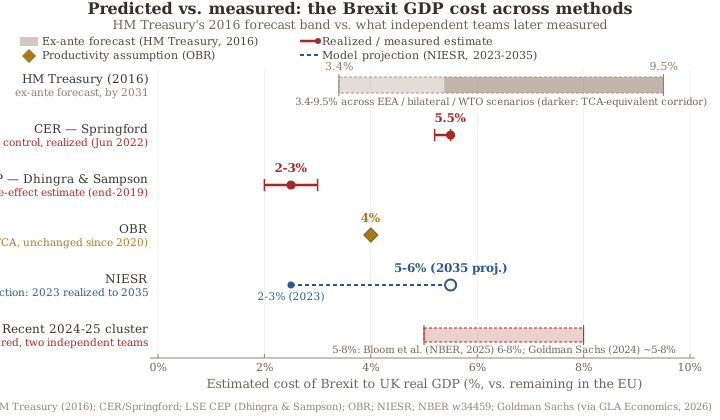
The forecast. In April 2016, before the vote, HM Treasury projected that leaving would cut UK GDP by between 3.4 and 9.5 per cent over fifteen years, depending on the post-exit relationship. Leave campaigners dismissed it as “Project Fear.” It was a gravity-model forecast, and the range was wide because the terms of exit were unknown.
The realized estimates. By the early 2020s several independent teams, using methods that share almost no assumptions, had measured the actual loss, and converged. The Centre for European Reform’s “doppelgänger” method builds a synthetic UK from countries that did not leave and reads the gap: roughly 5.5 per cent of GDP lost by mid-2022, holding into 2024. The LSE Centre for Economic Performance, using structural-gravity methods that identify the trade channel more tightly, lands lower, around 3 to 5 per cent. The OBR holds to its 4 per cent productivity assumption. Synthetic-control, structural-gravity, and FDI-tracking methods all point at the same 5-to-10-per-cent neighbourhood; macroeconomic forecasts rarely agree this closely.
The channels behaved exactly as drawn. Inward FDI fell sharply from its 2015 peak. Financial-services jobs relocated to Amsterdam, Dublin, Paris, and Frankfurt in the thousands; smaller than the tens of thousands some had feared in 2016, but unmistakably in the predicted direction. The European Medicines Agency physically moved from London to Amsterdam. Goods exporters drowned in new paperwork; the smallest firms stopped exporting to the EU. The 2000s integration baseline these losses are measured against sits in History Ch.18 §18.2 (hyperglobalization), and the post-2008 European stagnation that frames the comparison in Ch.19 §19.2.
Did the gravity model call it?
A specific, ex-ante prediction, vindicated across methods that share no assumptions. By the ordinary standards of a science, what should we conclude?
How big, and how sure?
“UK GDP is 5.5 per cent lower than that of the doppelgänger. Investment is 11 per cent lower; goods trade, 7 per cent lower; and services trade is around the same.”
— John Springford, Centre for European Reform, 2022
Springford’s synthetic-control work is the most-cited running estimate of the Brexit cost. He constructs a “doppelgänger” UK from a weighted basket of comparable economies that tracked the real UK closely before 2016, then measures the divergence after. The result puts the loss in the upper half of the Treasury’s pre-vote range.
“Our structural-gravity estimates suggest the long-run hit to UK income is real and material, but our point estimates for the trade channel sit toward the lower end of the published range.”
— after Swati Dhingra, Thomas Sampson and colleagues’ structural-gravity work on Brexit at the LSE Centre for Economic Performance
The LSE CEP team is mainstream and finds substantial costs. The dispute is methodological, about size. Structural gravity identifies the trade channel more cleanly and yields tighter, lower point estimates than synthetic control, which sweeps in everything that moved after 2016. Everyone in this debate finds Brexit made the UK poorer.
Where this leaves us
The cost prediction was real. The cost was paid. The apparatus that produced it (gravity, value chains, and the sensitivity of investment to regime uncertainty) is the apparatus for evaluating any future act of deliberate deglobalization. Why people voted for a policy the same apparatus said would make them poorer is a question the gravity model cannot touch.
If a policy was going to cost the UK something like 4 to 10 per cent of GDP, why did 17.4 million people vote for it? The reflexive answer, that they were misinformed or irrational, is itself an empirical claim. It turns out to be wrong. The case demands a different apparatus.
The case as a political economist saw it
“Support for the Leave option… was systematically higher in regions hit harder by economic globalization. Specifically, a one standard deviation increase in the strength of the import shock at the regional level leads to an increase by two percentage points in support for the Leave option.”
— Italo Colantone and Piero Stanig, “Global Competition and Brexit,” American Political Science Review, 2018
This is an identified empirical result. Colantone and Stanig instrument regional exposure to Chinese import competition (a shift-share, or Bartik, design that isolates the part of the shock no town chose for itself) and find it predicts the leave vote after controlling for demographics. The leave vote has a serious empirical explanation.
Start with the mechanism the gravity model in Stage 2 deliberately left out: who bears the cost. The Stolper-Samuelson theorem, in the same trade-theory chapter as the gravity model, says that trade with a labour-abundant partner lowers the real wage of the rich country’s scarce factor, which is its less-skilled workers. Standard theory then adds a reassuring footnote: the winners can compensate the losers. It says only that compensation is possible. In the UK, as in the US, it largely did not happen.
The China-shock literature (Autor, Dorn and Hanson on US local labour markets) found communities hit by import competition still depressed a full decade later: lower wages, lower participation, higher disability claims. The labour-market apparatus for why adjustment is so slow (search-and-matching frictions, the task framework) lives in the labour-economics chapter; the China-shock substance itself is the spine of the sibling free-trade walkthrough’s Stage 2. The UK’s industrial towns lived the same decade.
Then add identity. David Goodhart’s The Road to Somewhere names a gradient mainstream economics has come to ratify: mobile, credentialed “Anywheres,” whose identity travels with their careers and who experience EU membership as opportunity; and rooted “Somewheres,” whose identity is bound to a particular place and who experience the same membership as loss of control. The economic-dislocation channel and the identity channel are partly independent and partly entangled.
Why mainstream trade theory under-weighted all this. Stolper-Samuelson was in every textbook and rarely on the verdict line. The profession treated the compensation assumption as if it described the world. The slow, concentrated, regionally-cumulative political backlash that distributional trade losses produce was under-theorized in trade economics proper, flagged for years by Dani Rodrik but never central, until the post-2008 distributional turn, the empirical inequality work of Piketty, Atkinson, Stiglitz, and the hyperglobalization critique, pulled it toward the centre. That frame-shift is mapped in History of Economic Thought Ch.17 §17.4 (institutions and inequality, the empirical turn).
Sunderland declared first, and the anchors went pale. A little after 11pm the result came in well above the expected leave share, and on live television you could watch the night’s assumptions collapse. Then Stoke, then Boston, then Hartlepool. These were towns whose manufacturing employment had been hollowed out across the 2000s, whose grievances had accumulated for a decade and more, and whose political class had spent that decade looking elsewhere. Their 2016 vote was a protest against a policy regime that had asked them to absorb the costs of integration and had never delivered the compensation the textbook promised. It was a rational response to a real, unaddressed loss.
Take the sovereignty preference at its strongest. A reasonable person can prefer that the laws governing their country be made by a parliament they can vote out, rather than by institutions they cannot, even at a measurable economic cost. “Take back control” reads as a slogan to one voter and as a substantive constitutional commitment to another. Read fairly, a preference for self-government is a legitimate political-economic preference, and the cost figures from Stage 2 inform that judgment without deciding it. The systematic question of whether the EU is at root an economic or a political project is the territory of a sibling walkthrough.
The immigration channel is real and belongs in the picture. Net migration running near 333,000 a year by 2015 interacted with flat real wages and stretched local services in a way that made “immigration is the cause of the squeeze” politically dominant, even where mainstream economics finds the aggregate effects modest. The substance of that debate, what immigration actually does to wages and services, is owned at proper depth by the sibling walkthrough on the economics of immigration; here it is one political-economy mechanism among several, distinct from the trade-shock channel.
And it is not idiosyncratically British. Autor, Dorn, Hanson and Majlesi ran the same identification strategy on the 2016 US presidential election and found the same shape: regions more exposed to the China shock swung harder toward the populist candidate. The pattern repeats across European elections too. Stage 4 picks up the thread.
“A one standard deviation increase in the strength of the import shock at the regional level leads to an increase by two percentage points in support for the Leave option.”
— Colantone and Stanig, American Political Science Review, 2018
Was the leave vote economic or cultural?
One camp reads Brexit as economic dislocation finding a ballot box; another reads it as a cultural revolt that economics merely amplified. The answer is harder than either.
Which channel was load-bearing?
“Importing Political Polarization? The Electoral Consequences of Rising Trade Exposure”, trade-exposed commuting zones swung toward more polarized, and in initially white-majority areas more Republican, politics, the same shift-share logic Colantone and Stanig applied to the UK.
— after David Autor, David Dorn, Gordon Hanson and Kaveh Majlesi, American Economic Review, 2020
The economic-channel case rests on identification. Colantone and Stanig for Brexit, Autor and colleagues for the US 2016 vote: the same shift-share design, isolating the exogenous part of the import shock, returns the same finding in two countries. When a cleanly-identified economic cause predicts the political outcome across settings, the burden shifts to anyone who would treat the economics as incidental.
“The roots of the backlash lie less in economic deprivation than in a cultural reaction by older and less-educated voters against the value changes of recent decades.”
— after Pippa Norris and Ronald Inglehart, Cultural Backlash, 2019, and Eric Kaufmann, Whiteshift, 2018
The cultural-channel case argues that the identity realignment predates the economic shock and runs deeper than it. Norris and Inglehart trace a long value-shift; Kaufmann centres ethnic-change anxiety; Goodhart names the Anywhere/Somewhere divide. On this reading the economics is an accelerant, and the leave coalition stretched well beyond the places the China shock hit hardest. The dispute is about which channel carries more weight.
Where this leaves us
Both apparatuses are needed. The trade-theory side explains why the cost prediction returned; the political-economy side explains why the vote did. Brexit was one of the cases that moved Stolper-Samuelson from the textbook to the verdict line.
The US 2016 election, the Trump tariff cycle, and the broader retreat from globalization since 2016 form a pattern the combined apparatus illuminates. What does it show us beyond the United Kingdom?
What the combined apparatus explains beyond Brexit
“I am a Tariff Man… We are right now taking in $billions in Tariffs. MAKE AMERICA RICH AGAIN.”
— @realDonaldTrump, December 2018
Five months after Sunderland, an ocean away, the same forces delivered the same kind of result. The 2018 trade war is Brexit’s sibling case, and the combined apparatus reads both with one set of tools: the trade-theory side predicts who pays, and the political-economy side predicts why the policy is popular anyway.
The US 2016 / Trump-tariff cycle, read with the same two tools. The trade-theory side called the cost: Amiti, Redding and Weinstein, and Fajgelbaum and colleagues, found the 2018–2019 tariffs were passed through almost entirely to US importers and consumers, close to a hundred per cent. Americans paid the “billions in tariffs,” not China. The political-economy side called the politics: Autor and colleagues showed the China-shock regions delivered the votes. The deeper substance of the 2018 trade war lives in the free-trade sibling’s Stage 2.
The broader 2020s retreat from globalization. The CHIPS Act of 2022, the Inflation Reduction Act of 2022, and the EU Green Deal Industrial Plan of 2023 each spend public money to pull strategic production home. The vocabulary changed with the policy: “friend-shoring,” “de-risking,” “economic security” displaced the “hyperglobalization” of the 1990s. These are parallel symptoms of the same political-economy constraint Brexit exposed. The industrial-policy apparatus behind them sits in Ch 20 §20.8 (contemporary development) and the international-coordination machinery in Ch 17 §17.5 (international policy coordination).
What mainstream trade theory has updated. Dani Rodrik’s hyperglobalization trilemma (you cannot have deep economic integration, national sovereignty, and mass democratic politics all at once; pick two) has moved from heterodox warning to widely-absorbed framing since 2016. The post-2008 frame-shift that carried it into the centre is mapped in History of Economic Thought Ch.17 §17.5 (the expanding frontier).
The US 2016 parallel. Autor, Dorn, Hanson and Majlesi found the China-shock-to-populist-vote pattern in the American electorate that Colantone and Stanig found in the British one. Same identification strategy, different country, same result: what happened in Sunderland was a mechanism.
The tariff cycle as the diagnosis made policy. Tariffs were imposed; the costs passed through to American consumers exactly as the trade-theory side predicted; and the protectionist stance then survived across the Trump, Biden, and second Trump administrations. That persistence is what political economy predicts. Once a coalition forms around protection, it outlasts the party that built it, because the constituency it answers to does not change election to election.
The mainstream update. Rodrik’s trilemma, the industrial-policy revival, and the friend-shoring vocabulary are all the same recognition arriving at once: that trade integration has political-economy preconditions the 1990s consensus assumed away. The CHIPS Act and the IRA are the institutional acknowledgment that the compensation the textbook promised has to be built.
“We cannot simultaneously pursue democracy, national self-determination, and economic globalization. We have to choose among them.”
— Dani Rodrik, The Globalization Paradox, 2011
Did 2016 end the hyperglobalization era?
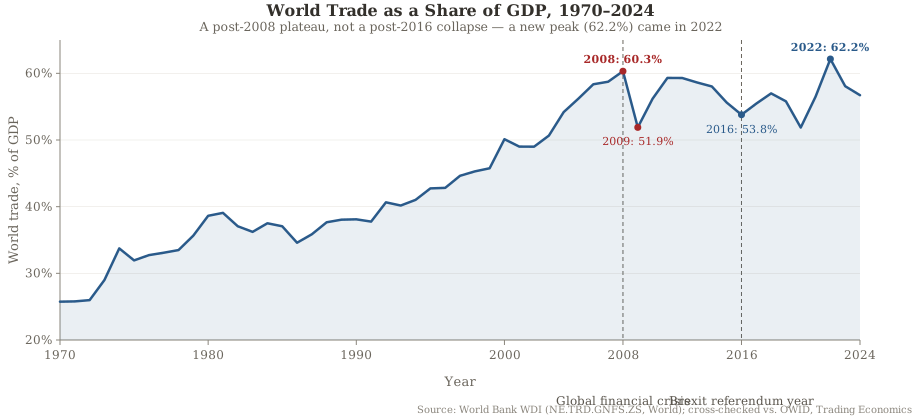
Brexit and Trump look like the hinge where globalization reversed. The trade-flow data is more ambiguous than the headlines. So which is it, retreat, or restructuring?
Frame-shift, or parameter update?
“The smart globalization of the future will be a thinner, more selective integration that leaves room for nations to manage their own social bargains. The alternative is the backlash we are already living through.”
— after Dani Rodrik, The Globalization Paradox, 2011, and later writings
Rodrik’s framing has become close to the mainstream reading: Brexit and the tariff cycle vindicated the combined apparatus, and the 2022–2023 industrial-policy turn is the policy ratification of it. Integration has political-economy preconditions; ignore them and you get the backlash. Working economists now design around the trilemma.
“The retreat from globalization has been far smaller than the rhetoric suggests, and the standard tools still explain most of what we see. We should be wary of declaring a new era on the strength of a few years of political turbulence.”
— composite of globalization-defender economists (Paul Krugman, post-2018 columns; Martin Wolf, Financial Times)
The within-mainstream skeptics argue the apparatus needs only a parameter update. The integration rollback has been smaller than feared; trade is re-routing; and the standard model, with higher friction and a security premium added, still does the explanatory work. Economists on both sides accept the cost and backlash findings; the dispute is over how much of the framework has to change.
Where this leaves us
The combined apparatus is the lesson Brexit teaches. Trade theory predicted the cost correctly; political economy is needed to explain the choice. The case has been replicated in the US 2016 election, in the tariff cycle that outlasted three administrations, and in the broader 2020s turn toward industrial policy and friend-shoring. The 2026 mainstream answer is that both apparatuses are load-bearing. The systematic case on whether tariffs are ever good policy takes up the tariff-cycle thread in depth, and the companion case on the Greek debt crisis shows the same integration-versus-sovereignty tension playing out inside the eurozone.
The verdict
Brexit yields its lesson only to a reader willing to hold two apparatuses at once. Stage 1 inhabited the case as the news told it: the vote nobody expected, four governments, a Christmas Eve deal closer to the leave-side ambition than the remain-side hope. Stage 2 brought the trade-theory cost-side apparatus and watched it return its own forecast: the gravity model said deepening friction against your largest neighbour would cost several points of GDP, and synthetic-control, structural-gravity, and FDI-tracking methods that agree on almost nothing else all agreed it did. Stage 3 brought the political-economy vote-side apparatus and explained the choice the cost numbers could not: a regional pattern of unaddressed trade-shock losses, braided with a sovereignty preference and an identity realignment. Stage 4 applied the combined apparatus beyond the UK and found the same shape in the US 2016 vote, the tariff cycle, and the industrial-policy revival.
Brexit is a textbook vindication of trade-theory cost predictions and a textbook indictment of pre-2016 trade theory’s under-weighting of who pays and how they vote. Treat “why did people vote for a welfare-reducing policy?” as an empirical question with an empirical answer. What to watch from here: how the Trade and Cooperation Agreement evolves toward 2030, whether the second Trump tariff cycle hardens the protectionist coalition further, and whether the EU’s industrial-policy push consolidates into a coherent frame or fragments. The tools to read all three are the two this walkthrough refused to choose between.