Is free trade always good?
Comparative advantage says yes. The workers who lost their jobs say it’s more complicated.
See as debate graphThe case for free trade

“I am a Tariff Man. … We are right now taking in $billions in Tariffs. MAKE AMERICA RICH AGAIN.”
— @realDonaldTrump, December 2018
Shared millions of times. The claim is that tariffs make America richer. Most economists disagree. But is it that simple?
To evaluate that claim, you need comparative advantage, the most powerful result in economics. David Ricardo showed in 1817 that trade makes both countries better off in aggregate, even when one country is better at producing everything.
Comparative advantage means a country gains by specializing in what it sacrifices least to produce, even if another country is better at every good. The country with the lower opportunity cost in a good has a comparative advantage in it, regardless of who is the more productive producer in absolute terms.
The insight is counterintuitive. In the model, the assumption is that the United States can produce both wheat and textiles more efficiently than Bangladesh in absolute terms. Should the US produce both? No. What matters is not absolute cost but opportunity cost. If producing one more ton of wheat costs the US 2 units of textiles forgone, but costs Bangladesh only 0.5 units, then Bangladesh has a comparative advantage in wheat, even if it’s less productive at both goods.
Both countries are better off if each specializes in the good where its opportunity cost is lower and trades for the rest. Under competitive markets, full employment, and no externalities, free trade maximizes total surplus.
So what happens when a country opens to trade? The domestic price converges toward the world price. If the world price is below the domestic price, the country imports. Consumer surplus rises (cheaper goods), producer surplus falls (domestic firms face competition), and the gains to consumers exceed the losses to producers.
What about those tariffs the “Tariff Man” is so proud of? A tariff is a tax on imports. It raises the domestic price above the world price, reduces imports, and protects domestic producers. But it creates deadweight loss, the same triangle of wasted potential we see with any price distortion.
If the world price is $P_w$ and the tariff raises the domestic price to $P_w + t$, the deadweight loss consists of two triangles:
$$DWL = \frac{1}{2}t \cdot \Delta Q_{\text{consumption}} + \frac{1}{2}t \cdot \Delta Q_{\text{production}}$$Every dollar of protection comes at a cost that no one receives.
A tariff is a tax that makes imports more expensive. Consumers pay more. Some of that extra money goes to domestic producers, some to the government, but some just evaporates. It’s pure waste: the cost of producing things at home that could have been made more cheaply abroad, plus the purchases consumers would have made but can’t at the higher price.
The standard model says tariffs reduce total welfare. The “Tariff Man” is taxing his own citizens and calling it income. Want the full derivation with the interactive graph? The formal home of the apparatus — comparative advantage from opportunity-cost ratios, the gains-from-trade range, and the tariff deadweight-loss triangles — is Ch 22 §22.1 (The Ricardian Model); the intro-level tariff diagram is Ch 2 §2.6. For the intellectual lineage — Smith’s 1776 demolition of mercantilism, Ricardo’s 1817 comparative-advantage step, Mill’s reciprocal-demand extension — see History of Economic Thought Ch.3 (Classical political economy).
“Do tariffs actually work?”
The “Tariff Man” says tariffs make America richer. Economists say they’re a tax on American consumers. The 2018 trade war is the first major test case in modern data.
The bedrock and the blind spot
“That it is logically true need not be argued before a mathematician; that it is not trivial is attested by the thousands of important and intelligent men who have never been able to grasp the doctrine for themselves or to believe it after it was explained to them.”
— Paul Samuelson, “The Way of an Economist,” 1969, answering mathematician Stanislaw Ulam’s challenge to name a true, non-trivial proposition in social science
Samuelson is making the strongest possible case. Comparative advantage isn’t a conjecture; it’s a mathematical theorem. Under the standard assumptions, free trade maximizes total surplus. The result survives extension to multiple goods, multiple countries, and varying factor endowments, generalizations Ricardo could not have imagined. This is the bedrock.
“The full incidence of the tariffs has fallen on domestic consumers and importers, with estimates implying a reduction in aggregate US real income of $1.4 billion per month by the end of 2018.”
— Mary Amiti, Stephen Redding & David Weinstein, Journal of Economic Perspectives, 2019
Amiti, Redding, and Weinstein ran the first rigorous empirical study of the 2018 tariffs, using customs microdata to show near-complete pass-through: foreign export prices didn’t fall, so the tariff was paid entirely by American buyers. The “Tariff Man” wasn’t taxing China. He was taxing Iowa farmers, Texas manufacturers, and every consumer who bought imported goods. The theory predicted this.
Where this leaves us
The case for free trade is strong in the aggregate. Comparative advantage is real, the gains from trade are measurable, and tariffs destroy welfare. The 2018 tariffs confirmed it with modern data. But the caveat is “in the aggregate.” Total surplus goes up. But the gains are spread thinly across millions of consumers, each saving a few cents, while the losses are concentrated on specific workers, specific factories, specific towns. The model says the winners could compensate the losers. In practice, they never do.
The standard trade model assumes displaced workers smoothly transition to new jobs. A factory closes in Ohio; the workers become software engineers in California. How long does that adjustment take? The answer, when economists finally measured it, changed the entire debate.
The China shock
“Adjustment in local labor markets is remarkably slow, with wages and labor-force participation rates remaining depressed and unemployment rates remaining elevated for at least a full decade after the China trade shock commences.”
— David Autor, David Dorn & Gordon Hanson, Annual Review of Economics, 2016
The “China shock” paper changed the debate. Free trade has winners, but the losers don’t just “adjust.”
The intro model from Stage 1 treats labor as perfectly mobile between sectors. A displaced factory worker costlessly becomes a barista, a coder, or a nurse. Total surplus rises; everyone lands on their feet. Autor, Dorn, and Hanson tested that assumption, and demolished it.
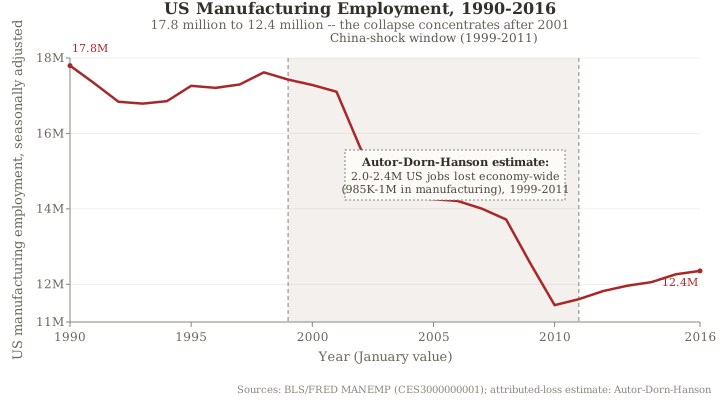
Between 1999 and 2011, China’s share of world manufacturing exports surged from 5% to 15%, the integration era covered in History Ch.17 (China reform and the Asian century) and Ch.18 (Globalization and the great moderation). US communities most exposed to Chinese import competition experienced persistent job losses, depressed wages, increased disability claims, and higher mortality. Those costs were still visible a decade later.
Acemoglu, Autor, Dorn, Hanson, and Price (2016) put a number on it: 2.0–2.4 million US manufacturing jobs eliminated between 1999 and 2011. The affected communities didn’t recover by moving into service jobs or tech. They experienced secular decline that outlasted any plausible adjustment window. The rust belt didn’t “adjust.” It collapsed.
Three critiques of the simple comparative-advantage story. The China shock crystallized objections that had been building for decades. The intro model survives them at its core, but each one carves off a piece of the unconditional case for free trade. The full formal treatment of each lives in later chapters.
1. Adjustment frictions. Labor isn’t perfectly mobile between sectors or across regions. A laid-off steelworker in Youngstown does not costlessly retrain as a coder in Austin. Skills, housing, social networks, and family ties anchor people in place. The China shock data showed adjustment windows measured in decades, long enough that for many displaced workers, the “adjustment” never happened in their working lives. The labor-economics apparatus for this — search-and-matching frictions, monopsony, the task framework — lives in Ch 21 (Labor Economics).
2. Stolper-Samuelson distribution. Trade with a labor-abundant country lowers the relative price of labor-intensive goods, which in the model lowers real wages for the scarce factor (unskilled labor in rich countries). This isn’t a market failure; it’s the model working as designed. The pie grows; the slice going to workers who compete with imports shrinks. Stage 3 returns to this with the formal theorem; the Heckscher-Ohlin / Stolper-Samuelson intellectual lineage lives in History of Economic Thought Ch.5 (Marginalist revolution and formalization).
3. Scale economies and cluster lock-in. Krugman’s 1980 new trade theory showed that trade generates gains beyond Ricardian specialization when markets have economies of scale, because consumers get more variety and firms move down their average cost curves. But when imports displace an industry that runs on scale economies and learning, what dies isn’t just jobs. The cluster of suppliers, tacit knowledge, and trained workers that made the industry possible dies with it, and rebuilding it is far harder than dismantling it was. The Krugman 1979/1980 lineage lives in History of Economic Thought Ch.10 (Counter-revolution) as the era’s origin point for the trade apparatus.
“The ‘China shock’ of the 2000s destroyed 2.4 million American jobs. The affected communities still haven’t recovered.”
— after Daron Acemoglu, David Autor, David Dorn, Gordon Hanson & Brendan Price, Journal of Labor Economics, 2016
Did China kill American manufacturing?
Economists spent decades saying trade adjustment would be smooth. Autor, Dorn and Hanson showed it wasn’t. Import competition from China hit specific communities with persistent effects that looked nothing like textbook labor-market adjustment.
Aggregate gains vs. concentrated losses
“The China shock operates through a narrow set of manufacturing industries concentrated in specific communities. The majority of American workers are in sectors unaffected by import competition and benefit from cheaper goods. The aggregate gains from trade with China are large and positive.”
— after Douglas Irwin’s argument in Free Trade Under Fire, 5th ed., 2020
Irwin is the leading historian of trade policy, and he’s making the nuanced version of the pro-trade argument. He doesn’t deny the China shock; the data is too strong. Instead, he argues that the aggregate gains still exceed the losses and that the right response is better domestic policy (retraining, relocation assistance, wage insurance). The question is whether that response will ever actually materialize.
“Regions more exposed to Chinese imports saw sharp declines in manufacturing employment, lower wages, and higher uptake of unemployment, disability, retirement, and healthcare benefits. The labor market costs of trade are real, persistent, and geographically concentrated.”
— after David Autor, David Dorn & Gordon Hanson, American Economic Review, 2013
This paper broke the consensus. Before Autor, Dorn, and Hanson, the profession treated trade adjustment as a short-run friction that theory could safely ignore. After it, the distributional costs of trade became impossible to dismiss. The assumption of costless adjustment was wrong, and real people bore the consequences of that assumption for decades.
Where this leaves us
Comparative advantage came through the China shock intact. Trade with China made the average American better off through cheaper goods. But averages lie. The costs were concentrated on communities that had no political voice and received no compensation. The profession’s consensus shifted accordingly, and distributional effects moved from an asterisk in the welfare calculation to the thing any honest trade-policy design has to solve first. The compensation mechanism the textbook assumed was never built, and the political consequences arrived on schedule.
But the China shock story is incomplete without the macro dimension. The US didn’t just import Chinese goods. It imported Chinese savings. The trade deficit everyone panics about has a mirror image that changes the entire picture.
Trade deficits and capital flows
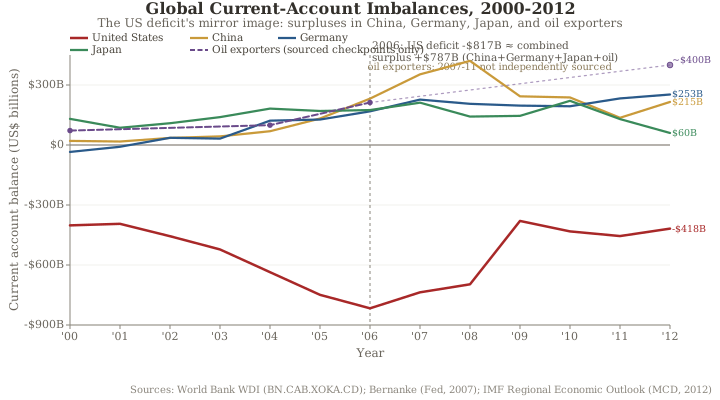
“Over the past decade, a combination of diverse forces has created a significant increase in the global supply of saving—a global saving glut—which helps to explain both the increase in the U.S. current account deficit and the relatively low level of long-term real interest rates in the world today.”
— Ben Bernanke, Sandridge Lecture, Virginia Association of Economists, March 10, 2005
The trade deficit looks scary until you read it from the other side of the ledger. Every dollar that leaves to buy foreign goods comes back as foreign investment in American assets, and Bernanke saw that flow building years before it broke the financial system.
The micro-level trade debate — comparative advantage, tariffs, the China shock — misses half the picture. Every trade flow has a financial mirror image. Here is the fundamental identity of international economics:
The current account measures the flow of goods, services, and income across borders (roughly, net exports). The capital account measures the flow of financial assets. If the US imports \$500 billion more in goods than it exports, that “trade deficit” means foreigners are investing \$500 billion in US assets, Treasury bonds, real estate, equities. It is an accounting identity, true by definition.
When politicians wave the trade deficit around as proof that foreigners are “winning,” they’re looking at one side of the ledger. On the other side, foreigners are pouring capital into America because they view it as a safe, profitable place to invest. The US runs a trade deficit because it runs a capital surplus, because the world wants to hold dollar assets. You can’t fix one without eliminating the other.
Exchange rates and adjustment. In a floating exchange rate regime, trade imbalances tend to self-correct. If a country runs persistent trade deficits, its currency depreciates, making exports cheaper and imports more expensive. But China managed its exchange rate for decades, keeping the yuan undervalued. This made Chinese exports artificially cheap, a de facto subsidy financed by Chinese consumers. The free-trade case assumes prices nobody is managing.
The impossible trinity. A country cannot simultaneously maintain (1) a fixed exchange rate, (2) free capital flows, and (3) independent monetary policy. It can pick any two. China chose a managed rate and independent monetary policy, requiring capital controls. The US chose free capital flows and independent monetary policy, accepting a floating rate. These choices shape trade outcomes as much as tariff schedules do.
The Stolper-Samuelson theorem predicts that trade with a labor-abundant country hurts the scarce factor (unskilled labor) in the rich country. Formally, an increase in the relative price of the labor-intensive good raises the real wage and lowers the real return to capital. Trade with China did the reverse in the US, lowering the relative price of labor-intensive manufactures and so reducing real wages for unskilled workers while benefiting capital owners and skilled workers. The model is working as predicted. The gains from trade are real; they’re also distributed in a way that increases inequality.
Trade with a country that has lots of cheap labor pushes down wages for workers who compete with that labor, and pushes up returns for the people who own the capital and high-skill workers who complement it. The pie gets bigger, but the workers who were already struggling get a smaller slice. The model predicts this outcome; it isn’t an accident or a glitch.
In the 2000s, the US ran massive current account deficits while China, Germany, Japan, and oil exporters ran surpluses. Ben Bernanke called it a “global saving glut”: excess savings flowing to the US, financing American consumption and the housing bubble. The 2008 financial crisis was partly a story of these imbalances unwinding. The pre-crisis era of hyperglobalization and the elephant curve sits in History Ch.18 (Globalization, financialization, and the great moderation); the unwinding itself is the spine of Ch.19 (The 2008 crisis and after). Capital inflows can finance productive investment. They can also finance bubbles, and for several years before 2008 they were doing both.
“Trade wars are good, and easy to win.”
— Donald Trump, Twitter, March 2, 2018
Are trade wars easy to win?
The U.S.-China trade war imposed tariffs on hundreds of billions of dollars of goods. The theory says both sides lose. The politics says someone has to blink first. What actually happened?
Are trade deficits a problem?
“A particularly interesting aspect of the global saving glut has been a remarkable reversal in the flows of credit to developing and emerging-market economies, a shift that has transformed those economies from borrowers on international capital markets to large net lenders.”
— Ben Bernanke, Sandridge Lecture, March 10, 2005
Bernanke’s framing was the dominant macroeconomic reading of the 2000s deficit: the world’s emerging surplus economies were sending savings into US assets. Capital flows to where returns are highest, and America’s deficit reflected the world’s confidence in its economy. What he half-saw and didn’t fully reckon with was that capital inflows also appreciate the dollar, making US exports less competitive and accelerating deindustrialization. Strength for the financial sector can mean weakness for the manufacturing sector. And if the capital finances bubbles, the “strength” turns out to be illusory, which is roughly what 2008 revealed.
“China was the champion currency manipulator of all time from 2003 through 2014. China bought more than $300 billion annually to resist upward movement of its currency by artificially keeping the exchange rate of the dollar strong and the renminbi’s exchange rate weak. China’s competitive position was thus strengthened by as much as 30 to 40 percent at the peak of the intervention.”
— C. Fred Bergsten, PIIE, 2016
Bergsten led the policy-establishment case that the free-trade framework assumes market-determined exchange rates, and that when a major trading partner manages its currency to maintain undervaluation, the price signals that comparative advantage depends on are distorted. For a decade, American manufacturers weren’t competing against Chinese productivity. They were competing against the People’s Bank of China. By Bergsten’s estimate, a 30-to-40 percent edge on the exchange rate alone. That is industrial policy, financed by Chinese consumers receiving less purchasing power for their labor.
Where this leaves us
Trade deficits reflect intertemporal trade: borrowing from abroad to consume or invest at home. A country can run deficits sustainably if the capital inflows finance productive assets. Persistent large imbalances, however, can fund bubbles, appreciate the currency to the detriment of exporters, and create strategic vulnerabilities. The partial-equilibrium analysis of Stage 1 is incomplete on its own; exchange rates, capital flows, and savings behavior belong in the picture. Politicians who wave the trade deficit around usually misread it. Economists who wave it away usually miss the structural effects underneath.
We’ve now seen the micro case, the labor market case, and the macro case. One dimension is left. The most successful development stories of the last century — Japan, South Korea, Taiwan, China — all used strategic trade policy. Were they right?
Industrial policy and development
“I don’t know any economist who would say that Korea or Taiwan would have been better off with free trade from the start. They used industrial policy, and it worked.”
— after Dani Rodrik’s argument in The Globalization Paradox, 2011
East Asia’s success is awkward for free traders. The countries that grew fastest did it by strategically violating the free-trade playbook.
In the 1960s, South Korea was poorer than Ghana. By 2000, it was a high-income country with world-leading firms in semiconductors, shipbuilding, and automobiles. Japan, Taiwan, and China followed similar paths. None of them did it with free trade. They all used targeted protection, export subsidies, managed exchange rates, and state-directed credit.
The infant industry argument. If production involves learning-by-doing, so that costs fall with cumulative output, a new entrant faces a chicken-and-egg problem. It can’t compete with established foreign firms at current costs, but it would become competitive if it could accumulate enough experience. Temporary protection allows the infant firm to survive the learning phase.
where $C_0$ is the initial unit cost, $Q$ is cumulative output, and $\beta > 0$ is the learning rate. If the present value of future competitive profits exceeds the cost of the temporary protection, the intervention is welfare-improving.
A new industry is expensive at first, but every unit it produces teaches it to produce the next one more cheaply. If you let foreign competition kill it before it finishes learning, you never find out how cheap it could have become. Temporary protection buys time to learn. The question is whether the firm will actually learn fast enough to justify the cost.
The Brander-Spencer model. Under oligopoly, strategic subsidies can shift profits from foreign firms to domestic ones. Consider a global market with two firms competing in a Cournot oligopoly. If the domestic government subsidizes its firm, the firm becomes more aggressive, the foreign firm retreats, and profits shift homeward. If the profit shift exceeds the subsidy cost, the domestic country wins.
South Korea’s POSCO is the argument at its best. When the state-owned steel company was established in 1968, the World Bank refused to fund it: Korea had no comparative advantage in steel. By the 1990s, POSCO was one of the most efficient steel producers in the world. The broader East Asian developmental-state archetype — postwar Japan, Korea, Taiwan, Singapore — is the spine of History Ch.14 (The post-war golden age and decolonization); the China extension is covered in Ch.17 (China’s reform and the Asian century).
POSCO is the exception. Latin American import substitution in the 1960s–80s created sheltered, uncompetitive industries that never grew up. India’s “License Raj” produced bureaucratic stagnation. Africa’s state-led industrialization efforts largely failed. The East Asian successes are the minority case.
What separates the winners from the rest is some combination of institutional quality, state capacity, and export discipline. East Asian firms received protection but were expected to export. The discipline of global competition prevented the rent-seeking that killed infant industries everywhere else.
The heterodox case from the Global South. The mainstream narrative treats Latin American failure as the cautionary tale and East Asian success as the existence proof. The dependency tradition of André Gunder Frank and Fernando Henrique Cardoso, together with the Prebisch-Singer thesis on the secular decline in primary-commodity terms of trade, argued that the global trade system was structurally rigged to keep the periphery poor, transferring surplus from commodity exporters to manufacturing cores. Latin American import substitution wasn’t a stupid policy mistake on this reading. It was a defensive response to a real distributional fact, attempted under institutions that couldn’t sustain it. The mainstream verdict still holds, but the dependency critique remains live in Global South policy discourse, and the historiography sits in History Ch.10 (Imperialism, colonial economies, and the global periphery) alongside the AJR institutionalist counter-account. The intellectual lineage from Lewis through Prebisch to Sen and the modern RCT turn lives in History of Economic Thought Ch.16 (Development economics lineage).
Industrial policy is back in the 2020s. The US CHIPS Act, the Inflation Reduction Act, and the EU Green Deal all involve the targeted subsidies to strategic industries that Brander-Spencer contemplated, justified now by supply chain resilience, national security, and the climate transition. The Krugman / Brander-Spencer strategic-trade lineage lives in History of Economic Thought Ch.10 (Counter-revolution).
“I don’t know any economist who would say that Korea or Taiwan would have been better off with free trade from the start.”
— after Dani Rodrik, 2011
Should we protect strategic industries?
East Asia proves industrial policy can work. Latin America proves it usually doesn’t. The CHIPS Act bets that the US can tell the difference. The 2018 tariffs suggest otherwise.
Strategic engagement vs. free trade default
“The right model for development is not free trade or protectionism. It’s strategic engagement with the global economy: selectively open, with industrial policies calibrated to institutional capacity.”
— after Dani Rodrik’s argument in The Globalization Paradox, 2011
Rodrik’s “industrial policy 2.0” is the most influential heterodox position in the trade debate. He doesn’t reject comparative advantage; he argues it’s incomplete. Countries can create comparative advantage through strategic investment, and the standard free-trade prescription ignores this possibility. Institutional capacity sets the limit. Countries without strong, accountable institutions shouldn’t try industrial policy. Which, Rodrik admits, describes most of the developing world.
“Any nation which by means of protective duties and restrictions on navigation has raised her manufacturing power and her navigation to such a degree of development that no other nation can sustain free competition with her, can do nothing wiser than to throw away these ladders of her greatness, to preach to other nations the benefits of free trade, and to declare in penitent tones that she has hitherto wandered in the paths of error, and has now for the first time succeeded in discovering the truth.”
— Friedrich List, The National System of Political Economy, 1841
List made the protectionist tradition’s sharpest argument before the East Asian record could either vindicate or embarrass it. List was writing against the British free-trade orthodoxy of his time, arguing that Britain itself had used a century of protection to build the industries it now told everyone else to expose to competition. The East Asian developmental record vindicated List’s argument in fragments: Korea, Taiwan, and Japan really did use targeted protection to build industries that wouldn’t have survived early exposure to global competition. The systematic Smith-vs-List comparison, with both traditions argued at full strength, sits in Smith vs. List on national economy; List is here to mark the historical depth of the dispute Rodrik and Irwin inherit.
“The historical record is more favorable to free trade than the infant industry narrative suggests. Countries that grew fastest in the 19th century, including the US, did so during periods of falling trade barriers. The East Asian cases are real but they are the exception, not the rule.”
— after Douglas Irwin’s argument in Free Trade Under Fire, 5th ed., 2020
Irwin is the leading trade historian, and his counterargument is data-driven. He shows that the US’s own 19th-century tariffs were more about revenue than industrial strategy, the period covered in History Ch.8 (Industrialization beyond Britain), and that US growth accelerated as trade barriers fell. East Asia’s success may have been despite industrial policy; the real drivers were high savings, human capital investment, and macroeconomic discipline. The selection bias is real: we remember POSCO and forget the failures.
Where this leaves us
Pure free trade doctrine was too strong. Development success stories involved strategic engagement with global markets. Most countries that tried industrial policy failed. For most countries most of the time, free trade remains the right default. Strategic intervention can work when institutions are strong, export discipline is enforced, and protection has a credible expiration date. The climate transition and supply-chain reshoring are creating a trade regime beyond what Ricardo or Brander-Spencer anticipated, one where national security, environmental externalities, and geopolitical risk matter as much as efficiency.
The verdict
We started with the “Tariff Man” claiming that tariffs make America richer. The textbook answer arrived first: comparative advantage is a real theorem, tariffs destroy welfare, and the 2018 tariffs proved both predictions in modern data. But each subsequent stage took something away from the unconditional version of that answer. The China shock showed that displaced workers don’t just adjust; they suffer persistent, concentrated, decade-long losses that the textbook assumed away. The macro reframe added that every trade deficit has a capital-account mirror image, that exchange-rate management can function as a hidden export subsidy, and that the impossible trinity constrains the policy menu in ways the partial-equilibrium picture ignores. The developmental record added a third limit. The most successful catch-up trajectories used strategic protection under conditions most countries can’t replicate, and List, writing in 1841, named the asymmetry the East Asian record would later vindicate in fragments.
Free trade is the right default for most countries most of the time, but it isn’t a universal law. What matters is market structure, exchange-rate regime, institutional quality, whether the state can credibly extract export discipline from the firms it protects, and whether anyone is compensating the losers. The next time someone tells you “tariffs bring back jobs” or “free trade is always optimal,” you know which conditions to ask about.