Trade: Hume through Krugman to gravity
How did economics learn why countries trade, and does the answer hold up? This is one of the cleanest cumulative threads in the discipline: each rung answered an anomaly the rung before it could not. Hume buried the dream of hoarding gold; Ricardo found the gains from trade; factor endowments said what each country exports until a single 1953 test broke them; Krugman explained why similar economies swap similar goods; gravity became the empirical workhorse; and the China shock forced the whole efficiency-minded tradition to confront who trade leaves behind. The thread is genuinely cumulative, and it is maturing into one that prices the distribution of those gains.
See the distribution lineage graph (Smith → Ricardo → Samuelson → Krugman)From bullion to comparative advantage
“Suppose four-fifths of all the money in Great Britain to be annihilated in one night… must not the price of all labour and commodities sink in proportion? What nation could then dispute with us in any foreign market?… In how little time, therefore, must this bring back the money which we had lost, and raise us to the level of all the neighbouring nations?”
— David Hume, Of the Balance of Trade, 1752
The dream of the age was simple: sell more than you buy, let the gold pile up, and grow rich and powerful on the hoard. Hume took that dream apart in a single argument. Gold flowing into a country raises its prices; higher prices make its exports dear and its imports cheap; the surplus that drew the gold in now reverses and drains it back out. A permanent trade surplus is impossible, self-defeating by the mechanism that produces it. The claim he was demolishing is still live. “I am a Tariff Man… We are right now taking in \$billions in Tariffs. MAKE AMERICA RICH AGAIN,” a US president posted in 2018. Hume answered it in 1752.
Hume’s mechanism has a name: the price-specie-flow mechanism. A trade surplus pulls in specie (gold and silver), which expands the domestic money supply, which raises domestic prices, which makes exports expensive and imports cheap, eliminating the surplus automatically. So chasing a permanent surplus is chasing your own tail. Smith supplied the positive account: in 1776 he argued that two countries gain by each specializing where it is the more efficient producer, absolute advantage. But that left an obvious hole. What about a country that is worse at making everything? Ricardo closed the hole in 1817 with the most counterintuitive result in economics: comparative advantage. A country gains by specializing where its opportunity cost is lowest, even if a trading partner is more productive at every good. The gains from trade are real, and they reach even the country that is worse at everything.
Two goods, one factor (labor), Ricardo’s setup. England needs 100 hours per unit of cloth and 120 per unit of wine; Portugal needs 90 and 80. Portugal is better at both, absolute advantage in everything. Comparative advantage turns on the opportunity-cost ratios:
$$\underbrace{\frac{120}{100} = 1.2}_{\text{England: wine per cloth}} \qquad \underbrace{\frac{80}{90} \approx 0.89}_{\text{Portugal: wine per cloth}}$$England gives up 1.2 units of wine to make a unit of cloth; Portugal gives up only 0.89. So Portugal’s opportunity cost is lower in wine and England’s is lower in cloth, each specializes where it sacrifices least, and both consume more than either could alone. The ratio drives the gain.
A brilliant surgeon may also be the fastest typist in town. She still hires a typist because every hour she spends typing is an hour she is not in surgery, where her edge is enormous. Countries work the same way. Even one that is worse at making everything has something it is least bad at, and the world is richer when it makes that and trades for the rest. The gain comes from what you give up to produce.
The intro-level apparatus — comparative advantage from opportunity-cost ratios, the gains-from-trade range, and the tariff deadweight-loss triangle — lives in Economics Ch.2 §2.6 (International Trade), with the full Ricardian formalism in Ch.22 §22.1. The intellectual lineage — Smith’s 1776 demolition of mercantilism, Ricardo’s 1817 step, Mill’s reciprocal-demand extension — runs through History of Economic Thought Ch.3 (Classical Political Economy).
The modern reflex — “they thought gold was wealth, how quaint” — gets the history backwards. In a specie-money world, bullion was liquid state power. Armies marched on coin; fleets were built and crewed on coin; a sovereign who ran chronic deficits watched his war chest drain at exactly the moment a rival’s filled. The Tudor and Stuart concern with the balance of trade was a sound concern about the sinews of war in a world where the money supply was a finite stock of metal you could lose to your enemies. The Navigation Acts that channelled this instinct built English shipping capacity, naval reserves, and a merchant marine that underwrote two centuries of sea power. The mercantilist-policy era Hume and Smith wrote against — the Navigation Acts, the chartered trading companies, the Atlantic and Asian commercial systems — is the historical record of Economic History Ch.5 (Early Modern Globalization) and Ch.7 (The Industrial Revolution).
The concern with persistent imbalances has a legitimate modern descendant. Large, chronic trade deficits have a capital-account mirror, can finance bubbles rather than productive investment, and can be engineered through exchange-rate management, the territory the modern free-trade debate takes up. What Hume demolished was the goal: the belief that hoarding bullion through a permanent surplus is the end of economic policy. That goal is impossible, for the reason his mechanism gives. The recoverable concerns, war-chest prudence and the dangers of chronic imbalance, survive Hume untouched; the hoard-as-the-point dream does not.
“I am a Tariff Man… We are right now taking in \$billions in Tariffs. MAKE AMERICA RICH AGAIN.”
— @realDonaldTrump, December 2018
“Trade deficits mean we’re losing”, is mercantilism back?
The idea that a trade surplus is a national victory and a deficit a national defeat is the oldest fallacy in the discipline, the exact dream Hume buried in 1752. It is also, in 2018 and again now, official policy. What does a 270-year-old argument say about the modern revival?
Hume settled that you cannot hoard your way to wealth; Ricardo settled that the gains from trade are real and reach even the less-productive country. This is the floor of the thread, and comparative advantage remains the foundation every subsequent rung builds on. The lineage runs through History of Economic Thought Ch.2 (Mercantilism, Physiocracy, and Hume), where Hume’s specie-flow argument closes the mercantilist era, into Ch.3 (Classical Political Economy), where Smith and Ricardo build the positive theory. But Ricardo’s model has a tell: it has one factor (labor), and it explains that countries gain without explaining what each one exports. Why does England sell cloth and Portugal wine?
A generation of economists answered: factor endowments. Capital-rich countries export capital-intensive goods, labor-rich countries export labor-intensive goods. It was elegant and formal, and for thirty years it was the reigning theory of what determines trade. Then, in 1953, a single empirical test on American data found the most capital-rich country on Earth exporting labor.
What you export, and the puzzle that broke the theory
“America’s participation in the international division of labor is based on its specialization in labor-intensive, rather than capital-intensive, lines of production. This country resorts to foreign trade in order to economize its capital and dispose of its surplus labor, rather than vice versa.”
— Wassily Leontief, Proceedings of the American Philosophical Society, 1953
The United States in 1947 was the most capital-abundant economy that had ever existed. The reigning theory of trade said, flatly, that such a country must export capital-intensive goods and import labor-intensive ones. Leontief built an input-output table of the US economy, computed the capital and labor embodied in a representative basket of exports and import-substitutes, and found that US exports were less capital-intensive than its imports. The finding was clean, well-measured, and wrong by the theory’s lights, and it earned its own name: the Leontief paradox. The theory it broke was the best account of trade anyone had.
The theory was Heckscher-Ohlin (Heckscher 1919, Ohlin 1933): a country exports the good that uses its abundant factor intensively. It was the natural generalization of Ricardo from one factor to two, and it finally answered Ricardo’s open question, what determines the comparative-advantage good. It also came with a rider that would matter later. Stolper-Samuelson (1941) showed that opening to trade raises the real return to a country’s abundant factor and lowers it for the scarce factor. Trade with a labor-abundant country pushes down the real wage of workers in a capital-abundant one. That is the model working as designed. Then came Leontief, and the resolutions: treat skill or human capital as a distinct third factor (US “labor” exports were really high-skill exports), refine the model into the Heckscher-Ohlin-Vanek factor-content form, and measure more carefully. The patches worked, for inter-industry trade. They left the largest anomaly untouched.
Stolper-Samuelson, the distributional core of Heckscher-Ohlin. A rise in the relative price of the labor-intensive good raises the real wage $w$ and lowers the real return to capital $r$:
$$\hat{p}_{\text{labor-int}} > 0 \;\Longrightarrow\; \hat{w} > \hat{p}_{\text{labor-int}} > 0 > \hat{r}$$where hats denote proportional changes, the “magnification effect.” Run it the other way for a capital-rich country opening to trade with a labor-rich one: the relative price of its labor-intensive goods falls, so the real return to its scarce factor, unskilled labor, falls more than proportionally. The model predicts that trade redistributes from the scarce factor to the abundant one. The winners and losers are a theorem.
A country exports what it has a lot of and imports what it is short on, that is the whole Heckscher-Ohlin idea. A land-rich country sells crops; a capital-rich one sells machines; a labor-rich one sells the things that take many hands. The sting in the tail: when a rich country opens up to a labor-rich one, the people who lose are its own workers who compete most directly with the imports, while the owners of its abundant factor gain. The pie grows, but the slices shift, and the model says exactly who loses a slice.
Heckscher-Ohlin has no chapter of its own; the closest is the factor-endowment extension of Economics Ch.2 §2.6, and the full factor-endowment and Stolper-Samuelson formalism (with the Leontief paradox itself) sits in Ch.22 §22.3. The intellectual lineage — Heckscher and Ohlin in the 1920s and 1930s, Samuelson closing the factor-price-equalization result in the 1940s — runs inside the broader marginalist formalization of value and distribution in History of Economic Thought Ch.5 (The Marginalist Revolution and Formalization).
Heckscher-Ohlin was the strongest pre-Krugman account of trade, and it earned that standing. It is the elegant, microfounded generalization of Ricardo: keep the gains-from-trade logic, add a second factor, and you get a theory that predicts what countries trade and who inside them wins and loses. And the prediction works where it should. The broad North-South pattern of trade — rich countries exporting skill- and capital-intensive goods, poor countries exporting labor- and land-intensive goods — is what Heckscher-Ohlin predicts for inter-industry trade, and it is what the data show. Bangladesh exports garments; Germany exports machine tools, decade after decade.
Stolper-Samuelson, the rider, turned out to be one of the model’s deepest contributions. It gave the first rigorous account of the distributional politics of trade — who, specifically, loses a slice when a country opens up — and that prediction was vindicated, decades later and at scale, by the China-shock evidence Stage 4 takes up. What the paradox revealed was the model’s boundary: it is the right theory for inter-industry, factor-driven, North-South trade, and it remains so. What Leontief showed, and what the resolutions could not fully absorb, was that a large and growing slice of world trade lives outside that boundary, and for that slice, endowment theory had nothing to say.
Heckscher-Ohlin survives as the explanation of inter-industry, factor-driven trade, bounded by Leontief, not refuted by him. That much is settled, and the lineage sits in History of Economic Thought Ch.5 (The Marginalist Revolution and Formalization), where the factor-endowment model joins the broader formalization of value and distribution. But endowment theory predicts that countries with similar factor endowments, two rich and capital-abundant economies, have little reason to trade with each other, because neither has a factor the other lacks. The data said the opposite, loudly. By the 1970s, roughly half of all world trade was rich countries trading similar goods with each other: Germany and France selling cars across the same border in both directions. No endowment difference could explain it.
Half of world trade was rich countries swapping similar goods, and both Ricardo and Heckscher-Ohlin were silent on why. In 1979 a young economist looked at the puzzle of Germany and France trading cars to each other and asked a question so simple it had been overlooked: what if the gains from trade did not require any difference between countries at all? The answer rebuilt the field and won a Nobel.
The new trade theory revolution
“The volume of trade between countries of similar factor endowments… is both large and growing. This is hard to reconcile with standard theory… A model is developed in which trade arises not from differences in factor endowments or technology, but from increasing returns to scale.”
— after Paul Krugman’s framing, Journal of International Economics, 1979
Germany and France sit next to each other, both rich, both capital-abundant, both skilled at making cars. Comparative advantage and Heckscher-Ohlin agree: countries this similar have nothing to gain from trading with each other, because neither has a factor or a productivity edge the other lacks. And yet Germany sells cars to France and France sells cars to Germany, by the billions, every year, intra-industry trade accounting for roughly half of all world trade. The reigning theory predicted it away. Krugman asked what nobody had: what if you do not need any difference between countries to get gains from trade?
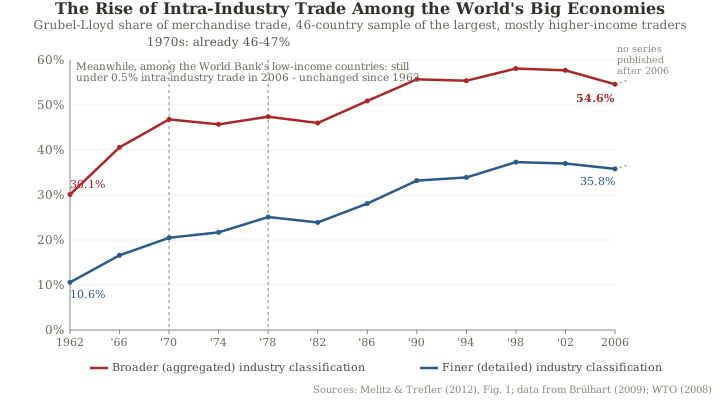
New trade theory got the answer by dropping two assumptions the classical thread had always carried: perfect competition and constant returns to scale. Replace them with increasing returns (bigger production runs mean lower average cost) and monopolistic competition with love of variety (consumers value having many differentiated versions of a good), and a new source of gains appears. Two identical countries still gain by trading: each specializes in different varieties of the same good, every firm gets a larger market and slides down its average-cost curve, and consumers in both countries get access to the full set of varieties from both. No comparative-advantage difference is required; the gains come from scale and variety. That is why similar rich economies trade similar goods, and trade more the larger and more alike they are.
The Dixit-Stiglitz engine. Consumers value variety through a CES (love-of-variety) preference over $n$ symmetric varieties:
$$U = \left( \sum_{i=1}^{n} c_i^{\,\rho} \right)^{1/\rho}, \qquad 0 < \rho < 1$$Each variety is produced by one firm under increasing returns, a fixed cost $f$ plus a constant marginal cost, so average cost falls with output. Free entry drives profit to zero and pins down the number of varieties a market of given size supports. Open two such economies to trade and the combined market supports more varieties at a larger scale per firm: consumers in both countries gain access to a wider set $n$ at lower average cost. The gain is symmetric, and it needs no difference between the countries at all.
Imagine two identical countries, each making the full range of car models for its own market in short, expensive production runs. Let them trade: each makes a few models for the whole combined market, long cheap runs, and buys the other models from across the border. Every factory is bigger and more efficient, and every driver can choose from twice as many cars. Nobody had a head start; both still come out ahead.
The imperfect-competition apparatus new trade theory runs on — monopolistic competition, scale economies, and the strategic-trade (Brander-Spencer) corollary — lives in Economics Ch.6 §6.4 (Monopolistic Competition) and §6.5 (Cournot and Stackelberg), with the new-trade-theory formalism in Ch.22 §22.4. The intellectual lineage, Krugman’s 1979–80 papers as the trade-theory node of the era, sits in History of Economic Thought Ch.10 (The Counter-revolution).
Krugman did not arrive from nowhere. His new trade theory sits at the modern end of a long formal lineage running from Ricardo’s comparative advantage through the marginalist formalization of distribution to Samuelson’s closure of the factor-price results. Here is that spine as a small influence map.
The strongest case here is the classical core as the foundation Krugman built on. Comparative advantage and Heckscher-Ohlin remain the explanation for inter-industry, North-South, factor-driven trade, which is most of the developing world’s trade and a large share of the rich world’s. When Bangladesh exports garments to Germany, that is Ricardo and Heckscher-Ohlin. The strongest pre-Krugman position is that intra-industry trade is a layer of rich-country exchange sitting on top of a comparative-advantage core.
And that position is essentially correct, which is what makes this rung different from the others. New trade theory explained the complement the classical thread could not reach, the rich-rich, similar-goods trade that Ricardo and Heckscher-Ohlin predicted away. The two now coexist as a single layered apparatus: factor endowments for the trade driven by difference, increasing returns and variety for the trade driven by scale. Krugman added a story for the half of trade the classical core had always left dark.
The addition explained the largest pattern the entire classical thread had predicted away, intra-industry trade between similar economies, and it earned the 2008 Nobel for doing so. The thread is now layered: comparative advantage and Heckscher-Ohlin for inter-industry, factor-driven trade; increasing returns and monopolistic competition for intra-industry trade. The Krugman lineage sits in History of Economic Thought Ch.10 (The Counter-revolution) as the era’s trade-theory node. But new trade theory was still a supply-side story about why the patterns of trade exist. It did not yet explain the most robust empirical regularity in trade, a law so stable it had been sitting in the data, theory-less, since 1962.
Long before Krugman, an obscure 1962 finding had noted that the trade between any two countries is predicted, with uncanny accuracy, by their economic size and the distance between them, the same form as Newton’s law of gravity between two masses. For decades it was a curiosity without a theory. Then the theory arrived, and with it the modern empirical workhorse, and the data that finally forced economics to confront the question the whole efficiency-minded thread had under-weighted: who does trade leave behind?
The empirical turn and the distributional frontier
“The flow of trade between two countries is proportional to the product of their economic sizes and inversely related to the distance between them.”
— after Jan Tinbergen’s empirical fit, Shaping the World Economy, 1962
Two facts open this stage, and they pull opposite ways. The first is gravity: trade between two countries scales with the product of their GDPs and falls with the distance between them, fitting the data so tightly that it has been called the most stable empirical law in economics, and it held for forty years before anyone could say why. The second is the one that cuts. “Between 1999 and 2011, the China shock destroyed 2.0 to 2.4 million American jobs,” in communities that did not recover, the empirical fact the supply-side thread, from Ricardo forward, had systematically under-weighted.
Gravity began as Tinbergen’s 1962 empirical fit: trade $\propto$ size $\div$ distance, no theory attached. The microfoundation came from Anderson and van Wincoop in 2003, and it carried a twist. Bilateral trade also depends on the two countries’ multilateral resistance, how hard each finds it to trade with everyone else. Gravity fits so well because it falls out of almost any trade model with trade costs, Ricardian, Heckscher-Ohlin, Krugman, or Melitz alike, which is why it became the shared empirical workhorse regardless of which supply-side story you believe. Melitz (2003) supplied the last rung by putting heterogeneous firms underneath: within any industry, only the most productive firms clear the fixed cost of exporting, which is why most firms never export at all and why opening to trade reallocates market share toward the best, a within-industry gains-from-trade channel the country-level models had assumed away.
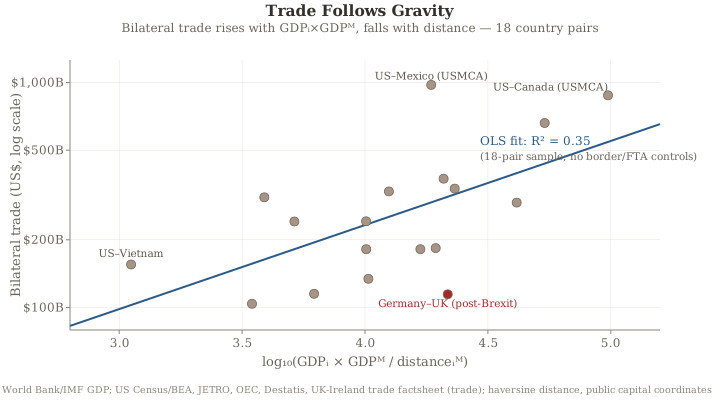
The structural gravity equation (Anderson–van Wincoop). Bilateral trade $X_{ij}$ between exporter $i$ and importer $j$:
$$X_{ij} = \frac{Y_i\, Y_j}{Y_W}\left(\frac{\tau_{ij}}{\Pi_i\, P_j}\right)^{1-\sigma}$$where $Y_i, Y_j$ are economic sizes, $Y_W$ world output, $\tau_{ij}$ the bilateral trade cost (rising with distance), $\sigma$ the elasticity of substitution, and $\Pi_i, P_j$ the multilateral-resistance terms, how costly $i$ finds it to sell to all markets, and $j$ to buy from all sources. Distance and size are the headline; multilateral resistance is the correction that made the fit structural.
Melitz adds a productivity cutoff. A firm with productivity $\varphi$ exports only if its profit clears the fixed export cost $f_x$:
$$\varphi \;\geq\; \varphi^{*}, \qquad \pi_x(\varphi^{*}) = f_x$$so only firms above $\varphi^{*}$ export; trade liberalization raises $\varphi^{*}$, culling the least productive and reallocating share to the best, a source of gains entirely within an industry.
Two ideas, both homely. Gravity: big economies trade a lot, far-apart economies trade little, and, the surprise, the same simple math comes out of almost any sensible theory of trade, which is why it fits no matter what you believe is driving the trade underneath. Melitz: trade sorts firms within a country. Only the strongest can afford to sell abroad, so opening up culls the weakest and grows the best. Most companies never export at all, and that turns out to be the whole point.
The trade-flow accounting frame is Economics Ch.17 §17.1 (Balance of Payments Accounting); gravity as a structural-estimation workhorse belongs to the empirical apparatus of Ch.10 (Econometrics Foundations), with the gravity and heterogeneous-firm formalism in Ch.22 §22.5. The lineage of the gravity model and the credibility-revolution empirical turn runs through History of Economic Thought Ch.12 (New Keynesian Economics and the Modern Consensus).
The pure-efficiency tradition is at its strongest here, and the gains are enormous. Trade with China delivered hundreds of billions of dollars in consumer-surplus gains: cheaper clothing, electronics, and household goods for every American household, year after year, concentrated most on the budgets of the poor who spend the largest share of income on traded goods. It brought export-sector jobs and revenues in America’s competitive industries. And it delivered the within-industry productivity reallocation Melitz formalized. Opening to trade culled the weakest domestic firms and grew the strongest, raising average productivity across the economy. From Ricardo through Melitz, the thread gives a true account of why trade makes the pie bigger. None of that is in dispute.
Which is why the distributional failure is one of policy and emphasis. The gains were real; the model also told you, through Stolper-Samuelson, precisely who would pay for them. The efficiency tradition treated the distribution of those gains as a second-order footnote, an asterisk on a welfare calculation, when it turned out to be a first-order political and human fact. The strongest case for the efficiency tradition is also its sharpest indictment: because the aggregate gains are real, the right response to the concentrated losses was to compensate the losers, and the failure to do so was a political choice.
The gains from trade are real, and the thread that established them is cumulative, settled from Ricardo through Melitz. And the modern frontier is maturing the thread to price the distribution of those gains. The China-shock literature (Autor, Dorn, and Hanson) and the trade-and-inequality work showed that the aggregate-gains framing systematically under-stated the concentrated, persistent, geographically local losses, and that the “winners compensate the losers” assumption was a model convenience the political system never honored. The integration era that produced the shock is the record of Economic History Ch.18 (Globalization and the Great Moderation); the distributional reckoning that followed is Ch.19 (The 2008 Crisis and After), with the integration source in Ch.17 (China’s Reform and the Asian Century).
The disagreement is easy to over-read in either direction. Economists agree that comparative advantage holds, that the gains from trade are real, and that trade carries concentrated distributional costs; what they argue about is how large those costs are, what the right compensation and adjustment policy would be, and how much weight the distributional side should carry against the efficiency gains. Nor is the method in dispute: gravity and structural estimation are the shared workhorse everyone uses. The distributional record sits in the policy walkthrough: Is free trade always good? engages the China-shock distributional claim at full strength in its “Did China kill American manufacturing?” Take. The thread matured into an apparatus that knows both what trade is worth and who pays for it.
The thread, whole
The arc, rung by rung. Hume’s impossibility (1752), you cannot hoard your way to wealth; a permanent surplus self-destructs through the price-specie-flow mechanism. Ricardo’s foundation (1817), the gains from trade are real and reach even the country worse at everything. Heckscher-Ohlin’s endowments (1919–1933), a country exports the good that uses its abundant factor, with Stolper-Samuelson naming who wins and loses inside it. Leontief’s anomaly (1953), the most capital-rich country exported labor, breaking pure-endowment theory empirically. Krugman’s varieties (1979–80), increasing returns and love of variety explain why similar economies trade similar goods. Gravity’s empirics (Tinbergen 1962 → Anderson–van Wincoop 2003), trade scales with size and falls with distance, the field’s most stable law. Melitz’s firms (2003), only the most productive firms export, so trade sorts firms within industries. The distributional frontier, the China shock forcing the efficiency-minded thread to price the distribution of the gains. The era-organized books carry these as fragments across five chapters and an interactive timeline; the thread is what connects them into one line.
Two things are true of that arc at once. It is genuinely cumulative: each rung answered an anomaly its predecessor could not, and the answers stack. Comparative advantage is the floor; factor endowments explain the inter-industry pattern on top of it; increasing returns explain the intra-industry pattern alongside that; gravity measures all of it; Melitz puts firms underneath. Almost nothing in the thread was a refutation, even the Leontief paradox only bounded Heckscher-Ohlin. And it is maturing: the one place the thread fell short was in treating the distribution of trade’s gains as an afterthought, and the China-shock generation corrected this by insisting that an honest trade economics prices who pays for them. The gains from trade are real; the distribution of those gains is the frontier.
For whether free trade is always good, the tariff verdict in modern data, and the China-shock distributional record, follow Is free trade always good? For the protectionist counter-tradition argued at full strength, follow the Smith-versus-List comparison; for the Brexit case that the gravity model’s trade-cost estimates run on, follow the Brexit walkthrough. The thread below is the labor-factor mirror of this goods-trade lineage.