Risk: one word, three disciplines
Economists, quants, and sociologists all study “risk.” They mean three different things by it, and 2008 tested all three at once. Here is what each got right, and which framing was load-bearing when the system broke.
Risk in economics
“Uncertainty must be taken in a sense radically distinct from the familiar notion of Risk, from which it has never been properly separated... The essential fact is that ‘risk’ means in some cases a quantity susceptible of measurement, while at other times it is something distinctly not of this character.”
— Frank Knight, Risk, Uncertainty, and Profit (1921), Chapter VII
When a central banker says a decision is clouded by “uncertainty,” the word is doing precise technical work that almost nobody outside the discipline hears. Economics has spent a century building an apparatus around exactly the line Knight drew, and then, for a while, walking away from the harder half of it.
Economics gave “risk” a sharp definition: outcome variability with a known probability distribution. That is the half Knight called measurable. The other half — outcomes with no known distribution, where you cannot even write down the odds — he called uncertainty. You can insure against risk. You cannot price uncertainty, because pricing needs a distribution to integrate over.
On Knight’s measurable side, the apparatus grew into something formidable. In 1944, von Neumann and Morgenstern showed that if a person’s preferences over uncertain prospects obey four axioms — completeness, transitivity, continuity, and independence — those preferences can be represented as if the person were maximizing the expected value of a utility function over outcomes. Rational choice under risk stopped being a hunch and became a representation theorem. A decade later, Arrow and Pratt turned the curvature of that utility function into a single number: the coefficient of absolute risk aversion, a local measure of how much someone will pay to dodge an actuarially fair gamble. Variance and standard deviation became the working measures of risk itself. Risk is a moment of a known distribution, and risk-aversion is a parameter of a preference.
A lottery $L$ pays outcome $x_i$ with probability $p_i$. Under the four axioms, the agent acts to maximize expected utility:
$$U(L) = \sum_i p_i\, u(x_i)$$and the local intensity of risk-aversion is captured by the Arrow-Pratt coefficient of absolute risk aversion:
$$A(w) = -\frac{u''(w)}{u'(w)}$$If you can write down the probabilities, you can write down the expected utility, and you can say exactly how much a given person would pay to avoid a given gamble. The case Knight called uncertainty, where you cannot write the probabilities down at all, sits outside it. And for forty years after the war, the discipline mostly worked the inside.
The move toward measurable risk was a research-program choice. Knightian uncertainty was simply harder to model, and the formal payoffs sat on the measurable side. Then 2008 dragged the harder half back into view. Nicholas Bloom’s 2009 work made “uncertainty” itself something you could measure indirectly, through spikes in implied volatility and the dispersion of forecasters’ expectations, without collapsing it back into ordinary risk. The apparatus grew back into Knight’s distinction. Want the formal scaffolding? The expected-utility apparatus and where the independence axiom eventually broke live in Ch 19 §19.1 (Violations of Expected Utility); risk as the variance of a return distribution is built in Ch 24 §24.2 (Portfolio theory). For the intellectual lineage, the von Neumann–Morgenstern closure of the neoclassical toolkit, see History of Economic Thought Ch.5 §5.6 (Von Neumann-Morgenstern and the completed toolkit).
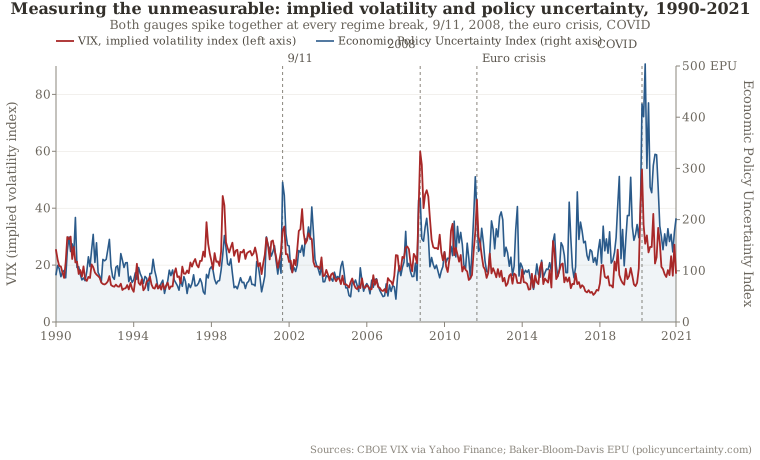
Uncertainty is not the same as risk
The two words get used interchangeably in everyday speech. Knight’s century-old distinction is the difference between a problem you can price and one you cannot, and the difference turns out to be decisive in a crisis.
Economics on its own terms
Economics-on-risk is a serious instrument. Insurance markets are real and they work; portfolio choice under measurable risk has a clean, correct solution; the expected-utility framework still organizes how the discipline thinks about every decision made against a known distribution. None of that was undone in 2008. What the crisis exposed was narrower: that the discipline had let the measurable half of Knight’s distinction crowd out the unmeasurable half, and that the unmeasurable half was the one doing the damage. The Bloom-era recovery of Knightian uncertainty, making it visible even where it cannot be priced, counts as a real methodological advance.
The economic apparatus assumes you can write the probabilities down. Now watch what happens when an entire industry institutionalizes that assumption, prices trillions of dollars of contracts on it, builds the global bank-capital rulebook around it, and then meets a tail event the apparatus never saw coming.
Risk in finance
“A Black Swan is an event with three attributes. First, it is an outlier, as it lies outside the realm of regular expectations... Second, it carries an extreme impact. Third, in spite of its outlier status, human nature makes us concoct explanations for its occurrence after the fact, making it explainable and predictable.”
— Nassim Nicholas Taleb, The Black Swan, Chapter 1 (published 2007, one year before the crisis it described)
The publication date is the whole provocation. Taleb’s argument that the financial risk apparatus systematically under-prices the tail landed in print roughly twelve months before the tail arrived and proved him right. The question is what the apparatus measures, and what it cannot see by construction.
Finance built a different apparatus for the same word. Where economics asks how a person should choose under risk, finance asks how a tradeable claim should be priced and hedged. The keystone is the 1973 Black-Scholes-Merton result: under assumptions of continuously traded markets, no transaction costs, and log-normal returns, the price of an option follows from no-arbitrage alone. BSM is not a forecast about where the stock is going; any price other than the formula’s would let a trader build a riskless arbitrage. Risk gets hedged away by replication. Two decades later, J.P. Morgan’s 1994 RiskMetrics document turned this world into a single firm-level number: Value-at-Risk, the loss a portfolio will not exceed at a given confidence (say 99%) over a given horizon (say one day), computed from a covariance matrix and an assumption of roughly normal returns. Basel II and Basel III then bolted the global bank-capital rulebook on top of VaR and its stress-test machinery.
The Black-Scholes price of a European call, derived from replication:
$$C = S\,N(d_1) - K e^{-rT} N(d_2)$$and the one-day 99% Value-at-Risk under a normal-returns assumption, where $\sigma$ is the portfolio’s daily standard deviation:
$$\text{VaR}_{0.99} = 2.33\,\sigma$$The apparatus prices risk off the assumption that returns follow a roughly bell-shaped distribution. That assumption is fine most of the time. On a calm Tuesday it is nearly exact. It fails systematically in the place the apparatus is asked to do the most work: in the tail, during a crisis, when the bell-curve assumption is most wrong.
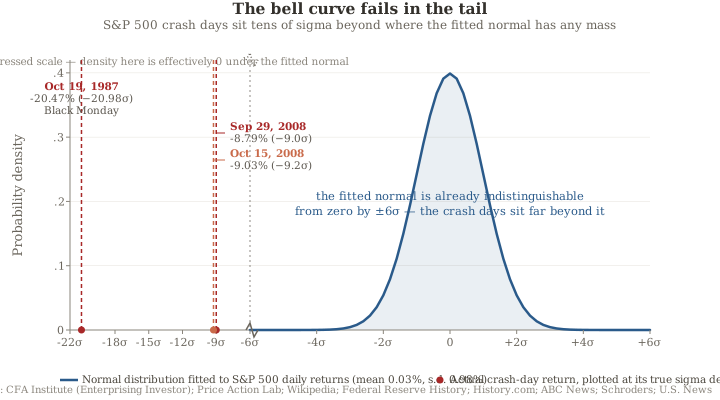
Taleb’s critique, across Fooled by Randomness (2001) and The Black Swan (2007), was precise: real return distributions have fatter tails than the apparatus assumes, so tail events are both more frequent and more violent than the model prices them. The 2008 evidence was brutal. For roughly twenty consecutive trading days at the worst of the crisis, daily losses at major banks fell outside their own one-day 99% VaR. Events the apparatus said should happen two or three times a year were happening daily for a month. Even after the lesson supposedly landed, JPMorgan’s 2012 “London Whale” saw VaR re-calibrated downward just as a position was blowing up, the apparatus under-pricing tail risk from inside the bank’s own risk-management shop. The regulatory response is real: Basel III’s Fundamental Review of the Trading Book replaced VaR with expected-shortfall (which averages over the tail rather than cutting it off at a threshold), and CCAR and EBA stress tests now sit alongside the capital math. The 2008 chronology — the crisis, the VaR failures, and the regime that followed — is the spine of History Ch.19 §19.1 (The 2008 crisis and after). The formal apparatus — CAPM, no-arbitrage pricing, the Black-Scholes argument, and the efficient-markets question — is built in Ch 24 (Finance Basics); its intellectual lineage, the rational-expectations program carried into asset pricing by Fama and Black-Scholes-Merton, sits in History of Economic Thought Ch.10 (the finance-apparatus origin within the counter-revolution). Taleb belongs to the post-2008 plural framings catalogued in Ch.17 §17.2 (Vindication and falsification, the Great Moderation to 2008).
“The central idea of this book concerns our blindness with respect to randomness, particularly the large deviations.”
— Nassim Nicholas Taleb, The Black Swan, Prologue (2007)
The apparatus systematically under-prices tail risk
Taleb said the models would fail in the tail. A year later the tail arrived, and for about a month the biggest banks lost more in a day than their own risk numbers said they could lose in years. Was the apparatus broken, or pointed at the wrong question?
Finance on its own terms
The no-arbitrage logic is beautiful: you can price an option without forecasting the stock, because replication pins the price down regardless of where the stock goes. That logic is correct, and it is the foundation of an industry that hedges real risk every day. The failure in 2008 was that the operational apparatus built on top of it — VaR, the ratings machinery, the Basel-II capital rules — which encoded a distributional assumption whose failure modes were invisible from inside the apparatus itself. A model that tells you the 99% loss tells you nothing about the shape of the 1% it cut off, and the 1% is where banks die. Several other walkthroughs hold the territory next door: Are markets efficient? carries the efficient-markets-versus-behavioral-finance debate where Taleb’s critique sits at full depth, and Did economics cause 2008? runs the parallel post-mortem on the macroeconomic apparatus, the DSGE models with no banks in them, that failed alongside this one. Was 2008 a financial or a monetary crisis? asks whether the financial-frictions apparatus this stage traces or the monetary channel was load-bearing; 2008, from below builds that financial-frictions apparatus up from the CDO case itself; and the banking thread from Italian merchants to shadow banking traces the institutional lineage this stage’s risk-pricing machinery grew out of. This walkthrough holds the risk-conceptual thread: what counts as risk, and which apparatus is right for which job.
Five years before Lehman, a sociologist had already written the book describing how systems exactly like the CDO machinery fail. And the discipline she worked in had been describing this kind of failure — across nuclear plants, space missions, and chemical works — for twenty-five years before that.
Risk in the sociology of disaster
“The small, tightly knit group that invented credit derivatives at J.P. Morgan believed their innovation would make finance safer by dispersing risk. They were brilliant, idealistic, and convinced of their own models, and the conviction itself, traveling through the industry as trust rather than proof, was part of what made the eventual collapse so total.”
— after Gillian Tett’s account of the J.P. Morgan derivatives team in Fool’s Gold (2009)
Tett was trained as a social anthropologist before she became a financial journalist, and it shows. She watched the same CDO machinery the quants were pricing, but she was asking a question their apparatus could not pose: how does a culture come to believe its own risk story so completely that it stops being able to see the risk?
The sociology of disaster starts with the structure of the system and the culture of the organization that runs it. Charles Perrow’s 1984 Normal Accidents is the founding move: studying Three Mile Island, he argued that some accidents are not failures of care or competence but structural properties of the system. When a system is tightly coupled — a failure in one part propagates to the next faster than any human can intervene — and interactively complex — it has more interaction pathways than its designers anticipated or its operators can watch in real time — then accidents become normal in a statistical sense. The structure guarantees that some unanticipated interaction will eventually occur. The High-Reliability-Organizations researchers — LaPorte, Weick, Sutcliffe, Roberts — did not refute Perrow; they specified the cultural conditions (preoccupation with failure, deference to frontline expertise, reluctance to simplify) under which an aircraft carrier or an air-traffic system partly beats the prediction. The two literatures together describe a property the quantitative apparatuses cannot reach from inside: risk as something the structure and culture of an organization produce.
Diane Vaughan’s 1996 The Challenger Launch Decision sharpened it into a mechanism. Her six-hundred-page ethnography of NASA found that the decision to launch in cold weather, against engineering worry about the O-ring seals, was the cumulative product of an organizational culture that had, across many prior flights, quietly reclassified evidence of damage as “within acceptable bounds” because each previous flight had come home safely. She named the mechanism normalization of deviance: the slow drift by which a warning sign becomes routine. Ulrich Beck’s 1986 Risk Society set the broadest frame, a Frankfurt-school-descended argument that modernity itself manufactures hazards (nuclear, chemical, ecological, financial) whose causes are smeared across institutions and whose costs land unequally, so that risk becomes a structural feature of the social order. And Gillian Tett’s Fool’s Gold brought the register to the CDO desk in real time: the J.P. Morgan team’s confidence in its own risk models traveled across the industry as social trust. She documented the cultural production of risk-blindness as it happened.
“If interactive complexity and tight coupling, system characteristics, inevitably will produce an accident, I believe we are justified in calling it a normal accident, or a system accident.”
— Charles Perrow, Normal Accidents (1984)
Complex systems produce risk-blindness structurally
Perrow wrote his framework about nuclear plants in 1984. Apply it to the 2007 CDO market and it reads like a forecast: tightly coupled, interactively complex, run by operators who had normalized the danger. The structure predicted the kind of failure that came.
The discipline on its own terms
The temptation, reading this from inside economics or finance, is to file the whole literature under “critics of technical systems.” That reading is wrong about every figure in the list. Perrow is a structural analyst whose normal-accidents framework has held up across nuclear, chemical, aviation, hospital, and financial applications for forty years. Vaughan is an ethnographer of organizational decision-making whose normalization-of-deviance mechanism has been replicated on the Columbia disaster, the BP Texas City explosion, the Boeing 737 MAX certification, and pandemic-preparedness institutions. Beck is a structural-modernity theorist in the Frankfurt-school line. Tett is a financial journalist who documented a cultural mechanism in real time. Taken at full structural strength, the discipline had been describing the exact shape of the 2008 failure, a tightly-coupled, interactively-complex, culturally-blind system accident, for a quarter-century before it happened. The complementary post-mortem on the economics side, where the charge is that the discipline indicted itself, runs in Did economics cause 2008? The recurrence itself is its own thread: the crises thread from medieval Bardi-Peruzzi to 2008 traces Perrow’s normal-accidents pattern across seven centuries of tightly-coupled financial systems failing the same structural way.
Three apparatuses, one word, one 2008. Together they explain risk in a way none manages alone, and the combined view reaches past finance to Fukushima, the 737 MAX, and COVID.
Where the three explain 2008, and what integration looks like
“The brief market seizure of 2008 was, at its core, a flight to quality driven by Knightian uncertainty, not measurable risk. Agents stopped trusting their models of the world, hoarded liquidity, and the short-term funding markets froze.”
— paraphrasing Ricardo Caballero & Arvind Krishnamurthy, “Collective Risk Management in a Flight to Quality Episode,” Journal of Finance (2008)
2008 tested all three apparatuses at once, and each lit up on a different question. Economics’ oldest distinction, Knight’s, named the mechanism of the funding freeze. Finance’s tail-risk blind spot was the channel. And the sociology of disaster had described the shape of the thing years in advance. The verdict is a map of which framing was load-bearing where.
Three absorptions followed, and they are the evidence that the disciplines have moved toward each other. On the economics side, Caballero and Krishnamurthy used Knightian uncertainty as the mechanism for the short-term funding freeze, and Bloom’s uncertainty-shocks program made the concept measurable enough to put in a macro model; the discipline grew back into its founder’s distinction. On the finance-and-regulation side, Basel III’s Fundamental Review of the Trading Book replaced VaR with expected-shortfall as the capital-charge framework, an explicit admission that VaR under-prices the tail, while CCAR and the EBA stress tests institutionalized scenario-based tail supervision alongside the quantitative math. On the sociology-of-disaster side, the absorption is real but thinner: the Federal Reserve’s post-2008 supervision added explicit “risk culture” and “governance” assessments at large banks, and macroprudential thinking now reaches for “complex systems” and “interconnectedness” language, though turning that language into formal supervisory tools remains unfinished. The 2008 chronology and the regime that followed sit in History Ch.19 §19.3 (the new monetary regime); the deep historical precedent, a Knightian-uncertainty reading of an earlier collapse, runs through Ch.12 §12.5 (Why the Depression: four readings). The post-2008 reckoning as a chapter in the history of economic thought — the Minsky revival, the paradigm-humbling of the synthesis — is History of Economic Thought Ch.17 §17.2.
“The crisis has shown that we need to do more to incorporate financial factors into our standard models, and to take seriously the institutional and governance arrangements through which risk is actually managed.”
— paraphrasing Ben Bernanke, “Implications of the Financial Crisis for Economics,” Princeton (2010)
The cross-discipline integration is real and incomplete
Since 2008, the three disciplines have moved toward each other, and you can document the moves. But the absorption is lopsided: the quantitative side has come further than the structural-cultural side, because culture does not formalize the way variance does.
How complete is the integration?
“Expected shortfall has replaced VaR in the trading-book capital framework; supervisory stress tests now run severe tail scenarios as a matter of course; and large-bank supervision explicitly assesses risk culture and governance.”
— the integration-optimist reading of the post-2008 regulatory record (Basel III FRTB; CCAR; EBA)
The optimist’s point is that you can audit the integration in the rulebook. Financial economics re-absorbed Knightian uncertainty through Caballero-Krishnamurthy and the uncertainty-shocks literature. Regulation absorbed Taleb’s tail-risk critique by writing expected-shortfall into capital requirements and making stress tests mandatory. Supervision reached toward the sociology of disaster by putting risk-culture and governance assessments into large-bank examinations. And the 2020 COVID response — fast, aggressive, and explicit about uncertainty — showed the absorbed lessons changing behavior in a later crisis. The quantitative side is rewriting its operating manual to take the other two seriously.
“The 737 MAX and Fukushima were diagnosed as normalization-of-deviance and normal-accident failures, structural and cultural, not quantitative. Risk culture appears in supervisory language; it has not been operationalized inside the capital and stress-test apparatus.”
— the integration-skeptic reading (JATR and House Transportation Committee on the 737 MAX; NAIIC on Fukushima)
The skeptic agrees on direction and disputes the distance traveled. Yes, the absorption is real, but it is real in language and architecture, and the structural-cultural side has barely moved. The structural-cultural register keeps drawing blood: the 737 MAX was Vaughan’s normalization of deviance inside a credentialed engineering organization; Fukushima was Perrow’s normal accident inside a captured regulatory relationship; COVID was institutional risk-blindness in pandemic-preparedness bodies. Each post-mortem reached for the sociology of disaster. And in every case the supervisory apparatus could name the problem but not encode it, because organizational risk culture does not collapse into a number a capital rule can use.
The verdict
This is a scope-dependent split: each apparatus owns a different sub-question of the same phenomenon, so the right question is which framing is load-bearing where. And layered on top of the split is a second axis that runs through time, an integration trajectory. Since 2008 the three disciplines have moved toward each other. The movement is real and documented, and it is incomplete. The same scope-dependent-split-plus-trajectory shape recurs one level down inside economics itself, in Was 2008 a financial or a monetary crisis?, and recurs again on an entirely different concept in Power across economics, political science, and sociology, the same one-concept-across-three-disciplines pattern, worked on a different word.
Each apparatus is right for its scope. Economics-on-risk owns individual decision-making under known probability — portfolio choice, insurance, saving against wage shocks — with the Bloom-era revival restoring Knight’s distinction inside the modern toolkit. Finance-on-risk owns the pricing and hedging of tradeable claims under stable distributions, with the post-2008 move to expected-shortfall and stress testing acknowledging the tail it used to cut off. Sociology-of-disaster-on-risk owns the organizational and cultural production of risk-blindness in complex, tightly-coupled systems, the register that had the 2008 CDO machinery’s failure-shape described a quarter-century early. The integration is the live frontier, and it is asymmetric: the Knightian-uncertainty and tail-risk lessons absorbed faster because they translate into the quantitative apparatus’s native language; the structural-cultural lessons absorbed slower because they do not. The open problem is the translation, how to put Perrow and Vaughan inside a supervisory tool without losing either the insight or the tractability.
2008 was a joint test, and every apparatus carried weight on a different sub-question: Knightian uncertainty named the funding freeze, fat tails named the channel, normal-accidents-plus-normalization-of-deviance named the shape. Two sibling walkthroughs sit inside that single weekend at closer range. 2008, from below builds the same financial-frictions apparatus up from the CDO case, and The Lehman weekend takes the crisis down to the hour-by-hour decisions, while the crises thread from Bardi-Peruzzi to 2008 shows the same normal-accident shape recurring across seven centuries of financial history. The events since have kept confirming the structural-cultural register outside finance entirely, Fukushima as a regulatory-cultural normal accident, the 737 MAX as normalization of deviance inside a blue-chip engineering firm, COVID as institutional risk-blindness in pandemic preparedness. The three, taken at their strongest and combined, explain risk-as-phenomenon in a way none manages alone, and economics and finance do not need to abandon their quantitative apparatuses to absorb the sociology of disaster. They need the translation that lets the structural insight survive the quantification.
Where this leaves us
One word, three apparatuses, each correct on a different sub-question:
- Economics-on-risk, the right tool for individual decision-making under known probability (Knight’s distinction, von Neumann–Morgenstern expected utility, Arrow-Pratt risk aversion, the Bloom-era recovery of uncertainty).
- Finance-on-risk, the right tool for pricing and hedging tradeable claims under stable distributions (Black-Scholes-Merton no-arbitrage, VaR, the Taleb tail-risk critique, the post-2008 move to expected-shortfall).
- Sociology-of-disaster-on-risk, the right tool for the organizational and cultural production of risk-blindness in complex tightly-coupled systems (Perrow’s normal accidents, Vaughan’s normalization of deviance, Beck’s risk society, Tett on the CDO desk).
- The cross-discipline integration, the live methodological frontier since 2008: real, documented, lopsided, and unfinished.
Holding all three at once matters because 2008 — and Fukushima, and the 737 MAX, and COVID — cannot be understood from inside any single one of them. The quantitative apparatuses are right about what they measure and blind to what they cannot. The sociology of disaster sees the blindness but cannot yet hand a regulator a usable tool. The scope-dependent split plus the integration trajectory is the position: each framing is load-bearing somewhere, the disciplines are converging, and the part of the convergence that resists the equation is the part still unsolved. The next time someone tells you the models failed in 2008, you can ask the better question: which model, on which question, and was it even the apparatus that should have been answering?