Is inflation monetary or fiscal?
For sixty years the answer was settled: inflation is a monetary phenomenon, full stop. Then 2021 happened — and a theory the profession had half-forgotten came roaring back to argue the opposite. They are reading the same price chart. They disagree on what it says.
Inflation as a monetary phenomenon
“Inflation is always and everywhere a monetary phenomenon in the sense that it is and can be produced only by a more rapid increase in the quantity of money than in output.”
— Milton Friedman, The Role of Monetary Policy, American Economic Review 58(1), March 1968
That one sentence organized sixty years of central banking. The entire edifice of inflation targeting, central-bank independence, and the Volcker disinflation rests on it. Ask an economist or a journalist what causes inflation and the monetary answer comes first, every time. The dominance is so complete it is easy to miss that it is a claim — one with a rival.
Friedman’s dictum starts from the oldest relation in macroeconomics. The quantity of money in circulation, multiplied by how fast it changes hands, equals the price level times the volume of real transactions. Rearrange it and inflation is just money growth running ahead of output growth.
The quantity equation links money, velocity, prices, and output:
$$MV = PY \quad\Longrightarrow\quad \pi = \mu - g$$At long-run equilibrium, with velocity $V$ roughly stable, inflation $\pi$ equals money growth $\mu$ minus real output growth $g$. Print faster than you grow, and prices rise. The arithmetic looks unanswerable.
More dollars chasing the same pile of goods means each dollar buys less. That is the whole monetary story in one image. And here is why it survived the 1980s, when stable money demand fell apart and money-stock targeting stopped working: modern central banking quietly re-described the mechanism. The Fed no longer targets the quantity of money — it sets an interest rate, follows a rule that leans against inflation, and anchors expectations through a credible promise to do whatever its target requires. Inflation stays monetary not because the money stock controls it, but because the central bank behaves as if it does, and everyone believes it. The Fed makes the price level monetary.
That modern form is the three-equation New Keynesian model: a demand curve, a Phillips curve, and a Taylor rule that describes how the central bank moves its policy rate in response to inflation and the output gap. The price level is anchored by the bank’s credible commitment to its target. One assumption makes the whole machine run — that the fiscal authority will quietly produce whatever surpluses are needed so the central bank’s price-level target stays consistent with the debt path. Hold that thought; Stage 3 is where it earns its keep.
“Inflation is always and everywhere a monetary phenomenon.”
— Milton Friedman, 1968
What was Friedman really saying?
The most quoted sentence in macroeconomics is usually read as a law of nature. Read carefully, it is a claim about how one particular kind of economy works — and that distinction turns out to be the whole game.
The monetary apparatus at full strength
“Our economic theory must give appropriate weight to the fact that economic decisions are made looking to the future, and that expectations about future policy shape the present.”
— Robert E. Lucas Jr., Nobel Prize Lecture, 1995
Lucas supplied the formal scaffolding the dictum had been missing. If people form expectations rationally, then inflation is whatever the central bank credibly commits to deliver: a determined bank can re-anchor expectations and break an inflation, and a wavering one will find inflation expectations drifting away from it. This is the analytical core of the monetary view — the price level is a forecast of central-bank behavior, and the bank controls the forecast by controlling itself. The Friedman → Lucas → Sargent counter-revolution that built this apparatus, and routed Keynesian fine-tuning in the process, is traced in History of Economic Thought Ch.10 (The monetarist and New Classical counter-revolution). It is not a fringe position. It is the mainstream, and it earned that place.
There is a counter-voice — a rigorous one — that says the monetary apparatus reads the right data through the wrong machine. We are deliberately holding it back. The honest way to flip a sixty-year orthodoxy is to inhabit it at full strength first, with no rebuttal whispering in the margin, and then bring the challenger in as a complete apparatus rather than a footnote. So Stage 1 ends with the monetary view standing tall and unanswered. Stage 2 introduces the fiscal theory of the price level — not as “here is what the critics say,” but as a rival theory of the same phenomenon, with its own equation and its own reading of the very episodes the monetary view treats as victories. The flip lands harder because we let Stage 1 win.
Where this leaves us
The monetary framing has earned its dominance. Volcker proved it can work — the 1979–82 disinflation broke double-digit inflation expectations almost exactly as the theory said central-bank credibility would, a case told in Economic History Ch.16 (Stagflation and the neoliberal turn). The inflation-targeting consensus that followed runs every major central bank in the developed world. The dictum is not wrong. But notice the word that keeps appearing: credibility. The apparatus works because a particular arrangement holds — an independent central bank that sets the price level, and a fiscal authority content to follow. The dictum is conditional on that arrangement, even though it never says so. Stage 2 asks what happens when the arrangement doesn’t hold.
But what if the price level isn’t anchored by the central bank at all? What if Friedman was reading the right empirical record through the wrong apparatus — and a small, rigorous strand of macroeconomics has been saying so the whole time, quietly, until 2021 made it loud again? That strand says inflation is always and everywhere a fiscal phenomenon. It is not a slogan. It has an equation. And it reads the last three years very differently than the Fed does.
Inflation as a fiscal phenomenon
“Inflation comes when people don’t expect the government to fully repay its debts. It is, in this sense, always and everywhere a fiscal phenomenon.”
— John H. Cochrane, The Fiscal Theory of the Price Level, Princeton University Press, 2023
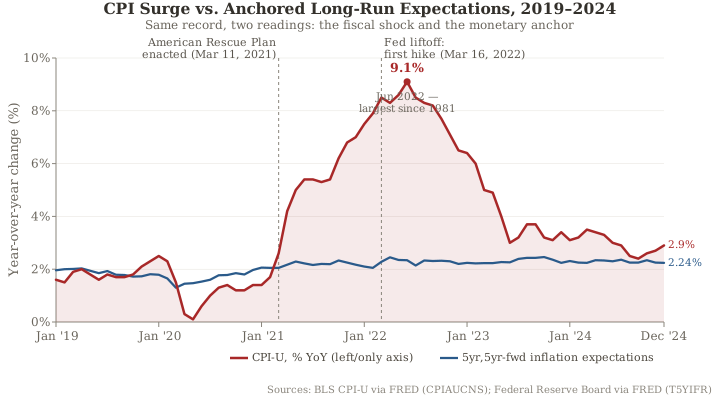
The echo of Friedman’s wording is deliberate. Cochrane has flipped the noun and kept the cadence — fiscal where Friedman wrote monetary — because he is making a claim of exactly the same kind: not a footnote to the quantity theory but a rival theory of what determines the price level. And he points at one episode above all. Between March 2021 and June 2022, US consumer prices rose at a rate not seen since the early 1980s, peaking at 9.1% year-over-year. The monetary view has a story about that surge. So does the fiscal theory. They are not the same story.
Here is where the ground shifts. Everything Stage 1 told you was true — and possibly the wrong apparatus for this moment. The fiscal theory starts not from the money stock but from the government’s budget constraint, and it asks a question the quantity equation never poses: what backs the value of money in the first place?
The real value of outstanding nominal government debt must equal the present value of the primary surpluses the government is expected to run to retire it:
$$\frac{B_t}{P_t} = \sum_{s=0}^{\infty}\beta^s\, E_t\!\left[\text{surplus}_{t+s}\right]$$Read it as a valuation equation, not a financing equation. The left side is fixed by the nominal debt already issued. If the expected surplus stream on the right falls, something on the left must give — and since $B_t$ is nominal and contractually fixed, the price level $P_t$ rises to restore the equality.
Treat government bonds like shares in the government’s future surpluses. A share’s price falls when the market expects the company’s earnings to shrink. A government bond is a claim on future tax revenue net of spending; if markets come to expect that those surpluses won’t materialize — that the debt will be allowed to grow with no credible path to retire it — the “share price” of the bond falls. But a bond has a fixed face value. The only way its real value can fall is for the price level to rise. So inflation is the mechanism by which the bond market re-prices a government whose books no longer credibly balance. The price level adjusts to validate the present-value relationship. That is the fiscal theory’s signature move.
This only binds under particular conditions — an active fiscal authority that sets surpluses without regard to debt sustainability, and a passive central bank that accommodates whatever rate path is consistent with the debt. Under those conditions, raising interest rates can make inflation worse: higher rates raise the interest bill, demand larger future surpluses to retire the debt, and if those surpluses won’t come, the price level adjusts further. The Fed’s most powerful lever runs backwards. (We name and number these regimes properly in Stage 3.)
Now point the apparatus at 2021–22. The American Rescue Plan put $1.9 trillion in transfers into the economy in March 2021; Build Back Better signalled more spending to come; the Fed held rates at zero and kept buying assets until March 2022. Read through the fiscal theory, the CPI surge is not a supply shock the Fed was slow to counter. It is the price level adjusting to a perceived decline in the present value of future surpluses — a regime-perception shift toward implicit active-fiscal, passive-monetary. That is the apparatus’s reading. Whether it is the correct reading is the fight of Stage 3.
This same fiscal-theory apparatus shows up inside a different question elsewhere on the site: for the FTPL engaged as one edge of the fiscal-stimulus debate — is deficit spending good policy? — rather than as a theory of the price level, see Does government spending help the economy? (Stage 4). Same equation, different question: there it is one heterodox edge among several; here it is the center.
“Inflation is, in this sense, always and everywhere a fiscal phenomenon.”
— John H. Cochrane, The Fiscal Theory of the Price Level, 2023
Can inflation really be fiscal?
A serious theory of the price level that puts the Treasury, not the Fed, in the driver’s seat. It is not a hand-wave about deficits — it has an equation, and it makes predictions the monetary view doesn’t. The catch is in the word “can.”
The flip, and the framing it has to survive
“A monetary policy that is too tight in a fiscal sense — that raises interest costs without a fiscal backing — can be inflationary rather than disinflationary. The interactions between monetary and fiscal policy are central, not peripheral.”
— Christopher A. Sims, “Stepping on a Rake,” Jackson Hole symposium, 2011
Sims, a Nobel laureate, dragged the fiscal theory out of the seminar and into the post-2008 policy conversation; Cochrane’s 2023 monograph then made it a complete, book-length apparatus. Their claim is not that the Fed is powerless — it is that monetary power is conditional on fiscal backing, and that an inflation rooted in a fiscal-credibility problem cannot be cured by interest-rate moves alone. The 2021–22 surge, on this reading, is what the theory predicted you would eventually see in a fiat, quantitative-easing world where the fiscal anchor had quietly loosened. The fiscal theory sits in the modern-pluralism wing of macroeconomics — one of the post-2008 challenger frames, alongside the Minsky revival and Modern Monetary Theory — traced in History of Economic Thought Ch.17 (Modern pluralism).
“The Fed’s commitment to its inflation objective, and the credibility it has built over decades, remained the decisive anchor. Once the Federal Reserve began raising rates and signalled resolve, longer-term inflation expectations stayed broadly anchored.”
— Ben S. Bernanke, 21st-Century Monetary Policy and related writing, 2022
This is the mainstream reading, and it is strong — it has to be taken at its full weight, because the flip only matters if the framing it challenges is genuinely formidable. Bernanke and Mishkin argue that the inflation-targeting apparatus did exactly what it was built to do. The 2021–22 surge is most parsimoniously explained by supply shocks, reopening demand, and a Fed that started late — not by a regime shift. The proof is in the recovery: once the Fed lifted off in 2022 and committed visibly to restraint, long-run inflation expectations stayed anchored and inflation fell, exactly as the credibility channel predicts. And the deeper objection is methodological. The fiscal theory generates distinctive predictions only under regime conditions no one can cleanly identify in real time — which means it can rationalize an inflation after the fact but struggled to call this one in advance. A theory that fits everything ex post and commits to little ex ante is, on this view, the weaker apparatus, however elegant its equation.
Where this leaves us
The disorientation is the point, and it is real: two apparatuses are reading the same CPI series — the 2021–22 chronology that Economic History Ch.19 (The 2008 crisis and after) lays out date by date — and disagreeing about what the data say. The fiscal theory is not a fiscal-side hand-wave; it is a genuine theory of the price level that fires under specific regime conditions, and 2021–22 plausibly met them in a way no episode in forty years has. But it does not displace the monetary view. The two apparatuses are answering different questions. The monetary view asks: how does the Fed control inflation? The fiscal view asks: when can the Fed control inflation at all? Both questions have answers. Which answer governs depends on the regime in operation — and that is the prior question Stage 1 buried and Stage 2 unearthed. Stage 3 makes it the explicit first move.
So we have two apparatuses for one phenomenon. One has dominated for sixty years; the other has revived because the dominant one stumbled in 2021. Which is right? That is the wrong question — and learning why it is the wrong question is the whole payoff of this walkthrough. The right question has three words. Which regime are we in?
It depends on the regime
“Monetary and fiscal policy each can be characterized as active or passive. The equilibrium — and which authority determines the price level — depends on the combination in force.”
— Eric M. Leeper, “Equilibria under ‘active’ and ‘passive’ monetary and fiscal policies,” Journal of Monetary Economics 27(1), February 1991
Leeper’s 1991 paper is the apparatus the discipline reaches for when the framework-versus-framework fight hits an empirical dead end. It refuses to ask “is inflation monetary or fiscal?” and asks instead which authority is committed to its policy and which one bends. Once you have that vocabulary, the question that drove Stages 1 and 2 reveals itself as malformed — not unanswerable, but asked one level too shallow.
Leeper’s framework is a two-by-two. Each policy authority can be active — it sets its policy without regard to the other’s constraints — or passive, adjusting to satisfy the joint budget constraint. Four combinations are possible; only two of them deliver a unique equilibrium, and those two are exactly the worlds Friedman and Cochrane were each theorizing.
The two determinate regimes:
| Regime | Who sets the price level | Whose theory describes it |
|---|---|---|
| Active monetary, passive fiscal | Central bank | Monetary / NK (Friedman’s world) |
| Active fiscal, passive monetary | Fiscal authority | Fiscal theory (Cochrane’s world) |
The other two combinations — both active, both passive — give an over-determined or under-determined price level, respectively. The economy has to be in one of the two determinate regimes for the question “what sets inflation?” to have an answer at all.
The whole thing reduces to one question: when the debt path gets tested, who blinks first? In the active-monetary regime, the central bank holds its inflation target and the fiscal authority quietly produces whatever surpluses are needed to make the debt consistent with that target — the Treasury blinks, and inflation is monetary. In the active-fiscal regime, the fiscal authority spends and borrows as it pleases and the central bank accommodates — the Fed blinks, its rate moves can’t anchor anything, and inflation is whatever the present-value relation requires. Friedman’s dictum is true in the first world and false in the second. Neither theory is wrong; each is the theory of its own regime. The hard part is not the theory — it is reading which regime you are actually standing in, because regimes aren’t printed on the data. You infer them from how the two authorities behave when their commitments are genuinely tested. The 2021–22 episode was exactly such a test, in real time, and that is why serious economists came out of it disagreeing.
This regime lens has a history as well as a structure. The post-Volcker decades were a textbook active-monetary, passive-fiscal arrangement — the world the inflation-targeting consensus was built for. The Bretton Woods order that preceded it bound monetary policy to the dollar’s gold convertibility and left more room for fiscal dominance; the contrast between the two eras, told in Economic History Ch.13 (The Bretton Woods order) and Ch.16 (Stagflation and the neoliberal turn), is itself a study in regime change. Regimes are not eternal. They are chosen, and they shift.
“Which authority determines the price level depends on the policy combination in force.”
— after Eric M. Leeper, 1991
Why regime-classification is the hard part
Naming the two regimes is easy. Knowing which one you are standing in — in real time, while it might be shifting under your feet — is the question honest economists fought over all through 2022. Here is why it is so hard, and why the disagreement is not a failure of rigor.
2021–22: which regime were we in?
“The fiscal helicopter drop of 2020–21, financed by debt with no clear repayment plan, is exactly the kind of event the fiscal theory says produces inflation. Watch what people expect about future surpluses, not just what the Fed does with rates.”
— John H. Cochrane, on the 2021–22 inflation, 2022–23
The regime-shift reading, argued at strength: the 2021–22 surge fits the fiscal theory’s distinctive predictions better than the supply-shock-plus-late-Fed story does. Inflation moved on fiscal news — it surged after the American Rescue Plan and the signalling of further spending, not after any money-growth threshold. The debt expanded with no articulated surplus path, and the Fed accommodated for the better part of a year. To Cochrane and Sims, the regime perceptibly drifted toward implicit active-fiscal, and the inflation is what the present-value relation does when it does. The supply-shock account, on this reading, explains the timing of the peak but not the underlying re-pricing of government debt that made the surge possible at all.
“The active-monetary regime held. The Fed was late, but its credibility carried through the episode — once it moved, expectations stayed anchored and inflation came down without a fiscal crisis.”
— the mainstream FOMC view, after Ben S. Bernanke and the 2022–24 policy record
The regime-held reading, equally at strength: the standard active-monetary, passive-fiscal regime never broke. The Fed was slow off the mark, but the apparatus worked as designed once it engaged — rate hikes, a visible commitment to restraint, and long-run expectations that stayed anchored throughout. Inflation fell back toward target without a debt crisis, without a default scare, without the fiscal-credibility rupture the fiscal theory requires. The surge is fully accounted for by supply shocks, reopening demand, and a delayed but ultimately credible monetary response. The fiscal-theory framing is interesting and possibly relevant in a way it wasn’t in 2015 — but interesting is not decisive, and the burden of proof sits with the side claiming a regime shift that the recovery does not corroborate.
The verdict
Is inflation monetary or fiscal? The honest answer is a question: which regime are we in? Under active-monetary, passive-fiscal — the arrangement that has held through the entire post-Volcker era, and the one Friedman’s dictum is correct within — inflation is monetary, and the central bank is the institution that sets it. Under active-fiscal, passive-monetary — rare, regime-perception-dependent, possibly the early 2020s — inflation is fiscal, and the present-value relation sets it while the Fed’s levers run backwards. The regime question is prior to the apparatus question; it is the first move, not the last. On 2021–22, this walkthrough takes the position that the episode is a live regime-classification dispute the discipline has not resolved: a mainstream majority reading it as the standard regime stretched late but never broken, and an honest minority reading it as a perceptible drift toward active-fiscal. The disagreement is method-level — about which apparatus has primacy under hard-to-read conditions — not a failure to take a stand. The regime-conditional verdict is the stand.
This question sits inside a cluster. The fiscal theory as one edge of the spending debate lives in Does government spending help the economy? (Stage 4); the central-bank-credibility machinery the active-monetary regime depends on is the subject of Can central banks control the economy?; and the upstream question of what money even is — which shapes how the monetary apparatus understands the price level at all — is What is money, actually? One boundary worth naming: this walkthrough deliberately leaves out Modern Monetary Theory, because MMT is a claim about fiscal constraints and monetary sovereignty, not a rival theory of price-level determination — a different question, engaged on its own terms in a forthcoming walkthrough on whether MMT is crank or serious.
Where this leaves us
- The regime is prior. “Is inflation monetary or fiscal?” is the wrong first question. The right first question is which policy regime — active-monetary or active-fiscal — is actually in force, because that determines which apparatus even applies.
- Both apparatuses are correct under their conditions. Friedman’s dictum is true in an active-monetary, passive-fiscal world; the fiscal theory is true in an active-fiscal, passive-monetary world. Neither replaces the other; the regime names which one you are reading.
- 2021–22 is the live test the discipline hasn’t called. Serious economists disagree on the classification — a method-level split, not a punt. The episode is the clearest real-time regime-classification dispute since the 1970s, and it is genuinely undecided.
What the reframe buys you is a way to argue about the last three years without sounding naive. The cable-news version of this fight has one side shouting “the Fed printed too much money” and the other shouting “the spending bills did it,” as though one of them has to be simply right. The regime vocabulary lets you say something truer and more useful: both stories describe a real mechanism, each governs a different policy world, and the actual disagreement worth having is about which world the United States was in when prices took off — a question on which the evidence is, honestly, still out.
That is not a fence-sit. It is a sharper position than either slogan: Friedman was right about his regime and would have been the first to say so; Cochrane is right that his regime exists and may have arrived; and the work of judging any specific inflation is the work of reading the regime, which is hard, contested, and occasionally only legible in hindsight. Next time someone tells you inflation is “always and everywhere” anything, you can ask the question that dissolves the slogan and starts the real conversation: always and everywhere — under which regime?