State formation across eras
The first states were grain warehouses with priests. Five thousand years later, governments argue over whether to subsidize a chip factory. The same thread runs through all of it: how a state learns to tax, to borrow, to steer, and whether the capacity it builds ends up enabling its economy or bleeding it dry. This walkthrough follows that one thread across the eras.
Voir comme graphe de débatThe fiscal origins of the state
“War made the state, and the state made war.”
— Charles Tilly, Coercion, Capital, and European States, AD 990–1990 (1990)

The earliest states were not night-watchmen standing back from the economy. They were the economy’s central nervous system, warehouses that stored grain, ledgers that tracked labor owed, priest-administrators who reallocated the harvest. And Tilly’s formula names the engine that, over a thousand years, turned the European war-state into the fiscal machine that would one day fund development. This is the origin pole of the thread: state economic capacity had to be built, and war built it first.
The first of the stage’s two ideas is the tribute and redistribution state. The Mesopotamian temple economies, Pharaonic Egypt with its granary administration, the Inca with the mit’a labor levy, these polities coordinated economic life by extracting a surplus and redistributing it. The palace or temple took grain, labor, and goods in, and sent rations, public works, and a standing administrative-priestly class back out. That is a real coordination technology. It smoothed consumption across good harvests and bad, funded monuments and irrigation, and fed people who did not grow their own food.
The second idea is the one Tilly named: the co-evolution of war and the state. In the fragmented Europe of 990 to 1990, rulers who could pull more resources out of their territory could field bigger armies, and the rulers who survived were the ones who built the apparatus to do it: systematic taxation, a bureaucracy to assess and collect, and eventually the capacity to borrow. War was the forcing function, selecting over centuries for state economic capacity. The state at this stage is an extractor; the apparatus that does the extracting is what the rest of the thread will inherit and repurpose.
The machinery here is institutional: the state as the enforcer of property and the holder of a fiscal claim on its territory. The general apparatus, how property rights and an enforcement authority structure an economy in the first place, is the abstract version of what these ancient states were doing by hand. For the pre-1500 economic record itself, Economic History Ch.1 (Foundations) walks the ancient and early commercial systems where these tribute arrangements sit.
The redistribution state, at full strength
It is easy to read the temple economy as a primitive thing, what people did before they discovered markets. The granary state was an achievement. It took a society living harvest to harvest, exposed to the full violence of a bad year, and it built a buffer. Grain went into the central store in the fat years and came out in the lean ones. It funded irrigation works that no single household could have built and that multiplied everyone’s yield. It sustained a class of administrators, scribes, and priests who did not farm, the first specialists, the first record-keepers whose full-time job was to make the system legible. Where markets are thin or absent, redistribution can coordinate an economy. The ancient states prove it: complex, durable, surplus-generating societies ran for millennia on extraction-and-reallocation, centuries before anything we would recognize as price coordination existed at scale.
Then comes Tilly’s rung, and it is the response to a limit the temple state never had to face: survival against armed rivals. Tilly’s argument runs through a thousand years of European fragmentation. Hundreds of would-be states competed; the ones that endured were the ones that learned to extract more, more reliably, from their territory, because extraction bought soldiers, and soldiers bought survival. To extract reliably you need to assess what people have, and to assess you need a bureaucracy, and to pay for the bureaucracy and the army between tax seasons you eventually need to borrow. War, in Tilly’s telling, was not a distraction from state-building. It was state-building. The European fiscal state was never designed to grow an economy. It was the by-product of a centuries-long military selection pressure that happened to forge the administrative and fiscal capacity that, much later, development would draw on.
The oldest objection to the whole enterprise is the libertarian line that taxation is simply theft and the only legitimate state is a minimal one. There is a real kernel in it: extraction has limits, and a state that takes without restraint is a predator, a problem the thread will return to head-on at Stage 4. But the strong form of the claim — that no state economic capacity is needed, that markets alone would have coordinated these societies — runs straight into the historical record. The first complex economies were coordinated by the state, because the state’s storehouse was the coordination mechanism. (The exchange-mode question, how redistribution, reciprocity, and market trade compare as ways of moving goods, is its own thread; this one reads the tribute state specifically as a fiscal extractor, the first rung in the capacity arc.)
Where this rung leaves us
The earliest states were extraction-and-redistribution engines, and that was a genuine coordination technology. Tilly’s war-and-state co-evolution then explains where systematic state economic capacity came from in Europe: the relentless demands of war drove taxation and administration, and the apparatus built to survive war became the apparatus available for everything else. State capacity is built, historically and contingently. Surplus enables the state; the state, once it exists, begins to restructure the economy that fed it. The rest of the thread is the story of what that capacity learned to do next.
Taxation could fund an army for a single season. But a state that could borrow, that could spend ten years’ revenue in one year of war and pay it back over decades, could out-resource a rival twice its size. In 1694, a small island off the coast of Europe invented the institution that made that possible, and changed what a state could do.
The fiscal-military state
“The English state, far from being weak or anaemic, possessed the financial and administrative means to wage war on a scale that astonished contemporaries, and the sinews of that power were taxes, deficit finance, and a professional bureaucracy.”
— after John Brewer, The Sinews of Power: War, Money and the English State, 1688–1783 (1989)

How did England out-borrow and out-spend France through a century of great-power war, on a smaller tax base? The answer is an institution. After 1688 the English state built a fiscal-administrative machine — a professional excise service, a funded national debt, and a central bank — that let it mobilize the future. The breakthrough of this rung is not extraction. It is credit: the state learned to spend tomorrow’s revenue today, on the strength of a promise it could be trusted to keep.
The first of two fiscal technologies is the tax state, Schumpeter’s term for a state whose revenue rests on the systematic taxation of a market economy, collected by a professional bureaucracy, rather than on the ruler’s own domain lands or one-off emergency levies. England’s excise is the model case. The second, and the genuinely new one, is the public-credit revolution: a funded national debt, in which specific streams of tax revenue are pledged to service perpetual bonds, backed by a credible commitment to repay. The Bank of England (1694) sat at the center of this machine, managing the debt and lending against it.
Credibility is the hinge. A state that lenders trust to repay can borrow cheaply; a state they distrust either cannot borrow at all or pays a ruinous premium. The classic account of how England earned that trust comes from Douglass North and Barry Weingast: the constitutional settlement of the Glorious Revolution — parliamentary control of the purse, an independent judiciary, limits on arbitrary royal seizure — made the Crown’s promise believable because it tied the Crown’s own hands. A monarch who cannot unilaterally default or expropriate is a monarch worth lending to.
The intuition has a compact form. A government with outstanding debt $B$ paying interest rate $i$, raising tax revenue $T$ and spending $G$ (excluding interest), faces the budget constraint that ties this period’s borrowing to last period’s debt:
$$B_{t} = (1 + i)\,B_{t-1} + G_t - T_t$$The interest rate $i$ is the price lenders charge for default risk: $i = r + \rho$, where $r$ is the safe return and $\rho$ is the credibility premium. The North-Weingast point is that constitutional constraints lower $\rho$ — a state that has bound itself not to renege borrows closer to the safe rate, and so can sustain a far larger $B$ for any given tax base.
A loan is a bet that you will be paid back. If a king can seize your money or simply refuse to pay whenever it suits him, lending to him is a bad bet, so you demand a steep interest rate or you do not lend at all. England’s trick after 1688 was to make the king unable to cheat: Parliament held the purse, the courts were independent, and the rules could not be rewritten on a whim. That made the promise to repay believable, and a believable promise is cheap to borrow against.
The formal home of the borrowing apparatus, the government budget constraint and the dynamics of public debt, is Economics Ch 16 §16.3 (The Government Budget Constraint); the credible-commitment machinery sits in Ch 18 §18.2 (North’s Framework). For the early-modern European state-building context, the Dutch fiscal-state precedent and the British funded-debt system, see Economic History Ch.5 (Early modern globalization). The classical statement of the state’s proper economic role, Smith’s “duties of the sovereign,” is walked in History of Economic Thought Ch.3 (Classical Political Economy), the seed of the minimal-state tradition the thread engages at full strength in Stage 4.
“The national debt is a burden we are laying on our children and grandchildren, money borrowed today that they will have to pay back tomorrow.”
— the recurring debt-clock argument, from David Hume’s 1752 essay “Of Public Credit” to the modern fiscal hawk
Is public debt just a burden on the future?
From Hume’s warning that the debt would ruin the state to today’s debt clock, the burden framing is old and intuitive. It is also missing the institutional breakthrough that made the funded debt the most powerful fiscal tool a state ever acquired.
The fiscal-military state, at full strength
Brewer’s Sinews of Power documents the scale. By the middle of the eighteenth century the English state was among the most fiscally extractive in Europe per head of population, with an excise service that was probably the largest and most professional administrative organization in the country, salaried inspectors, standardized procedures, audited accounts. The funded debt grew through every war and was serviced through every peace: by the end of the Napoleonic wars Britain’s national debt stood at roughly double its annual national income, a level that would have been unimaginable to a state that could only spend what it taxed. This was a genuine institutional revolution. It decoupled crisis spending from annual revenue by letting the state borrow against future taxes, and the credibility that made the borrowing cheap was itself an achievement, the Crown bound by Parliament and the courts.
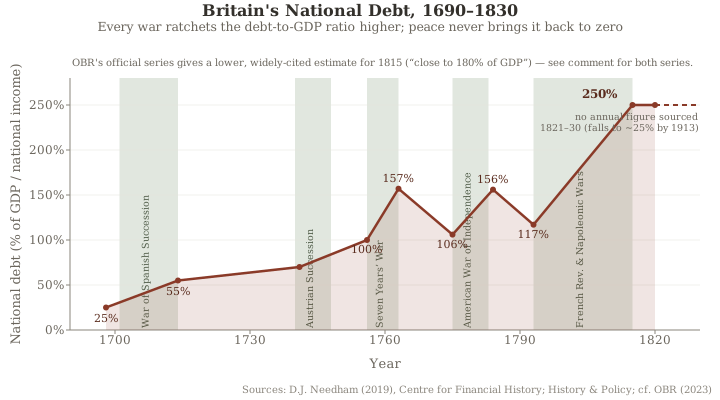
The fiscal-military state's capacity was built to fund armies and navies. The whole apparatus — the excise, the Bank, the funded debt — was a war machine. The nineteenth and twentieth centuries redeployed the fiscal-administrative apparatus the war-state had already built, turning it inward toward peacetime functions, taxing income, insuring citizens, and in a handful of countries, coordinating an economy’s industrial transformation. What changed was the purpose.
Where this rung leaves us
The fiscal-military state added public credit to the tax state, and the credibility that made the credit cheap was an institutional achievement, the Glorious Revolution settlement that tied the Crown’s hands and so made its promise to repay believable. This is the rung where state capacity became the ability to mobilize future resources. What survives for the thread: the states that would later fund development had already learned to borrow against tomorrow on the strength of credible institutions, and the apparatus built for war was the capacity development would inherit. The co-evolution runs deeper here. The very institutions that made the state credible (parliamentary purse-control, independent courts, secure property) are the same inclusive institutions that Stage 4’s framework will argue are what make state capacity enabling. The North-Weingast story of England’s tied hands is, in this sense, an early chapter of the institutions-and-development argument; the live version of that question is walked in Why are some countries rich and others poor?
For two centuries this enormous fiscal capacity was built and spent on war. Then, in the nineteenth and twentieth centuries, states turned it inward, taxing income, insuring citizens against poverty and old age, and in a handful of countries after 1945, doing something no state had deliberately done before: engineering an economy’s transformation from the top down.
The revenue and developmental state
“In states that were late to industrialize, the state itself led the industrialization drive, that is, it took on developmental functions. The Japanese case is the archetype: MITI did not merely regulate the economy; it set out to remake it.”
— after Chalmers Johnson, MITI and the Japanese Miracle: The Growth of Industrial Policy, 1925–1975 (1982)
The twentieth century turned the war-state’s fiscal capacity inward. First it taxed income and insured citizens, the revenue and welfare state. Then, in a handful of countries after 1945, it did something new: it deliberately steered an economy’s industrial transformation. Was the East Asian developmental state a real thing, a distinct state-form that coordinated growth, or were the miracles just markets working while the state mostly stayed out of the way?
Two parts, unequal in weight. The revenue state is the lower-stakes half: the income tax (made permanent in Britain in 1842, established in the United States in 1913 with the Sixteenth Amendment) gave the state a broad, elastic, progressively scalable revenue base, and the welfare state — Bismarck’s social insurance in the 1880s, the postwar Beveridge expansion — turned that fiscal capacity to social provision. This is the war-state’s apparatus, redeployed: the same machinery that once funded armies now funded pensions and unemployment insurance.
The higher-stakes half is the developmental state. This is a state-form with high bureaucratic capacity, a meritocratic economic bureaucracy with enough autonomy to resist short-term political capture, deployed for industrial coordination: directing credit to priority sectors, guiding investment through “administrative guidance,” and disciplining the firms it helped by tying support to performance in export markets. Peter Evans named the condition that separates success from disaster: embedded autonomy. The bureaucracy must be autonomous enough to avoid being captured by the businesses it directs, and embedded enough in business networks to get the information and cooperation it needs. Autonomy without embeddedness produces a predatory state that extracts; embeddedness without autonomy produces a captured state that hands out favors.
The fiscal and tax-policy apparatus sits in Economics Ch 16 §16.7 (Ramsey Optimal Taxation); the developmental-state and state-capacity institutional framing is in Ch 18 §18.6 (Political Economy), with the state-capacity-as-growth-input angle in Ch 13 (Growth Theory). For the historical record: the nineteenth-century British income-tax and administrative expansion in Economic History Ch.7 (Industrial Revolution); the German late-developer and Bismarckian social-insurance state in Ch.8 (Industrialization beyond Britain); the welfare-state expansion and the East Asian miracles in Ch.14 (Postwar golden age and decolonization); and the Chinese developmental and state-capitalist extension in Ch.17 (China reform and the Asian century). For the intellectual ancestry — List’s national-economy tradition, the developmental state’s thought-lineage — see History of Economic Thought Ch.16 (Development economics) and the institutional adjacency in Ch.15 (Institutionalist tradition).
“The East Asian miracle proves what works: free markets, free trade, sound money, and a government that gets out of the way.”
— the market-fundamentalist reading of the miracles, in the spirit of the World Bank’s The East Asian Miracle (1993)
Was the East Asian miracle free markets, not the state?
The popular reading turns the fastest growth in history into a morality tale about getting government out of the way. The states that actually did the growing were doing the opposite of getting out of the way, and the honest account is harder than either slogan.
Did the state engineer the miracle, or just stay out of its way?
“Korea’s industrialization was the result not of getting prices right but of getting them deliberately ‘wrong’, the state set relative prices to spur investment in industries it had chosen, and disciplined the firms that received its largesse.”
— after Alice Amsden, Asia’s Next Giant: South Korea and Late Industrialization, 1989
The developmental-state case, argued at full strength by the scholars who built it, Johnson on Japan, Wade on Taiwan, Amsden on Korea, Evans on the general condition. These states picked sectors. They allocated credit below market rates to priority industries. They imposed “administrative guidance” that steered private investment. And they disciplined the firms they favored: support was conditional on hitting export benchmarks, on actually competing in world markets, so subsidies could not become a permanent entitlement. The coordination was load-bearing. It is how late industrializers compressed a century of catch-up into a generation. This is the strongest historical evidence that a high-capacity state can engineer development.
“The rapid growth of the East Asian economies is largely due to superior accumulation of physical and human capital, and to the ability to allocate resources to highly productive investments and to acquire and master technology. Interventions, where they worked, were those that were market-friendly.”
— after The World Bank, The East Asian Miracle, 1993
The market-friendly reading carries real weight. The World Bank study conceded that the East Asian states intervened heavily, but argued the growth was primarily driven by getting the fundamentals right: extraordinary savings rates, massive investment in education, macroeconomic stability, and openness to export markets. The interventions that succeeded, on this reading, were the market-conforming ones; the heavy-handed picks were as often costly as catalytic. And the deepest objection is about inference: the developmental-state thesis has a selection-and-attribution problem. We see the interventions that coincided with success and call them causal, but how do we know the coordination caused the growth rather than riding alongside fundamentals that would have delivered it anyway? Plenty of states tried industrial policy; almost none got these results. Maybe what the winners shared were the fundamentals.
Where this rung leaves us
The developmental state was a real, distinct state-form, the rung where state economic capacity became the capacity to steer industrial development. The East Asian states genuinely coordinated development through credit allocation and export discipline, and Evans’s embedded-autonomy condition explains why their coordination worked where so many other states’ industrial policy collapsed into rent-seeking: high bureaucratic capacity plus the narrow autonomy-and-embeddedness balance. But the market-friendly reading has a real point on attribution and selection, the fundamentals (savings, education, export orientation) were necessary, the market-conforming interventions worked best, and developmental-state coordination is not a recipe most states can run, because they lack the capacity and the balance it requires. The revenue state and the developmental state are the same rung’s two faces: the twentieth-century redeployment of fiscal-administrative capacity from war to peacetime, one face funding social insurance, the other funding industrial transformation. Whether capacity ends up steering an economy upward or merely bleeding it depends on the form the state takes, which is what Stage 4 formalizes.
So a high-capacity state can engineer development, under rare conditions. That raises the question that has organized development economics for forty years: if state capacity is what separates rich countries from poor ones, can we measure it, and does it cause development, or just come along for the ride?
State capacity and the modern frontier
“The state has been the most important actor in the most radical and uncertain investments, not just fixing markets, but actively creating and shaping them. The iPhone is a collection of technologies that were funded by the state.”
— after Mariana Mazzucato, The Entrepreneurial State (2013)
Forty years of development economics converged on an answer: state capacity — the ability to tax, enforce contracts, and provide public goods — is a determinant of whether countries get rich. But two complications sit on top of it. Capacity in the wrong hands extracts. And the live industrial-policy revival — CHIPS, the IRA, the EU and China’s state capitalism — is testing whether rich countries should re-acquire the developmental state’s coordinating capacity. (Whether the 2020s industrial-policy turn is justified as policy is its own contested question; the revival is this thread’s living frontier.)
The first of two modern formalizations is state capacity, as Timothy Besley and Torsten Persson framed it in Pillars of Prosperity (2011). They split it in two: fiscal capacity, the institutional ability to raise taxes broadly and efficiently, and legal capacity, the ability to enforce contracts and protect property rights. The key claims are that these capacities are investments — states build them up over time at a cost, choosing how much to invest — that they are complementary, and that together they co-determine development.
The second is the inclusive-versus-extractive institutions framework of Daron Acemoglu, Simon Johnson, and James Robinson, the colonial-origins papers (2001, 2002) and Why Nations Fail (2012). Inclusive institutions — broad property rights, constraints on the executive, broad participation — enable development; extractive institutions — concentrated power, expropriation — extract from it. Their canonical evidence is colonial: where Europeans settled in large numbers they built inclusive institutions; where disease made settlement deadly they built extractive ones to strip resources, and those institutional patterns persisted long after independence to shape who is rich and who is poor today. It is not the amount of state capacity alone that matters, but its form.
Besley and Persson treat capacity as a chosen investment. A state picks fiscal capacity $\tau$ and legal capacity $\pi$ today to raise expected output tomorrow, against investment costs $C(\tau)$ and $C(\pi)$, maximizing roughly:
$$\max_{\tau,\,\pi}\; \mathbb{E}\big[\,Y(\tau, \pi)\,\big] - C(\tau) - C(\pi)$$The returns to investing in capacity are higher when politics is cohesive, when whoever holds power expects the capacity to serve common interests rather than to be turned against them, and lower when politics is purely redistributive, a contest to capture the state’s machinery. That single condition is the formal face of the whole thread’s verdict: the same capacity is worth building, and worth deploying, only when the institutional form makes it enabling.
Can the state actually do things? Can it collect the taxes it levies, enforce the contracts it writes, deliver the services it promises? That ability has to be built, deliberately, over decades, and a state can choose to invest in it or let it wither. And whether building it is worth doing depends on who controls it and what they will use it for. A capable state in good hands is the engine of development. The same capable state captured by a narrow elite is the most efficient extraction machine ever invented. Capacity is necessary; what determines whether it helps or harms is the form of the state that wields it.
The AJR and Besley-Persson apparatus is walked in Economics Ch 18 §18.3 (The AJR Framework) and §18.4 (Extractive vs. Inclusive Institutions). The colonial-origins evidence, settler versus extractive colonies, sits in Economic History Ch.9 (Atlantic slavery and after) and Ch.10 (Imperialism and colonial economies); the contemporary state-capacity record in Ch.17 (China reform) and Ch.18 (Globalization); and the post-2008 and post-2020 industrial-policy revival in Ch.19 (The 2008 crisis and after). The thought-lineage, Veblen through to Acemoglu, is in History of Economic Thought Ch.15 (Institutionalist tradition); the public-choice skepticism the minimal-state tradition draws on (Buchanan and Tullock) is in Ch.14 (Public choice).
Two traditions, both at full strength, and one honest empirical dispute
The state-capacity and developmental tradition makes the affirmative case. Besley-Persson, the AJR framework, and the developmental-state record converge: weak states underdevelop, because without the ability to tax, enforce contracts, and protect property, the investment and exchange that growth requires cannot be sustained. State capacity is a first-order determinant of development. The inclusive-institutions configuration is what makes that capacity enabling. And the industrial-policy revival, on this reading, is the justified re-acquisition of a coordinating capacity that the developmental states demonstrably wielded to good effect. The state’s economic role, in this tradition, is large, the engine of prosperity.
The minimal-state tradition answers. Its classical statement is Adam Smith’s “duties of the sovereign”: defence, justice, and a short, bounded list of public works the market will not provide. Its modern form is the public-choice and Chicago tradition, Buchanan and Tullock on how the machinery of the state gets turned to private advantage, Stigler and Becker on how regulators are captured by the very firms they regulate. State capacity is necessary and dangerous, because the same capacity that can coordinate development can be captured to extract. The industrial-policy revival, in this tradition, risks reproducing the failures — picking losers, entrenching rent-seekers, manufacturing politically immortal “infant” industries — that the handful of East Asian successes conveniently obscure. The state’s economic role should be the framework plus a narrow list, because every expansion of it is an expansion of what can be captured.
There is also one live empirical dispute: the AJR thesis that institutions are the first-order cause of development is itself contested, and honestly so. Jeffrey Sachs argues geography does heavy lifting the institutions story ignores — tropical disease burden, soil, distance from markets. Joel Mokyr and Deirdre McCloskey argue culture and ideas — a “culture of growth,” a new dignity for commerce, carry weight institutions alone cannot explain. And the AJR identification has been challenged on its own terms: David Albouy (2012) showed the settler-mortality data underpinning the famous instrument is fragile, the numbers patched together from inconsistent sources. The thread commits to the claim that institutions and state capacity are a first-order determinant, the weight of the evidence and the whole arc point that way, while naming, plainly, that how much they explain relative to geography and culture is not settled, and that one of the field’s signature instruments is under fire.
Where the whole thread leaves us
State economic capacity, traced from the tribute state’s extraction, through the fiscal-military state’s credit, through the developmental state’s steering, to the modern formalization of state capacity, is a genuine determinant of development that co-evolved with it. Four commitments hold the verdict together. One: capacity matters, weak states underdevelop, and the ability to tax, enforce, and protect is a first-order input to growth. Two: the form determines whether capacity enables or extracts, the inclusive-versus-extractive distinction matters, because high capacity in extractive hands is the predatory state that bleeds an economy, and over-extractive states fail just as surely as incapable ones. Three: the fiscal-military origins explain how the enabling states got their capacity in the first place, war forged the apparatus, credible institutions made it cheap to wield, and development inherited it. Four: the industrial-policy revival is the live frontier, the developmental record says coordinating capacity can work, but it is not a portable recipe, because it depends on the bureaucratic capacity and the embedded-autonomy balance that most states lack.
Two questions stay open, deliberately. The first is empirical, the AJR institutions thesis itself: institutions and state capacity are first-order, but their magnitude relative to geography and culture is a live dispute, and the settler-mortality instrument is contested. The second is political-philosophical, the minimal-state-versus-developmental disagreement about how large the state’s economic role should be. The thread commits to the empirical claim that high-capacity inclusive states have historically enabled development, while holding the minimal-state warning — that capacity is dangerous, that capture is real, that every expansion of the state expands what can be seized — as a genuine constraint. The state is neither the night-watchman of the minimal frame nor the omnicompetent planner of the command frame. It is the capacity-builder whose form determines whether the capacity it builds enables or extracts, and that capacity has a five-thousand-year history, of which the live industrial-policy debate is only the latest chapter.
The thread, in one arc
The economic role of the state moved through four state-forms, each adding a capacity the previous one lacked:
- The tribute and redistributive state. The granary economies of Mesopotamia, Egypt, and the Inca coordinated economic life by extracting and reallocating a surplus, a real coordination technology, while Tilly’s war-and-state co-evolution forged systematic fiscal capacity in Europe. The state learned to extract.
- The fiscal-military state. Early-modern Europe, and England above all after 1688, built the tax state and the public-credit revolution, a funded national debt made cheap by credible institutions that tied the Crown’s hands. The state learned to borrow, mobilizing the future.
- The revenue and developmental state. The twentieth century turned the war-state’s capacity inward, income tax and social insurance, and in East Asia, the developmental state’s deliberate coordination of industrial transformation under the embedded-autonomy condition. The state learned to steer.
- The state-capacity frontier. Development economics formalized state capacity as a measurable determinant of growth, the inclusive-versus-extractive distinction as what decides whether capacity enables or extracts, and the industrial-policy revival as the live edge of the whole question. The state learned to measure itself, and to argue, again, over how much capacity it should have.
The verdict the arc earns is co-evolution. State economic capacity and development grew together, each enabling more of the other. War built the apparatus; credible institutions made it cheap to wield; peacetime redeployed it toward growth; and the form of the state, inclusive or extractive, decided, at every rung, whether the capacity it built enabled its economy or bled it. That is why the same word, “state capacity,” describes both the engine of the East Asian miracle and the machinery of the predatory state: capacity is necessary, but its deployment is what matters.
This walkthrough carried the long-run history of state economic capacity, the spine that an era-by-era textbook scatters across a dozen chapters. The specific live debates that grow out of it have their own homes. Whether the 2020s industrial-policy turn is justified, whether the markets-versus-states binary is even the right frame, whether the welfare state is sustainable, how China’s and the USSR’s planned states actually compared, how a predatory state like Venezuela’s collapses, each is its own walkthrough, and each rests on the formation history walked here.