Is dollarization good economics?
A country with a wrecked currency elects a man who pledges to abolish its central bank and adopt the US dollar. Salvation, or a straitjacket nobody can take off?
Voir comme graphe de débatThe salvation pitch

“The central bank is the worst garbage that exists on this Earth. The solution is to dollarize and shut it down.”
— after Javier Milei, presidential campaign, 2023
In 2023 Argentina elected a president who campaigned on a chainsaw and a promise: burn down the central bank and replace the peso with the US dollar. To most of the world this sounded like a stunt. To Steve Hanke, who has spent two decades telling chronic inflators to dollarize, it sounded like the first sensible monetary policy Argentina had proposed in seventy years. We are not here to re-litigate Argentina’s exact case; the Argentine chronology has its own walkthrough. The question here is broader and colder: is dollarization good economics, for what kind of country, and at what price?
Strip away the chainsaw and the salvation case rests on one idea: a government with a long enough record of printing money to cover its deficits cannot fix the problem by promising to stop. It has a credibility problem. Even an honest reformer inherits the lies of every predecessor. Markets and citizens have watched the promise be broken before, so inflation expectations stay high, the reformer is forced to keep printing to service the consequences, and the promise defeats itself. Economists call this time inconsistency. The government always has a future incentive to break the rule it announced today, and everyone knows it.
The escape is a commitment device, something that removes the government’s own ability to break the promise. And dollarization is the strongest commitment device a monetary economy can adopt. By abolishing the domestic currency outright, the government makes printing money physically impossible. The country imports the Federal Reserve’s credibility wholesale, in a single irreversible move.
Read it off the government’s budget constraint. A government finances its deficit three ways, taxes, borrowing, or money creation:
$$G - T = \Delta B + \Delta M$$Dollarization sets the inflation-tax term $\Delta M = 0$ permanently. The deficit must now be closed by real taxes or real borrowing; the discipline is built into the arithmetic.
A government that can print money will always be tempted to print money, and everyone, knowing that, refuses to trust its currency. Dollarization takes the printing press away for good. You can no longer cheat, so people finally believe you won’t.
This is why the commitment framing belongs to the institutional-economics tradition. An external anchor substitutes for the domestic institutional credibility a country lacks. The formal home of the commitment-device argument is Ch 18 §18.2 (New Institutional Economics); the time-inconsistency problem and the inflation bias it generates are in Ch 16 §16.2, and the budget-constraint substrate is §16.3.
“A central bank run by a sovereign government with a history of fiscal indiscipline cannot be trusted. The only durable fix is to take money out of the politicians’ hands entirely.”
— after Steve Hanke, Johns Hopkins / Cato Institute
Does only an external anchor close the discipline gap?
Hanke and the early Milei make a claim that sounds extreme until you do the arithmetic: for a country that has broken its fiscal promises for seventy years, “just be disciplined” is not a policy. Only an irreversible external anchor is a commitment markets will believe.
Import the credibility, or build it?
“Dollarization is the ultimate monetary reform. It removes the exchange rate as a policy variable and, with it, the temptation that has wrecked one currency after another.”
— after Steve Hanke, in the currency-board and dollarization tradition
Hanke is the leading voice of the “tie your hands” tradition, and that tradition has a lineage. It descends from Milton Friedman’s case for monetary rules over discretion, the argument that a fixed, automatic rule beats the judgment of central bankers because judgment can be captured, pressured, and wrong. The currency-board and dollarization wing took that logic to its limit. The most automatic rule is no domestic money at all. You can see the whole rules-over-discretion line in the monetary-lineage view of the timeline, where the monetarist counter-revolution branches into the hard-money positions Hanke now represents.
“Credibility can be built at home. An independent central bank and a credible fiscal anchor deliver low inflation without surrendering the tools a country needs when the next shock arrives.”
— the mainstream monetary-policy view
The mainstream answer is that the commitment problem is real but the solution is too blunt. Independence and a fiscal rule, properly designed, can import the same credibility without amputating the central bank; dozens of countries built durable low inflation that way without giving up their currencies. The live crux is whether that domestic path is actually open to a country like Argentina, or whether seventy years of failure is itself the evidence that it is not. Both sides agree on the diagnosis. They disagree on whether the patient can be trusted to take the medicine, or has to be locked out of the cabinet.
Where this leaves us
The commitment-device logic is sound. A country with destroyed monetary credibility cannot fix the problem by promising harder, and dollarization imports credibility by removing the printing press entirely. That is the case for, and it is stronger than the chainsaw makes it look. But a commitment that strong carries a cost that is invisible in calm years and brutal in a crisis. To see it, we have to ask what the dollar actually buys a chronic inflator, and then what it makes that country surrender.
Hanke isn’t bluffing, countries have actually done this, and some of them have done well. Before we count the costs, let’s count the wins. Ecuador, Panama, and El Salvador have lived on the dollar for years. What does the record actually show?
What dollarization buys
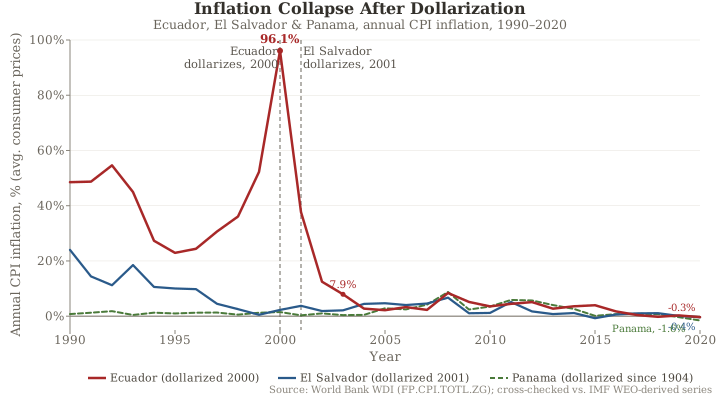
“We dollarized in the middle of the worst crisis in our history, and within a few years inflation simply stopped being a political issue. People could save again.”
— Ecuadorian policy advocate, on the 2000 adoption
Ecuador dollarized in 2000 with inflation near 100 percent. Within three years it was in single digits and it has stayed there for two decades. Panama has used the dollar for a century and never had a hyperinflation. The salvation case has a track record. The question is what that record actually proves, and for whom.
To read the record, you need the spectrum dollarization sits on. Exchange-rate regimes line up on a single continuum that trades monetary autonomy for imported credibility. At one end is a free float, where the currency moves with the wind and the central bank keeps every tool. Then a managed float, a crawling peg, a hard peg, a currency board, and at the far corner, full dollarization, where the country keeps no monetary autonomy at all and imports the maximum credibility, irreversibly.
The most instructive neighbor on that spectrum is the currency board (Argentina 1991–2001, Hong Kong today). A currency board keeps the domestic currency but pegs it one-to-one to the anchor and backs it fully with reserves. It looks almost as hard as dollarization, and it is softer in one way that matters. It is reversible. The domestic notes still exist, so a future government can break the peg, and because markets know that, they keep pricing the abandon-option. The credibility import is real but incomplete. Dollarization closes that last gap by removing the domestic currency entirely; there is no peg to abandon. The whole regime spectrum is laid out in Ch 17 §17.2 (Exchange Rate Determination).
What does the maximum-credibility corner actually deliver? Three things, all visible in Ecuador and Panama. The inflation tax ends overnight, because there is no money to print. A stable nominal anchor lets contracts, savings, and credit markets re-form in a unit people trust (the thing a chronic inflator loses first and misses most). And country risk falls as the devaluation-risk premium disappears, which pulls down borrowing costs across the economy.
There is one cost to flag now and cash later. Issuing currency is profitable. The difference between the face value of the money and the near-zero cost of producing it is real revenue, called seigniorage. A dollarized country hands that revenue to the US Treasury, which prints the dollars it uses. Ecuador, El Salvador, and Panama all pay this. It is a genuine fiscal cost, and we will put a number on it in Stage 3.
“The dollarization debate is over in the countries that did it. Ecuador and El Salvador have low inflation, and no serious politician proposes going back.”
— after Steve Hanke, on the precedent record
Does the precedent record prove it works?
Two decades of single-digit inflation in Ecuador, a century of stability in Panama, a crisis-free adoption in El Salvador. The pro-dollarization claim is simple: this isn’t theory, it’s a record. So why doesn’t everyone do it?
A proven cure, or three lucky patients?
“Where the domestic currency has failed, imported stability is not a second-best compromise. It is the decisive gain, and the data from the countries that adopted it are unambiguous.”
— the credibility-import case
The pro-dollarization reading takes the record at face value and dares the skeptic to name a country that dollarized and regretted it on inflation grounds. There isn’t one. The regional backdrop makes the case sharper. Latin America’s currencies were destroyed in the debt crises and stabilization failures of the 1980s, the era of lost decades narrated in History Ch.16 (Stagflation and the neoliberal turn). Against that history, importing a currency that simply works is the most conservative thing a wrecked monetary system can do.
“Ecuador, Panama, and El Salvador are special cases. Most of Latin America is not an optimum currency area with the United States, and the costs of pretending otherwise show up later, not sooner.”
— the optimum-currency-area skeptic
The skeptical reading does not deny the wins, it questions the sample. Three small, US-tied economies that have not yet met an asymmetric shock are weak evidence for a large, diversified economy that will. And there is a deeper dependency the cheerful chart hides. The credibility a country imports is only as good as the anchor currency staying dominant. Bind yourself to the dollar and you inherit the dollar’s fate, a risk explored in the walkthrough on whether the dollar’s reserve status is sustainable. The full apparatus behind “not an optimum currency area” is the next stage’s work; here it is only the warning.
Where this leaves us
What dollarization buys is real and it is not small. For a country whose own money has failed, the dollar imports a credibility the government could never build alone, and Ecuador and Panama prove it can hold for decades. But notice what every one of these cases has in common. They are small, open, and structurally tied to the US economy already. Whether they survive in a large economy that gets hit with a shock the dollar can’t absorb is the whole ballgame, and that is the cost side.
Every dollarized country has been lucky in one specific way. It hasn’t yet faced the shock that a floating currency would have absorbed and a borrowed one can’t. To see why that matters, we need the framework economists built for this question, the one that asks whether two economies should ever share a currency at all.
What dollarization costs
“A region should share a single currency only if it has the means to adjust to shocks that hit one part and not another, labor that can move, fiscal transfers that can flow, or prices that can fall. Lacking these, it needs its own currency, whose exchange rate can do the adjusting instead.”
— after Robert Mundell, A Theory of Optimum Currency Areas, 1961
Buenos Aires, December 2001. Crowds at shuttered banks during the corralito, when Argentina’s decade-old currency board collapsed. The hard external anchor held right up until the fiscal commitment beneath it failed, and then the rigidity that had imported credibility turned the failure into a catastrophe.
Mundell asked in 1961 when two regions should share a currency. His answer is the core argument against dollarization, and it is why most economists flinch at it. The visible demonstration is Argentina’s December 2001: a currency board that imported credibility for a decade, then shattered when a shock hit an economy with no way to absorb it. We treat that collapse as one exhibit; the Argentine case has its own walkthrough.
Stage 1 built the case for the straitjacket. This is the case against, and it has four parts. Take them in order of weight.
1. The optimum-currency-area objection (the heaviest). Mundell’s question was when two economies should share a currency, and his answer was: only when an asymmetric shock to one can be absorbed without moving an exchange rate between them. That requires one of three adjustment channels, labor that migrates from the shocked region, fiscal transfers that flow to it, or wages and prices flexible enough to fall (an “internal devaluation”). Latin America has essentially none of these with the United States: workers cannot freely move north, Washington sends no transfers south, and wages are sticky downward everywhere. So a country dollarized to the US must absorb any shock the US does not share — a fall in its commodity prices, say — through the one channel left: grinding internal deflation, meaning recession, unemployment, and wage cuts. A floating peso would have done that adjustment painlessly, by depreciating. Dollarization trades that automatic shock-absorber for a decade of imported calm.
Mundell’s criterion, compactly: a currency union is optimal for regions $i$ and $j$ when shocks are highly correlated, $\rho(\varepsilon_i,\varepsilon_j)\to 1$, or an adjustment channel (labor mobility $\mu$, fiscal transfers $\tau$, price flexibility $\phi$) is large enough to offset the residual. When $\rho$ is low and $\mu,\tau,\phi$ are all small (Latin America with the US), the optimal regime is an independent, flexible exchange rate.
If a bad year hits your exports, something has to give. A country with its own currency lets the exchange rate fall. The whole economy quietly gets cheaper overnight and exports recover. A dollarized country can’t do that, so the adjustment has to come out of wages and jobs instead. Same shock, far more pain.
2. The impossible trinity, cashed. A country can have at most two of three things: a fixed exchange rate, free capital flows, and an independent monetary policy. Dollarization takes the fixed rate and free capital flows and gives up monetary policy entirely. There are no countercyclical rate cuts in a recession, ever, because there is no domestic interest-rate instrument to cut.
The trilemma: of $\{$fixed rate, free capital mobility, monetary autonomy$\}$, choose at most two. Dollarization selects the first two and sets the third to zero.
3. The lost lender of last resort. When a banking panic hits, a sovereign central bank can create the currency its banks need to meet a run. That backstop is what stops a liquidity scare from becoming a collapse. A dollarized country cannot create dollars, so it has no domestic lender of last resort. Ecuador and Panama patch the hole with liquidity funds and reliance on foreign-parent banks, and those help, but they are weaker than a sovereign that can print. What you abolish when you abolish the central bank is exactly the power examined in the central-banks walkthrough’s treatment of the lender of last resort.
4. Lost seigniorage (cashed from Stage 2). The profit from issuing currency now accrues to the US Treasury, a permanent fiscal transfer abroad. It is modest in steady state but real and ongoing, and it is paid in good years and bad. The mechanism is detailed in the “What is money?” walkthrough and formally in Ch 16.
Seigniorage as the real revenue from money issuance: $S = \frac{\Delta M}{P}$. Dollarizing sets a country’s own $S$ to zero and transfers the flow to the currency issuer.
Now read Argentina’s 1991–2001 currency board against all four costs. The board imported credibility and held for ten years, then Brazil devalued in 1999, commodity prices turned, and a shock hit an economy that had no devaluation valve, no independent monetary policy, and a fiscal position it could no longer finance. The rigidity that had bought a decade of low inflation turned the adjustment into a depression and a default. An external anchor is not a substitute for fiscal discipline; when the fiscal discipline fails anyway, the rigidity makes the failure worse. The same mechanism is on older display in the 1930s gold standard, told in History Ch.12 (Interwar monetary collapse); the countries that left gold earliest recovered fastest.
The OCA framework sits in the postwar open-economy-macro tradition that runs through the postwar-synthesis and counter-revolution clusters of the timeline. Mundell’s 1961 paper is its origin node.
“Dollarization gives you a strong nominal anchor and takes away every instrument you would want when the anchor becomes the problem. It is insurance you can never cash.”
— after the optimum-currency-area tradition (Werning, Eichengreen)
Is dollarization a straitjacket?
The OCA tradition says surrendering the lender of last resort, monetary autonomy, and the devaluation valve all at once is categorically too costly. Argentina 2001 is the exhibit. Is the cost decisive, or only decisive if the alternative actually works?
A straitjacket, or the freedom to keep failing?
“A country that surrenders the lender of last resort, monetary autonomy, and the exchange rate has disarmed itself before the war starts. The costs are categorical, and they fall due exactly when you can least afford them.”
— after the Mundell-OCA mainstream (Werning, IMF research)
This is the profession’s center of gravity, and it is held with reasons. The mainstream reads Argentina 2001 as proof of concept for the OCA objection. A hard external anchor did not prevent the crisis; it amplified it. The position is that the discipline can be had more cheaply by fixing the institutions directly, keeping the tools you will need when the anchor itself becomes the problem. Why pay the OCA cost for a credibility you could build at home?
“You call it a straitjacket. For a country that has burned its currency to ash four times in a generation, the ‘flexibility’ you want to preserve is just the freedom to do it a fifth time.”
— after the salvation frame’s reply (Hanke, early Milei)
The salvation frame turns the OCA objection inside out. Yes, dollarization removes the devaluation valve, but for a chronic inflator that valve has been a faucet of disaster. The monetary “autonomy” the mainstream wants to protect is, empirically, the autonomy to inflate. The rules-over-discretion tradition that runs from Friedman through the currency-board school holds that for some countries, the rigidity is not a cost to be minimized but the entire point. Only an instrument you cannot misuse is safe in hands that have misused every other one.
Where this leaves us
Mundell’s framework is the real reason most economists are skeptical of dollarization. A country dollarized to the US has no way to absorb a shock the US doesn’t share except through recession and deflation, and Latin America shares almost nothing with the US business cycle. You lose the lender of last resort, you lose countercyclical policy, you lose the devaluation valve, and you hand your seigniorage to Washington. Argentina’s currency board showed how this ends. But the OCA cost only beats the alternative if the alternative works. For a country whose own currency has failed for seventy years, “keep your monetary autonomy” can mean “keep failing autonomously.” Which cost is bigger is a judgment about a specific country.
So we have two airtight arguments pointing opposite ways: imported credibility is a real gain, surrendered flexibility is a real cost, and both sides are right about their own half. The verdict can’t be “yes” or “no” in the abstract. It has to be: for whom, and compared to what?
The verdict: a second-best straitjacket
“The binding problem in Argentina is fiscal, and fiscal discipline is sufficient to solve it. Dollarization adds rigidity without adding solvency. If you can run the surplus, you don’t need the straitjacket; if you can’t, the straitjacket won’t save you.”
— after Iván Werning, in the mainstream first-best tradition
By mid-2025 Argentina had done the thing the mainstream said mattered (run a fiscal surplus for the first time in fourteen years) and disinflated sharply without dollarizing. Milei kept dollarization on the table but didn’t pull the trigger. The mainstream economist reads that as proof he didn’t need to; the dollarization advocate sees a discipline gap still open, one election away from reopening. Both are looking at the same data. The Argentine case is tracked in its own walkthrough; here it is one exhibit in the policy verdict.
The first-best: fix the institutions directly. The mainstream position is that you can import the same credibility without amputating the central bank. A credible fiscal surplus plus a genuinely independent central bank kills inflation and keeps the devaluation valve, the lender of last resort, the monetary autonomy, and the seigniorage. You get the gain without the OCA cost. The commitment-device machinery behind this is in Ch 18 §18.2. An external anchor is one way to solve a credibility problem, but it is the most expensive way, and it is reserved for the case where the cheaper ones are foreclosed.
The historical demonstrations. Two cases settle that the first-best is achievable. Brazil’s 1994 Real plan ended more than thirty years of high inflation through a fiscal-anchored stabilization — a transitional indexed unit of account, then constitutional fiscal-responsibility reforms — with no dollarization. Mexico’s 1995 recovery from the Tequila crisis came through fiscal stabilization plus an IMF package plus a floating peso that absorbed the shock rather than transmitting it into the labor market. Both killed inflation; both kept their currencies; both are narrated against the regional backdrop in History Ch.16 (Stagflation and the neoliberal turn).
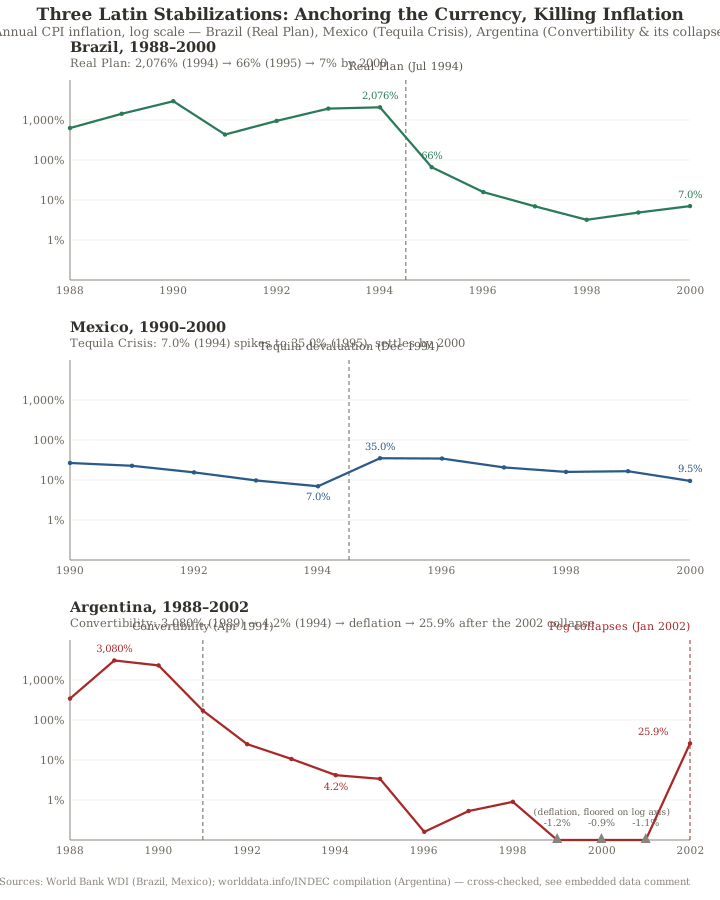
The second-best logic. So where does dollarization earn its keep? Precisely where the first-best is politically impossible, where the country’s institutional context cannot sustain a fiscal rule without an external straitjacket holding it in place. There the trade looks different. You give up the OCA flexibility you would have kept under the first-best, in exchange for a commitment you cannot otherwise obtain. That trade is good economics only when three conditions hold together: destroyed monetary credibility, no political path to the domestic fix, and a real economy synchronized enough with the US to bear the OCA costs. Ecuador met the first two. Whether any large economy meets the third is the open question Stage 2’s wins could not close.
“The first-best is a credible fiscal surplus and an independent central bank, not a straitjacket. Dollarization is what you do when you’ve given up on being able to govern your own money.”
— after the mainstream first-best view (Werning, IMF research)
Should you just fix the fiscal instead?
Brazil and Mexico killed inflation without dollarizing and kept every tool. The mainstream says that’s the answer. The catch: it assumes a political path that some countries provably do not have.
Fix the institutions, or lock them out?
“Argentina ran a surplus and inflation fell. That is the proof: the constraint was always fiscal. Solve the fiscal problem and the monetary problem solves itself, no need to give up the central bank.”
— after Iván Werning and the mainstream, 2024–2025
The mainstream reads mid-2025 Argentina as a live vindication. The surplus came, the inflation fell, and the central bank still exists with all its tools. If discipline can be demonstrated without dollarizing, then dollarizing was never necessary; it would only have added the OCA rigidity for no extra solvency. This is the first-best happening in real time, and it is the answer to Hanke: you said it couldn’t be done at home, and it is being done at home.
“One surplus is not credibility. Argentina has run surpluses before, then reversed them. Until the discipline is irreversible, it is one election away from being undone, which is exactly the gap dollarization was meant to close.”
— after Steve Hanke and the salvation frame, 2024–2025
The salvation frame is unmoved by one good year. Its entire argument is about irreversibility. A surplus that a future government can reverse is not the same kind of commitment as a currency a future government cannot reprint. The discipline gap is not whether Argentina can run a surplus once, it can, but whether it can be trusted to keep running one across the next administration and the one after that, when the present resolve has spent itself. On the rules-over-discretion logic that runs from Friedman through the currency-board school, the only credible answer to “will you defect later?” is to make defection impossible. Both readings look at the same surplus. One sees a cure; the other sees a remission.
The verdict
What dollarization buys is real but narrow. It imports monetary credibility wholesale and durably, proven by Ecuador and Panama, and that is a genuine gain for a country whose own money has failed. What it costs is real and shows up in the next asymmetric shock. The lender of last resort, monetary autonomy, the devaluation valve, and the seigniorage go at once, dormant in calm years and acute in a crisis. The mainstream first-best is to fix the fiscal-monetary institutions directly. Brazil 1994 and Mexico 1995 show it can be done without dollarizing, and where it is available it dominates on every axis.
Whether the straitjacket is worth it is contested at the frame layer. The salvation frame holds that for a country with a seventy-year fiscal-promise-then-break record, the rigidity is the point; only an irreversible anchor closes the discipline gap. The rigidity frame holds that the OCA costs are categorically too high relative to the achievable first-best, and that dollarization fails catastrophically when the fiscal commitment fails anyway; Argentina 1991–2001 is the warning. This is a frame-level split. It resolves on a single checkable parameter, country-circumstance: destroyed monetary credibility, no political path to the domestic fix, and a real economy synchronized enough with the US to bear the OCA costs.
Dollarization is good economics for a narrow class of countries, those whose monetary credibility is destroyed and whose politics foreclose the fiscal-institutional first-best, and costly economics everywhere else. It is a straitjacket the mainstream prefers to avoid by fixing the institutions directly, and it earns its keep only when fixing them directly is off the table. For the deeper apparatus, the live Argentine case sits in the Argentina 2023 walkthrough; the power you abolish when you abolish the central bank is in the central-banks walkthrough; and the international-monetary-system depth — reserve status, seigniorage, de-dollarization — is in the walkthrough on the dollar’s reserve status.
Where this leaves us
- The salvation pitch. A country with a wrecked currency cannot fix the problem by promising harder; it has a credibility problem, and dollarization is the strongest commitment device there is, because it makes printing money physically impossible.
- What it buys. Imported credibility is real and durable. Ecuador, Panama, and El Salvador ended monetary disorder for decades. But every winning case is small, open, and US-tied; the wins may not generalize to a large, unsynchronized economy.
- What it costs. The optimum-currency-area objection: no devaluation valve, no lender of last resort, no monetary autonomy, and lost seigniorage, dormant in calm years, brutal in the first asymmetric shock. Argentina 2001 is the demonstration.
- The verdict. A second-best commitment device. Good economics only for countries with destroyed credibility, no political path to the domestic fix, and enough US-synchrony to bear the OCA cost. Calibrate by country-circumstance.
We started with a chainsaw and a slogan: abolish the central bank, adopt the dollar. Dollarization does exactly one thing (it imports a credible currency by surrendering your own), and it does it irreversibly. For a country whose money already works, that surrender is a needless amputation, and the optimum-currency-area framework explains why the bill comes due in the next shock. For a country whose money has failed for seventy years, the same irreversibility is the only commitment markets will believe. Both halves are true. The discipline is to know which half a given country is in.
The verdict depends on a named, checkable parameter: destroyed credibility, no domestic-fiscal path, and real-economy synchrony with the anchor. Brazil and Mexico killed inflation without dollarizing because the first-best was open to them. Ecuador dollarized because it was not. The next time someone tells you dollarization is either the obvious fix or an obvious folly, you have the tools to ask the only question that settles it: for whom, and compared to what?