Is competition a state of the market or a process?

Look at one dominant firm with fat margins. One economist sees failed competition. Another sees competition working exactly as it should. They are not arguing about the data. They are arguing about what “competition” means.

以辩论图谱查看
Stage 1 of 4

The market as equilibrium

“The agencies will presume that a merger may substantially lessen competition when the merger would significantly increase concentration in a highly concentrated market.”

— U.S. Department of Justice & Federal Trade Commission, 2023 Merger Guidelines, Guideline 1

A number does the deciding here. Measure how concentrated the market is, compare it to a threshold, and the law presumes harm. This is not a relic of a dustier era of antitrust — it is the live apparatus the United States rebuilt its merger enforcement around in 2023. Behind that number is a complete theory of what competition is: a state of the market you can measure at a point in time. Get the measurement right and you know whether competition is present or absent. The whole discipline of industrial organization runs on this picture. Before we question it, we should inhabit it — because on the questions it was built to answer, it works.

Start where every textbook starts: perfect competition. Many firms, each too small to move the price, all selling an identical good, with free entry and exit. No single seller has any power over the market price; each takes it as given. In long-run equilibrium, price equals marginal cost, and economic profit is driven to zero — any rent above the competitive return invites entry until it disappears. This is not a description of any real market. It is a limiting condition, a benchmark. Competition, in this frame, is the distance from that benchmark, and the benchmark is precise enough to measure against.

Monopoly is the deviation. A single seller facing a downward-sloping demand curve restricts output to push price above marginal cost, capturing a profit and leaving a wedge of forgone trades — the deadweight loss. Between the two poles sit the oligopoly cases that occupy most of the real economy: a handful of firms, each large enough to matter, choosing quantities (the Cournot story) or prices (the Bertrand story) while watching one another. The whole spectrum — from price-taking competition through strategic oligopoly to monopoly — is parameterized by how much power a firm has to move price away from cost.

To turn that spectrum into evidence you can put in front of a court, you need a measurement. The Herfindahl-Hirschman Index sums the squared market shares of every firm; it runs from near zero (atomistic competition) to 10,000 (pure monopoly). The structure-conduct-performance paradigm built an entire empirical research program on the premise that this kind of structural measurement predicts behavior: concentrated markets produce higher prices and higher margins, so structure is the thing to watch. The 2023 Merger Guidelines are the descendant of that program — a concentration threshold that triggers a legal presumption. The framing is operational, and it has been operationalized.

The Herfindahl-Hirschman Index is the sum of squared percentage market shares across the $n$ firms in a market:

$$HHI = \sum_{i=1}^{n} s_i^2 \qquad s_i = \text{firm } i\text{'s market share}$$

In a symmetric Cournot oligopoly with $n$ firms, constant marginal cost $c$, and linear demand $P = a - bQ$, each firm produces $q = \frac{a-c}{b(n+1)}$, and the equilibrium price is

$$P^* = \frac{a + nc}{n+1}$$

As $n \to \infty$, price falls to marginal cost $c$ and the markup vanishes — the competitive limit. As $n \to 1$, it collapses to the monopoly price. The whole apparatus lives on this continuum, and HHI is the scalar that locates a market on it.

直觉模式

Picture a wheat market with ten thousand farmers. No single farmer can charge a penny more than the going rate — buyers would just go next door. The farmer is a price-taker: the market sets the price, and the farmer accepts it. That powerlessness is competition in this frame. The more sellers, the less power any one of them has, and the closer the market sits to the ideal where no one can push the price around. To ask “how competitive is this market?” is to ask “how close is it to that powerless state?” — and that is a question you answer by counting and measuring.

The formal home of this apparatus is the microeconomics core. Perfect competition and its long-run equilibrium, the monopoly deviation, and the Cournot oligopoly mechanics are worked out in the market-structures chapter; the welfare-theorem grounding — why the competitive equilibrium is the efficiency benchmark in the first place — sits in advanced micro. The intellectual lineage of this picture runs from Marshall’s partial-equilibrium scissors through the marginalist formalization, and its twentieth-century game-theoretic machinery (Bain through Stigler and Demsetz to Tirole) lives in the thought-graph chapter on the game-theory revolution.

观点

“Perfect competition is a model, an abstraction... Its importance derives from the fact that it provides a benchmark against which the performance of actual markets can be evaluated.”

— Jean Tirole, The Theory of Industrial Organization, MIT Press, 1988

Why we still teach perfect competition

No real market is perfectly competitive — not one. So why does every economist still reach for a model of a market that has never existed? Because the critics and the defenders are answering different questions, and only one of them is the question the model was built for.

The benchmark and the alternative it cannot see

“The standard of perfect competition is the benchmark of allocative efficiency... a market is performing well to the extent that price is close to marginal cost.”

— Jean Tirole, The Theory of Industrial Organization, 1988

Tirole is stating the discipline’s working definition, and stating it as a practitioner, not an apologist. Competition is a property of a market structure — you read it off the gap between price and marginal cost, and that gap is what the whole empirical machinery of industrial organization is built to estimate. This is the apparatus a Nobel-laureate theorist of market power actually uses. It is not a strawman. It is the mainstream, and it earns its place by answering its questions precisely.

“Competition is by its nature a dynamic process whose essential characteristics are assumed away under the assumptions underlying static analysis.”

— Israel Kirzner, Competition and Entrepreneurship, University of Chicago Press, 1973

Kirzner is not, here, the right answer — the next stage will inhabit his framing in full. He is the marker that an alternative exists. His charge is that the equilibrium picture defines competition by the very thing competition is supposed to produce: a settled state with no power to move price. Measure the resting point, and you have measured the place where the rivalry has already finished. What you have not measured is the rivalry itself. Hold that thought. Stage 1 is right that the benchmark answers its questions; Stage 2 asks whether those are all the questions.

Where this leaves us

The state framing is what modern industrial organization actually does, and on the work it was built for it does it well. Short-run welfare loss, merger-driven price effects, market-definition tests in court — these are real questions with real answers, and the equilibrium apparatus delivers them with a precision no rival framing matches. The 2023 Merger Guidelines are not a confusion to be cleared up; they are this framing operating at full power. The open question is not whether the apparatus works. It is whether the snapshot it measures is the whole of what we mean by competition — or only the part that holds still long enough to be measured.

The benchmark assumes the equilibrium exists — that markets gravitate toward a stable resting point you can locate and measure. But what if the resting point is the wrong object entirely? What if competition is not a state markets reach but a process markets do — and the fat profit the snapshot flags as failure is the very signal that keeps the process running? That alternative has its own school, its own apparatus, and its own verdict on the same firms.

Stage 2 of 4

The market as discovery

“The opening up of new markets... and the organization of production... incessantly revolutionizes the economic structure from within, incessantly destroying the old one, incessantly creating a new one. This process of Creative Destruction is the essential fact about capitalism.”

— Joseph Schumpeter, Capitalism, Socialism and Democracy, ch. 7, 1942
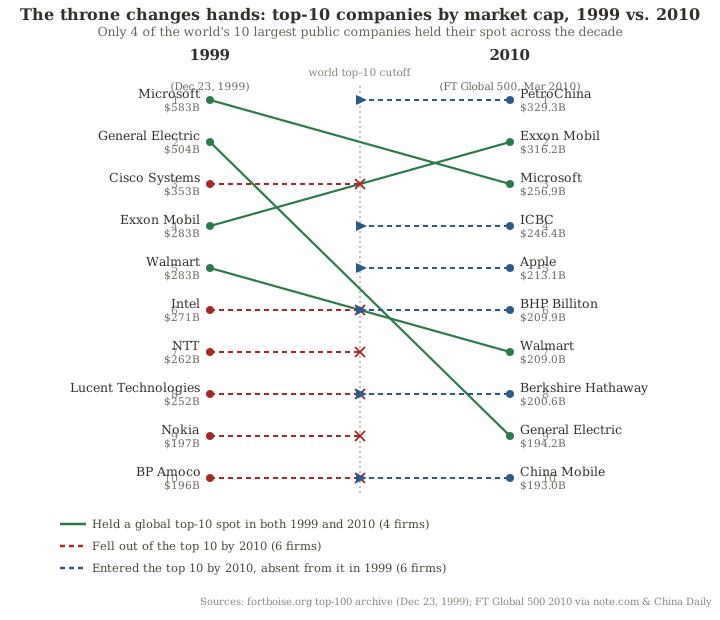
The most valuable companies of 1999 — Microsoft, GE, Cisco, Walmart, Intel, Lucent, IBM, AOL, Nokia. The most valuable of 2010 — Exxon, Apple, Microsoft, Berkshire, GE, Walmart, Google, Chevron, IBM, P&G. Half the throne changed hands in a decade. Cisco, Lucent, AOL, and Nokia, untouchable at the peak of the dot-com boom, were displaced or destroyed. The process framing’s central empirical claim, in one before-and-after: the dominant firm of one decade is not the dominant firm of the next.

Schumpeter is describing something the snapshot cannot hold. The equilibrium framing freezes the market and counts; this framing watches the market move. Its central claim is that what looks, in a single year, like high-concentration monopoly may be, across a decade, one of the most competitive arrangements there is — because the dominant firm knows it is being hunted, and the hunt is the competition. Whether that pattern still holds for today’s platform giants is Stage 3’s problem. First, the apparatus.

Hayek named the move in 1946. Competition, he argued in “The Meaning of Competition,” is a procedure for discovering facts that no one possesses in advance — which goods consumers will want, which methods will produce them cheaply, what they should cost. The equilibrium model assumes those facts are already known and the firms have already optimized against them; it then calls the result “competition.” But that, Hayek said, defines competition by assuming away everything competitive activity actually does. Rivalry is the search. The equilibrium is where the search would end if it ever stopped — and it never stops, because the facts keep changing.

Kirzner, in 1973, gave the searcher a face: the entrepreneur. An entrepreneur is alert to a gap — a price that is too high, a demand no one is serving, a way to make the same thing for less — and acts on it before anyone else notices. That act of noticing-and-acting is competition. It is what drives a market toward coordination it never quite reaches, because every act of alertness reshapes the landscape the next entrepreneur is scanning. In this frame, monopoly does not mean “one large firm.” It means the foreclosure of entry — a legal barrier, a coercive cartel — that stops the alert outsider from acting. A large firm earning fat profits in an open market is not a monopoly in Kirzner’s sense. It is a flashing signal to every entrepreneur watching.

Schumpeter completed the picture and made it macroeconomic. The competition that counts is not price-shading among incumbents but the gale of new products, new technologies, new forms of organization that arrives from outside and lays waste to whole industries. And here is the inversion that breaks the state framing: monopoly profit is the prize. The expectation of a temporary monopoly is what funds the research, justifies the risk, and rewards the firm that disrupts. Strip the prize away to enforce the price-equals-marginal-cost ideal at every instant, and you defund the very process that produces the next disruption. The monopolist of one decade is the deposed firm of the next precisely because the profits it earns advertise the territory worth conquering.

Aghion and Howitt formalized the trade-off in a growth model where innovation is itself the competitive act. In sketch:

  1. A successful innovation hands its creator a temporary monopoly worth a flow of profit $\pi$ until the next innovation arrives and destroys it — creative destruction made literal.
  2. The arrival rate of innovations rises with research effort, and research effort rises with the size of the prize $\pi$: bigger expected monopoly rents draw more entrants into the innovation race.
  3. So there is a genuine trade-off the static model cannot represent: a higher $\pi$ means more static distortion now (price above marginal cost during each firm’s reign) but a faster arrival of the disruptions that raise long-run growth. Competing the rent to zero at every instant maximizes static surplus and minimizes the engine of dynamic change.
直觉模式

Imagine the corner store and the firm that has not been founded yet. The state framing asks who competes with the corner store today — the shop across the street, maybe a second one down the block — and measures the rivalry between them. The process framing says the real competitor is Amazon, or the company that will be Amazon in ten years, which does not yet exist and is not in anyone’s concentration measure. Competition, here, is mostly invisible at any single moment: it is the pressure of the entrant who has not arrived, kept alive by the profit the incumbent is currently enjoying. You cannot count it. You can only watch for it.

The growth-theoretic apparatus for this — endogenous innovation, the Aghion-Howitt model, the static-versus-dynamic trade-off — lives in the growth-theory chapter. The dispersed-knowledge problem that grounds Hayek’s claim, and its formal descendant in mechanism design, sits in the mechanism-design chapter. The intellectual lineage runs through the Austrian tradition — Menger to Mises to Hayek and Kirzner — and Schumpeter, who earns his own chapter in the thought graph for the move that made innovation the load-bearing form of competition. The school-level engagement with the Austrian program belongs to its own walkthrough; here we take only the Kirzner-on-competition piece. What did the Austrians get right? walks the broader program in full.

观点

“The pure monopolist’s gains... act as the prize that lures resources into a discovery process. To suppress them is to suppress the process that the gains were directing.”

— Israel Kirzner, on entrepreneurial profit in Competition and Entrepreneurship, 1973

What monopoly profit is for

The state framing reads a fat profit as a red flag: someone has power they shouldn’t. The process framing reads the same number as a green light: here is where the next entrant should aim. Both are looking at the same line on the same income statement.

The process and what it cannot guarantee

“Competition is by its nature a dynamic process whose essential characteristics are assumed away under the assumptions underlying static analysis... It is the entrepreneurial element that is responsible for our understanding of human action as active, creative, and human rather than as passive, automatic, and mechanical.”

— Israel Kirzner, Competition and Entrepreneurship, 1973

This is the framing in its own voice, not as “Austrian critics of the mainstream.” Kirzner is making a positive claim: the thing the equilibrium model labels competition is the residue left after competition has done its work. The live activity — the alertness, the entry, the disruption — is exactly what the static apparatus assumes away to get a determinate answer. Schumpeter would add the macro stakes: this process is the engine of growth, and the temporary monopolies it produces are not bugs but the mechanism. The Austrian and Schumpeterian lineages converge here on a single point — competition is a verb.

“The danger is that the dynamic-efficiency defense becomes a blanket justification: any acquisition, any exclusionary practice, can be recast as part of the competitive process. The deadweight loss in the snapshot is real and measurable; the future erosion is asserted and often does not arrive.”

— the equilibrium tradition’s reply, after Tirole, The Theory of Industrial Organization

This is the state framing answering — not restating Stage 1, but replying to the flip. Its point is that the process framing buys its sweep by becoming unfalsifiable: if every concentration is “competition working over time,” then no concentration is ever evidence of anything, and the framing rationalizes whatever it finds. Meanwhile the static cost is not hypothetical — the wedge between price and marginal cost is sitting on consumers right now, and the promised erosion is a forecast, not a measurement. The marginalist tradition’s discipline is precisely that it commits to a number the data can check.

Where this leaves us

The process framing sees something the state framing systematically cannot: the role of monopoly profit in funding the next disruption, the rate at which dominant firms get displaced when entry is feasible, the discovery work that competition actually performs. It is also rationalizable into any concentration if it is applied without the entry condition that disciplines it. The honest version is empirical, not doctrinal: erosion happens reliably in some industries and not at all in others, and the framing earns its verdict only by checking which case it is in. The dot-com-to-2010 transition is the canonical case where it was right. Whether platform markets are the next case — or the exception — is exactly the live question.

The two framings agree on everything they can see: the same firms, the same revenues, the same concentration ratios. They disagree only on what the picture means. That disagreement is not academic. It is being litigated right now, in the largest antitrust cases in a generation — and the verdict turns on which framing the court treats as load-bearing. The fight looks like a fight about remedies. It is actually a fight about how to read the evidence.

Stage 3 of 4

The dominant firm test case

“Google is a monopolist, and it has acted as one to maintain its monopoly.”

— Judge Amit Mehta, United States v. Google LLC, opinion, U.S. District Court for the District of Columbia, August 5, 2024

Read the sentence again and notice what kind of claim it is. “Is a monopolist” is a state-framing measurement — a verdict about market structure at a point in time. “Acted as one to maintain its monopoly” is a state-framing conduct claim. The opinion is the equilibrium apparatus working exactly as designed, applied to the most-watched firm of the decade. But the same firm, the same shares, look like something else through the process framing — and that reading is defended by serious antitrust scholars, not cranks. The dispute is methodological before it is remedial. Should Big Tech be broken up? walks the remedy question; this walkthrough engages the prior question that determines how to read the evidence the remedy turns on.

Platform markets complicate both framings, because they have features traditional industrial organization did not have to model. Cross-side network effects: more users make a platform more valuable to advertisers, whose money funds more product investment, which draws more users — a loop that rewards size directly. Switching costs: your data, your identity, your accumulated history are tied to the platform, so leaving is expensive even when an alternative exists. Two-sided pricing: search is free, the advertiser pays, and the “price” on the user side may be below any marginal cost — which makes the textbook price-equals-marginal-cost test ambiguous about which side to even look at. Data feedback loops: every query trains the model that delivers the next result, so usage itself becomes a moat.

Each framing reads these features differently, and the divergence is the whole stage. For the state framing, the features make the snapshot harder to take but do not change its nature: the puzzle is market definition (is Facebook’s market display ads, social networking, or attention? — each yields a different concentration measure) and conduct (Google paying Apple billions to be the default search engine is exclusionary foreclosure in this reading). For the process framing, the features bear on the one question the snapshot cannot answer: do they make this generation of dominance more durable than the dot-com generation? The entry that displaced Yahoo and AltaVista was an entrepreneur with a better algorithm and a few servers. The entry that would displace Google must reproduce a data feedback loop trained on twenty years of the world’s queries. That may not be a snapshot problem at all. It may be a structural change in how fast erosion can happen — which is the process framing’s own claim turned against its optimistic conclusion.

Cross-side network effects make a user’s value from a platform increase in participation on the other side. If $u_1$ is the utility to a side-1 user (say, searchers) and $N_2$ is side-2 participation (advertisers), then

$$u_1 = v_1 + \beta\, N_2, \qquad \beta > 0$$

and symmetrically $u_2 = v_2 + \gamma\, N_1$. Each side’s growth feeds the other’s, so an incumbent with a head start enjoys a self-reinforcing advantage that has no analog in single-sided Cournot competition. The same loop the process framing celebrates as a discovery engine is, here, the source of a durability the contestable-markets story did not anticipate.

直觉模式

Why can’t someone just build a better Facebook? Technically, they can — the code is not the hard part. The hard part is that Facebook is valuable to you mostly because everyone you know is already on it. A better-designed empty network is worthless. To compete, a rival has to move millions of people at once, against the gravity of where their friends already are. That is not a barrier the dot-com upstarts faced when they toppled the portals. It is a new kind of moat, and whether it erodes the way old moats did is the entire empirical question of this stage.

The platform apparatus — network effects, two-sided markets, the strategic mechanics of default-search payments — extends the market-structures and advanced-micro chapters. The historical context for the firms in question sits in the economic-history narrative: the late-2010s rise of the platform giants and the post-2020 antitrust resurgence in the chapter on the global financial crisis and after, and the dot-com and Microsoft-2000 episode — the process framing’s canonical exhibit of dominance that did erode — in the chapter on globalization and the great moderation.

For the historical narrative behind the firms: History Ch.19 (The 2008 crisis and after) covers the late-2010s platform-giant dominance and the post-2020 antitrust resurgence; Ch.18 (Globalization and the great moderation) covers the dot-com and Microsoft-2000 episode — the previous-generation dominance that eroded.

观点

“Gauging real competition in the twenty-first century marketplace... requires analyzing the underlying structure and dynamics of markets. Animating broader antitrust goals... requires understanding whether the structure of a market creates dependencies and economic power.”

— Lina Khan, “Amazon’s Antitrust Paradox,” Yale Law Journal 126, 2017

Will Big Tech erode?

The process framing’s whole verdict is “give it time — dominance erodes.” On platforms, that prediction has a track record. The trouble is, it points in two directions at once.

Two readings of the same firm

“The current framework in antitrust—specifically its pegging competition to ‘consumer welfare,’ defined as short-term price effects—is unequipped to capture the architecture of market power in the modern economy.”

— Lina Khan, “Amazon’s Antitrust Paradox,” Yale Law Journal, 2017

Khan — with Tim Wu’s The Curse of Bigness (2018) alongside her — makes the neo-Brandeisian case that high concentration in platform markets is primarily evidence of structural power that the price-effect test is built not to see. The architecture of these markets, not the current price, is the thing to measure. Notice that this is a state-framing argument turned up to full intensity: it does not abandon structural measurement, it insists the measurement reach the structure the consumer-welfare snapshot misses. The neo-Brandeisian revival is the current-era pluralism node in the thought graph; its lineage and the post-2008 institutional turn it belongs to live in the modern-pluralism chapter.

“In dynamic, innovation-driven markets, today’s dominant firm is tomorrow’s cautionary tale. Antitrust intervention premised on static market shares risks punishing the very success that competition is supposed to reward—and freezing in place an incumbent the market would otherwise displace.”

— the dynamic-competition position, after Joshua Wright, “Antitrust, Multidimensional Competition, and Innovation”

Wright — an economist-lawyer of the Chicago and post-Chicago tradition, writing on dynamic competition in technology markets — makes the process-framing case at full strength: market share is a snapshot, innovation is the real competitive margin, and intervention keyed to structure risks entrenching the incumbent the gale of creative destruction would otherwise sweep away. The reading reaches Big Tech through Kirzner’s rivalrous-entry argument — the fat profit is the beacon, not the crime — carried forward by the Chicago-school antitrust tradition (Bork, Posner, Easterbrook) whose lineage lives in the counter-revolution chapter. The Austrian roots of this rivalrous-entry framing are walked in full at “What did the Austrians get right?”

Where this leaves us

The state framing reads Google’s concentration as evidence of failed competition; the process framing reads it as the visible profit of a competitive process not yet finished. Both are honest applications of their apparatus to the same firm, the same shares, the same conduct. What separates them is an empirical claim about durability — and on platform markets that claim currently has weaker process-framing support than it had for the dot-com generation, because data feedback loops, network effects, and switching costs are exactly the features the earlier analog lacked. Which framing carries the load for the Google case is not a question the apparatus alone settles; it is a question about which features of this market the law treats as definitive, and that choice is partly what the current antitrust dispute is about. What to actually do about it — the applied remedy — is the question “Should Big Tech be broken up?” takes up.

Step back from Google. The dispute we have just watched is not really about one search engine — it is about which question to ask of any market. And once you see that, the framings stop looking like rivals and start looking like instruments, each calibrated for a different measurement. The final stage assigns them their jobs.

Stage 4 of 4

The integrated verdict

“Competition... is the benchmark against which the performance of actual markets is measured. The deadweight loss of monopoly is the welfare cost of departing from it.”

— the state framing, after Tirole, The Theory of Industrial Organization

“Competition... is a process of the formation of opinion... It creates the views people have about what is best and cheapest, and it is because of it that people know at least as much about possibilities and opportunities as they in fact do.”

— Friedrich Hayek, “The Meaning of Competition,” in Individualism and Economic Order, 1948

Set the two passages side by side and notice what they are not arguing about. Neither disputes the data — the firms, the prices, the shares are common ground. They disagree about what apparatus to bring to that data, and therefore about what the data means. The integrated verdict is not a compromise between them. It is a job assignment: a ruling about which framing is the load-bearing instrument for which kind of question.

The synthesis is a per-question load assignment, and it is not symmetric. The state framing is the load-bearing apparatus for short-run welfare analysis — the deadweight loss from monopoly pricing, the price effect of a merger, the cost of distortion in a regulated industry — and for static measurement: concentration ratios, market-definition tests, the things a court can establish on a record. When the question is “what does this distortion cost, here, now?” the equilibrium apparatus answers it, and nothing else answers it as well. This is the disciplinary mainstream, and it is mainstream because it earns the position.

The process framing is the load-bearing apparatus for the questions the snapshot structurally cannot reach: long-run structural change (which firms will dominate in ten years given which dominate now), Schumpeterian growth dynamics (how the prize of temporary monopoly funds the research that produces the next disruption), and innovation-and-entry questions where the relevant counterfactual is not “would the firm price at marginal cost?” but “would the innovation have happened at all without the prize?” When the question is about the movie rather than the frame, this is the apparatus that has something to say. It is the heterodox refinement — not co-equal with the mainstream, but right on a specific and important subset of questions where the mainstream systematically misreads the data. And the live Big Tech dispute needs both at once: the state framing measures the snapshot, the process framing forecasts the trajectory, and the policy verdict depends on which question the law decides carries the load.

The per-question load assignment, made explicit:

Question being asked Load-bearing framing
Deadweight loss from monopoly pricing; cost of a distortion now State (equilibrium)
Price effect of a specific merger; market-definition test in court State (equilibrium)
Which firms dominate at $t+10$ given who dominates at $t$ Process (discovery)
Whether an innovation happens at all without the prize of monopoly profit Process (discovery)
Whether platform-market dominance will erode like dot-com dominance did Both — state measures the snapshot, process forecasts the trajectory
直觉模式

Picture two antitrust judges handed the identical Google file. The first applies the state framing: she reads the market shares, the default-search payments, the price of advertising, and concludes a monopolist is restricting competition — the apparatus did its job. The second applies the process framing: he reads the same file as a snapshot of a contest still running, the profits as the beacon drawing the next entrant, and counsels patience. Neither has misread the evidence. They have asked different questions of it. The integrated verdict says the file does not contain the answer to “which judge is right” — that depends on which question the law has decided to ask.

观点

“Static and dynamic efficiency are not the same thing, and policies that maximize one can sacrifice the other. The hard work of competition policy is deciding, case by case, which margin is doing the economic work.”

— the integrator’s position, in the Schumpeterian-growth tradition after Aghion

Neither framing is wrong; each is right for what it’s asked to do

“Both have a point” is usually a way to avoid having one. Here it is the opposite: a specific claim about which framing owns which question, with a clear judgment about which is the mainstream and which the refinement.

One file, two instruments

A two-voice debate would be the wrong shape here — it would re-stage the very dispute the verdict is meant to dissolve. So instead, the integration. The Austrian and Schumpeterian lineages put the discovery process at the center of what competition is; the marginalist tradition built the apparatus that measures its results. Hayek’s “formation of opinion” and Tirole’s “benchmark of allocative efficiency” are not two answers to one question. They are answers to two questions that happen to share a word. The dispersed-knowledge problem that grounds Hayek’s claim and the welfare theorem that grounds Tirole’s describe different facets of the same markets, and a competition policy that could only see one of them would be blind in a way the other framing could correct. The knowledge-problem half of this story is walked in full at “What did the Austrians get right?”

Which is why the live antitrust dispute is so hard to settle — and why it is the right place to end. The Google case is not a disagreement about facts. It is a disagreement about which question the facts are being asked to answer, and that is a choice the apparatus cannot make for us. The remedy question — what, if anything, to do — is taken up at “Should Big Tech be broken up?”; the prior question this walkthrough leaves you with is how to read the evidence the remedy turns on.

Where this leaves us

Both framings have explanatory force, in different contexts. The state framing is right for cost-of-distortion analysis and short-run welfare; the process framing is right for long-run-discovery analysis and structural-change prediction. The current antitrust dispute turns on which framing carries the load for the question actually being asked — and the honest answer to “is competition a state of the market or a process?” is that it depends on what you are trying to measure. The same firm, at the same instant, can be both highly concentrated by the state framing and actively competing by the process framing, with no contradiction, because the two framings are measuring different things. And whichever framing the law treats as load-bearing for a Big Tech-class dispute is itself a policy choice — not a finding the apparatus alone delivers.

So, calibrated: the split is frame-internal, not a clash of paradigms — both apparatuses have an institutional home inside the same discipline. The methods are mainstream on both sides — each is formal, peer-reviewed, and makes checkable predictions; what differs is what they measure, not how rigorously. The genuine disagreement is one of magnitude — how much weight to give the process framing in any particular case, and whether the platform features make this generation of dominance more durable than the last. The question “is competition a state or a process?” has no winner because it was never the right question. The right question is which apparatus carries the load for the case in front of you — and once you ask it that way, the two definitions stop competing and start dividing the labor.

Where this leaves us

We started with a number doing the deciding — a concentration threshold that triggers a legal presumption of harm. Behind it sat a complete theory: competition is a state of the market you can measure at a point in time, and the equilibrium apparatus that measures it is the discipline’s mainline because, on the questions it was built for, it works. Then Hayek, Kirzner, and Schumpeter flipped the apparatus on the same data: competition is a discovery process, monopoly profit is the prize that drives it, and the dominant firm of one decade is the deposed firm of the next. The Google case showed both framings applied to one firm, yielding opposite verdicts that were each honest. And the integration showed why — the two framings answer different questions that happen to share a word.

The honest verdict lives in the load assignment. The state framing owns static welfare and measurement; the process framing owns dynamic structural change and innovation incentives; the live platform-durability question needs both and currently leans against the optimistic read. The next time someone tells you “that firm is a monopoly” or “the market will sort it out,” you have the tools to ask the question that actually decides it: which kind of competition are we measuring, and is it the kind the snapshot can see?