Why are some countries rich and others poor?
Norway is roughly 80 times richer than Niger. Two centuries of economists have offered four big answers — capital, ideas, institutions, experiments — and won four Nobel Prizes without settling it.
See as debate graphWhat the numbers actually show

Fifty million views. Two hundred years of every country’s income compressed into four minutes of bubbles racing up and to the right. Hans Rosling made the gap visible, then optimistic: look how far the poorest have come. He is right that they have. He never answers the question the animation poses. What caused the pattern? Before any cause can be argued, one thing has to be nailed down. Is the gap even real, or an artifact of how we count?
Start with the headline number, measured the only way that lets you compare a haircut in Oslo with a haircut in Niamey: GDP per capita at purchasing-power parity. The United States sits near \$80,000. India is around \$9,000. The Democratic Republic of the Congo produces roughly \$600 per person. That is a factor of more than 100 between the top and the bottom, two human economies living in different centuries. PPP already strips out the cheap-haircut objection: it prices each country’s output in what that output actually buys at home. The gap survives the adjustment.
What GDP misses. GDP ignores the informal economy, which runs 30–60% of activity in many developing countries, the street vendor, the subsistence farmer, the unregistered workshop. It says nothing about distribution: two countries with identical averages can be a broad middle class or a tiny elite floating above mass poverty. It treats environmental destruction as growth when you cut the forest and sell the timber. And it counts none of the unpaid care work, overwhelmingly women’s, that holds every economy together.
So economists keep alternative metrics. The Human Development Index folds in life expectancy and schooling alongside income, and the rankings shuffle: Sri Lanka outperforms its income on health and literacy; oil-rich Equatorial Guinea badly underperforms its income on both. Money and human flourishing are correlated but not identical, and a serious account of why some places are rich has to keep both columns open.
Every revision does the same thing to the gap. It narrows here, widens there, and leaves the central fact untouched. Add the informal economy and the DRC is still desperately poor. Switch to the HDI and Niger still trails Norway by a chasm. The measurement debate is genuine, and it sharpens what we mean by “rich.” It does not make the gap disappear. The numbers underneath this stage live in the formal home of macroeconomic measurement, how GDP is built, and why real and nominal pull apart.
“Gross National Product counts air pollution and cigarette advertising, and ambulances to clear our highways of carnage… it measures everything, in short, except that which makes life worthwhile.”
— Robert F. Kennedy, University of Kansas, March 18, 1968
Does GDP measure what matters?
Kennedy’s line is quoted every time someone wants to retire GDP. The Easterlin paradox and Bhutan’s Gross National Happiness push the same way. But if GDP measures the wrong thing, why does it track almost everything we care about?
Can we even measure the gap?
“The world is much better than it was, and it is still very bad. Both can be true at the same time. Extreme poverty has more than halved in the last twenty years.”
— after Hans Rosling, Factfulness, 2018
Rosling’s case is that the gap is real but closing. More than a billion people have left extreme poverty since 1990; Sub-Saharan life expectancy rose from the low fifties to the low sixties; child mortality has fallen everywhere. The convergence story is true and underappreciated. The qualifier that Rosling soft-pedals: most of that convergence is China and India. Strip those two giants out and the picture darkens. A number of Sub-Saharan economies have lower real income per capita today than they did in 1980. Convergence is real where it happened. It is not yet a law.
“Development can be seen… as a process of expanding the real freedoms that people enjoy. Economic growth cannot sensibly be treated as an end in itself.”
— Amartya Sen, Development as Freedom, 1999
Sen reframes the question away from output toward capability, what people are able to do and to be. Kerala and Cuba make his point: each delivers life expectancy and literacy that shame countries several times richer in dollar terms. Wealth is a means; the end is freedom, health, and the capacity to live a life one values. The qualifier that even Sen accepts: on his own multidimensional measures the gap remains vast and stubborn. Capability accounting humanizes the question.
Where this leaves us
The gap between rich and poor countries is real, vast, and persistent, after adjusting for purchasing power, after adding the informal economy, after switching to capability-based measures, after granting every point the skeptics make. Measurement tells us the gap exists. It is silent on why.
The first formal explanation arrived as the workhorse of growth economics for half a century. Its answer is simple: countries are poor because they haven’t accumulated enough capital. Tidy, teachable, and nowhere near enough.
Capital deepening
“The consequences for human welfare involved in questions like these are simply staggering: once one starts to think about them, it is hard to think about anything else.”
— Robert Lucas, “On the Mechanics of Economic Development,” Journal of Monetary Economics, 1988
This line launched modern growth theory. Lucas was staring at the same factor-of-50 gap and confessing that existing theory could not explain it. The place to start is the model that tried hardest, and the point where it gave up.
The production function. The Solow model starts where intuition does: output per worker rises with capital per worker. Write it as
where $y$ is output per worker, $k$ is capital per worker, $A$ is the level of technology, and $\alpha$ (the capital share, about one-third) governs how fast extra capital pays off. The crucial feature is in that exponent: $\alpha < 1$ means diminishing returns. The first factory in a poor country adds enormous output. The thousandth adds far less. Capital flows, in theory, to where it is scarce and its return is highest, from rich countries swimming in machines to poor countries starved of them, and the gap should close on its own.
Steady-state income. Set investment equal to the capital needed to replace depreciation and equip new workers, and the economy settles at
$$y^* = A \left(\frac{s}{n + \delta}\right)^{\frac{\alpha}{1-\alpha}}$$Income in the long run rises with the saving rate $s$ and falls with population growth $n$ and depreciation $\delta$. Save more, breed slower, and you get richer, but only up to a ceiling set by technology $A$. Two countries with the same $s$, $n$, and $\delta$ should converge to the same income.
Picture a bathtub. Saving is the faucet pouring capital in; depreciation and a growing population are the drain pulling it out. Open the faucet wider (save more) and the water level rises, but the higher it rises, the harder the drain pulls, until inflow and outflow balance and the level holds. That level is steady-state income. You can’t fill the tub forever just by saving; eventually the drain wins.
The calibration problem. Plug in realistic numbers and Solow predicts that the gap between rich and poor countries should be a factor of two or three. The actual gap is a factor of fifty. The model can explain the difference between Germany and Greece. It cannot explain the difference between Germany and Mali. To close the books, you have to dump almost all of the unexplained gap into $A$ — “technology,” the term Solow leaves as a residual and never derives. $A$ is a confession of ignorance dressed in algebra.
Mankiw, Romer, and Weil (1992) gave the model its best save, adding human capital, schooling and skills, as a third accumulable factor. It tightened the fit and bought the framework another decade of life. The verdict held. Even augmented, the model leaves most of the cross-country gap in a residual it cannot account for. The formal apparatus — the Solow model proper, and the convergence and growth-accounting machinery that exposes the residual — is two chapters away.
The longer story, how growth theory traveled from the classical stationary state through Solow to the ideas revolution of the next stage, is the spine of a thread-tracing walkthrough on the growth tradition: Growth: classical stationary state through endogenous.
“Aid is not benign — it’s malignant. No longer part of the potential solution, it’s part of the problem — in fact, aid is the problem.”
— Dambisa Moyo, Dead Aid, 2009
Can foreign aid close the gap?
If poor countries are poor because they lack capital, the cure writes itself: ship them capital. Foreign aid is the Solow model turned into policy. Sixty years and trillions of dollars later, did it work?
Is capital the answer?
“The poorest of the poor are caught in a poverty trap… They need a boost up the ladder of development. The rich world has the resources to give that boost, 0.7 percent of our income would do it.”
— after Jeffrey Sachs, The End of Poverty, 2005
Sachs holds the high-modern position that the problem is solvable with money applied competently. The poverty trap is a coordination failure: no single investment pays off because all the complements are missing, so you have to push everything at once. The Solow scaffolding is doing the work. Capital is scarce, returns are high, the boost should compound. The qualifier his critics never let him forget: the Millennium Villages produced gains that faded once the money stopped, and the boost rarely became self-sustaining.
“The West spent $2.3 trillion on foreign aid over the last five decades and still had not managed to get twelve-cent medicines to children to prevent half of all malaria deaths.”
— William Easterly, The White Man’s Burden, 2006
Easterly’s indictment is not that aid is too small but that it is structured to fail. Planners promise the world and answer to no one; searchers find what works on the ground and are starved of resources. The trillions bought astonishingly little of what mattered most. The qualifier the other side presses back: the same critique would have condemned the vaccine campaigns that have since saved tens of millions of lives. Read carefully, Easterly is devastating on growth aid and wrong about humanitarian aid, and the two keep getting argued as if they were one thing.
Where this leaves us
The Solow model is essential scaffolding because of how it fails. It teaches that capital accumulation alone cannot explain the gap, the predicted factor-of-three falls fifty-fold short of reality, and most of the difference lives in a technology residual the model never derives. The foreign-aid debate is that diagnosis turned into policy: if the binding constraint were just capital, aid would close the gap. At the national level, it doesn’t. So the constraint must be something else.
If capital can’t explain the gap, what can? The next generation had a radical answer: ideas. Ideas don’t depreciate, they can be shared without being used up, and they compound. But if ideas drive growth, one puzzle breaks the whole framework open. Why don’t poor countries simply copy the ideas the rich ones already have?
The ideas answer
The 2024 Nobel went to the institutions answer, the destination of this walkthrough’s next stage. But you can’t understand why the field landed on institutions without the answer it tried first and outgrew: ideas. The residual Solow couldn’t explain has a name, and a Nobel of its own.
Paul Romer’s move was to ask what ideas are, economically, and to notice they are nothing like a steel beam. A steel beam is rival: if you are using it, I can’t. An idea — a blueprint, an algorithm, a chemical formula — is non-rival: a billion people can use the Pythagorean theorem at once and none of them deprives the others.
Why non-rivalry changes everything. Double the workers in a factory and, holding the machines fixed, you get diminishing returns, the Solow story. But double the workers in a research lab and you get more ideas, and each new idea is available to everyone, forever, at zero marginal cost. Ideas don’t run into diminishing returns the way capital does; they accumulate and compound. Growth, in Romer’s telling, comes from discovering more.
In the simplest endogenous-growth setup, the growth rate of the stock of ideas is
$$g = \delta_A \cdot L_A$$where $L_A$ is the number of researchers and $\delta_A$ their productivity at generating ideas. More minds working on discovery means faster permanent growth, a steeper trajectory. The contrast with Solow: there, more saving raised the level of income and then stopped; here, more research raises the growth rate and keeps it raised.
Solow says: save more. Romer says: think more. Compare Silicon Valley with Pittsburgh in 1975. Pittsburgh had the capital, mills, machines, a skilled workforce. Silicon Valley had the ideas, and the institutions that let ideas turn into companies. Fifty years later the gap between them is a gap in what people figured out, and whether the place let them keep the upside.
The evidence backs the ideas turn. Growth accounting consistently finds that total factor productivity, the residual that captures technology and ideas, accounts for somewhere between half and two-thirds of cross-country income differences. Capital and labor, the things Solow tracked, explain the minority.
And the puzzle that breaks it open. If ideas are non-rival, a poor country should be able to copy the rich world’s technology for free and leap forward. The blueprints are published. The algorithms are open. The crops, the vaccines, the management techniques all exist. So why don’t poor countries simply adopt them? They mostly can’t. Ideas are non-rival in principle; in practice they are gated by whatever determines whether a society can use them. That “whatever” is the rules of the game. The formal lineage, from the Ramsey foundation through the AK simplification to Romer’s own model, lives one chapter away.
“It doesn’t matter whether the cat is black or white, as long as it catches mice.”
— Deng Xiaoping, attributed, 1962
Is the China model replicable?
China lifted 800 million people out of poverty in forty years, the largest and fastest reduction in human history, under a one-party state. If poor countries can’t simply copy ideas, China copied and adapted faster than anyone. Was the secret the authoritarianism, or what the authoritarians actually did?
Are ideas enough?
“A design is a nonrival good. The cost of using it again is independent of the scale of its previous use. This is the central fact that distinguishes ideas from objects.”
— Paul Romer, “Endogenous Technological Change,” Journal of Political Economy, 1990 (Nobel, 2018)
Romer’s for-the-record claim is that growth is endogenous, produced inside the economy by people choosing to invent, and that the engine is the non-rivalry of ideas. It earned a Nobel and reorganized the field around innovation, research effort, and the incentives to discover. The lasting contribution is real and uncontested: TFP is the majority of the gap, and TFP is ideas. The qualifier is the bridge: Romer explains the proximate engine and leaves open why some societies climb aboard it and others can’t.
“If ideas are nonrival and freely available, why hasn’t the developing world simply adopted the technologies that already exist in rich countries? The barrier is not the idea. It is everything around it.”
— the line of argument in Daron Acemoglu, “Directed Technical Change,” Review of Economic Studies, 2002
Acemoglu’s objection doubles as the doorway to the next stage. Take Romer seriously — ideas are non-rival, technology is public — and the developing world’s failure to adopt becomes the central mystery. The bottleneck is whatever decides whether a society can put the technology to work. The qualifier relocates ideas. Ideas remain the proximate cause of growth; institutions become the cause of whether ideas get used.
Where this leaves us
Ideas are the proximate engine of growth, Romer’s lasting contribution, and TFP accounts for the majority of the cross-country gap. But ideas are endogenous to something deeper. If technology were the only barrier, poor countries could copy their way to prosperity. They can’t, and understanding why means looking past the ideas to the rules that decide who gets to invest, invent, and keep the returns.
If technology is available but not adopted, the bottleneck must be the environment. The next stage presents the answer that won the 2024 Nobel: institutions, the rules of the game that determine who invests, who innovates, and who captures what they build.
The institutions answer
“Countries differ in their economic success because of their different institutions, the rules influencing how the economy works, and the incentives that motivate people.”
— Daron Acemoglu & James Robinson, Why Nations Fail, 2012
In October 2024 the Nobel committee crowned this answer: Acemoglu, Johnson, and Robinson, “for studies of how institutions are formed and affect prosperity.” Colonial-era rules set up centuries ago still sort which countries are rich today. The evidence is written in the mortality records of European settlers.
The AJR claim, made in their 2001 paper and extended for two decades after, is that geography, culture, and natural resources matter less than older stories claimed, and that institutions, the rules of the game, are what determine the wealth of nations. The split that organizes the framework is between inclusive institutions, which secure property, enforce contracts, and let broad populations invest and innovate, and extractive ones, built to funnel resources from the many to a narrow elite. Inclusive rules let the non-rival ideas of the last stage get adopted; extractive rules block them, because the people who could use them can’t keep the upside.
The identification problem, and AJR’s answer. Rich countries have good institutions, but maybe being rich is what buys good institutions; the causation runs both ways and you can’t tell which dominates. AJR’s famous move was to find an instrument: where European colonizers faced lethal disease environments, high settler mortality two centuries ago, they built extractive institutions to grab resources and leave; where they could settle safely, they built inclusive institutions to live under. Settler mortality affects income today only through the institutions it shaped, which lets them isolate the causal arrow. The estimated effect is large, and it has survived twenty years of attack. The full identification strategy — the regression, the exclusion restriction, the persistence argument — lives in the institutional-economics chapter.
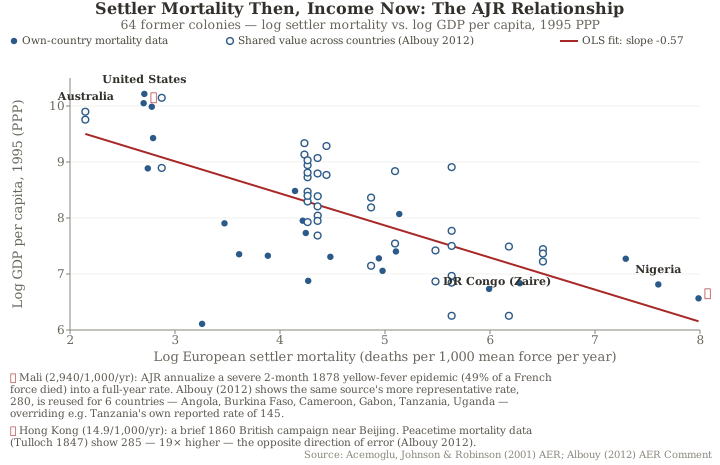
The extractive institutions AJR build on were forced-labor systems, monopoly trading companies, racial legal hierarchies, and tax regimes designed to move wealth out, the colonial state as an extraction machine, documented economy by economy in the history of imperialism.
AJR sit at the end of a long institutionalist lineage, Veblen’s habits and Commons’s working rules, Coase on transaction costs, Douglass North on rules and enforcement, and finally the AJR turn to colonial origins. That tradition, traced as intellectual history, is History of Economic Thought Ch.15 (The institutionalist tradition).
“The colonial origins of comparative development… where Europeans faced high mortality rates, they could not settle and set up extractive states; these institutions persisted after independence.”
— after Acemoglu, Johnson & Robinson, “The Colonial Origins of Comparative Development,” American Economic Review, 2001
Did colonialism cause poverty?
The 2024 Nobel reads, to many, as the academy crowning colonial institutions as the root cause of present-day poverty. The evidence is strong. So is the temptation to make it a single, total explanation it can’t bear.
The deeper version of this dispute, whether the European rise itself was institutions or geography or coal-and-colonies, runs through the Did Britain have to industrialize first? walkthrough, where the Pomeranz case for contingency is argued at full strength. Here the AJR institutional thesis is the frame, and geography enters as its strongest counter.
Institutions, geography, or culture?
“Inclusive economic institutions… create inclusive markets, which give people freedom to pursue the vocations in life that best suit their talents. Extractive institutions… are designed to extract incomes and wealth from one subset of society to benefit a different subset.”
— Daron Acemoglu & James Robinson, Why Nations Fail, 2012
The case for AJR holds that the inclusive/extractive distinction is the master variable, and that the settler-mortality identification gives it a causal footing few claims in development economics can match. The qualifier the authors themselves supply: their answer to the China case — that growth under extractive institutions is real but unsustainable, doomed once the easy catch-up ends — is still only a prediction. China keeps not collapsing on the timetable the theory implies. The framework is strong; its hardest case is still open.
“Institutions do not rule. Geography, through its effects on disease, transport costs, and agricultural productivity, exerts a powerful and continuing influence on development that institutional measures do not capture.”
— after Jeffrey Sachs, “Institutions Don’t Rule,” NBER Working Paper, 2003
Sachs presses geography as a constraint institutions can’t dissolve, tropical disease burdens, landlocked transport costs, low agricultural productivity that no rulebook repeals. Malaria is not a policy choice. The qualifier that complicates his case: Singapore is tropical and rich, which shows geography binds but does not determine. Geography shapes which institutions form and how much room they have to work. The two are entangled.
Where this leaves us
Institutions almost certainly matter a great deal. The causal evidence from AJR, Dell, and Nunn is too strong and too varied to dismiss, and 2024 made it the field’s current strongest single answer. But “institutions” is a broad category, and the extractive/inclusive binary is a useful simplification. Geography, culture, and historical contingency interact with institutions. Botswana inherited extractive institutions and built inclusive ones; Zimbabwe inherited better and wrecked them. The divergence is a reminder that origins constrain but don’t determine. Which leaves the hardest question: if institutions matter this much, how does a country actually change them?
The Botswana-and-Zimbabwe contrast, and the wider story of which post-colonial states escaped extraction, sits in Economic History Ch.17 (China Reform and the Asian Century).
Grand theories are satisfying. Do they survive contact with data? Can randomized experiments, the same method used to test drugs, tell us how to make entire nations less poor?
Experiments and aggregation
“We wanted to show that it is possible to make progress against the biggest problems in the world by understanding them, breaking them down into smaller, more manageable problems, and addressing each rigorously.”
— after Esther Duflo, Nobel Prize Lecture, 2019
Two centuries of growth theory, and the field still can’t agree on what makes nations rich. Duflo, Banerjee, and Kremer won the Nobel for a different bet: stop arguing about grand causes, run the experiment. It worked, for a class of questions. The fight is over which class.
The RCT revolution. Borrow the method that made modern medicine credible. Take a population, randomly assign some to a treatment — free bed nets, a cash transfer, deworming pills — and some to a control group, then compare. Randomization is what buys the causal claim: with enough people, the two groups differ only in the treatment, so any difference in outcomes is the effect of the treatment. The development field reorganized itself around running these trials by the thousand.
What the trials found. GiveDirectly’s unconditional cash transfers raised consumption and assets with little of the waste skeptics predicted. Miguel and Kremer’s 2004 deworming trial in Kenya found that cheap pills cut absenteeism and raised later earnings, one of the most cost-effective interventions ever measured. Information nudges, teacher incentives, micro-loans: each got a clean point estimate where before there had been only ideology.
The object a trial estimates is the average treatment effect,
$$\text{ATE} = E[Y_i(1) - Y_i(0)] = \bar{Y}_{\text{treatment}} - \bar{Y}_{\text{control}}$$the difference between the outcome each person would have under treatment, $Y_i(1)$, and under no treatment, $Y_i(0)$. You can never observe both for one person, the fundamental problem of causal inference, but randomization makes the control group’s average a valid stand-in for the treated group’s missing counterfactual. The estimate is clean. The question is what it is clean about.
A randomized trial is the gold standard for one reason: it kills selection bias. People who choose to buy bed nets differ from people who don’t — in income, education, caution — so comparing buyers to non-buyers tells you about the people, not the nets. Randomize who gets the net and the comparison is finally about the net. The price is scope: the answer holds for these people, this place, this intervention. Whether it travels is a separate, harder question.
The aggregation problem. RCTs evaluate micro interventions — a clinic, a textbook, a transfer. The income gap is macro — the difference between the Democratic Republic of the Congo and Denmark. And the gap between the DRC and Denmark is not caused by a shortage of bed nets. You can deworm every child in a poor country, raise their test scores, lengthen their lives, all genuinely worth doing, and still not have a theory of why the country is poor.
The structural alternative. Where RCTs go small, structural estimation goes for the whole machine. Hsieh and Klenow (2009) estimate that misallocation, capital and labor stuck in low-productivity firms instead of flowing to high-productivity ones, could account for differences in aggregate TFP of 30–50% between India, China, and the United States. The result depends on a fully specified model rather than a randomized comparison; it buys economy-wide reach at the cost of the design transparency a trial has.
An RCT is a trial of one medicine. Structural estimation is a model of the whole hospital. You need both, and you must not confuse them: knowing that a drug works tells you nothing about why the hospital is failing, and modeling the hospital tells you nothing reliable about which drug to prescribe. Angus Deaton’s warning sharpens the same point. A clean experiment without a theory of mechanism is blind to whether its result means anything beyond the room it was run in.
The arc from Arthur Lewis’s 1954 dual-economy model, through the structural-adjustment era, to the credibility revolution that brought RCTs to development is itself a tradition, traced as intellectual history in History of Economic Thought Ch.16 (Development economics).
Experiments or grand theories?
“The poor are no less rational than anyone else, quite the contrary. Precisely because they have so little, we often find them putting much careful thought into their choices. To understand poverty, we have to abandon the habit of reducing the poor to cartoon characters and take the time to really understand their lives.”
— after Abhijit Banerjee & Esther Duflo, Poor Economics, 2011
Banerjee and Duflo make the case that rigorous, granular evidence has changed development economics for good, that we now know things about deworming, immunization incentives, and savings devices that we used to only argue about. The qualifier they grant: “taking what we’ve learned to scale” is exactly where the micro-macro gap bites hardest, because general-equilibrium effects — what happens when everyone gets the treatment, not just the trial sample — can swamp the partial-equilibrium estimate a trial delivers.
“The RCT-based view of the world is dangerously narrow. The big questions in development, why some countries industrialize and others don’t, are not amenable to randomized trials, and the obsession with what can be experimentally evaluated has pulled the field away from what matters most.”
— after Lant Pritchett & Justin Sandefur, “Context Matters for Size,” Center for Global Development, 2013
Pritchett’s charge is that the field is studying bed nets when it should be studying industrialization — mistaking what is measurable for what is important, and letting the method dictate the question. South Korea, Taiwan, China, and Botswana escaped poverty through structural transformation and growth no trial could have designed or detected. The qualifier the other side returns: Pritchett’s preferred tools, case studies and structural models, carry their own evidentiary burdens, and “study the big thing” is easier to demand than to do credibly.
The growth trajectories Pritchett points to — the Asian tigers, China’s takeoff, the Botswana exception — are the historical baseline in Economic History Ch.17 (China Reform and the Asian Century).
Where this leaves us
The honest verdict is layered. Institutions and ideas are the fundamental causes, operating through property rights, human capital, technology adoption, and political stability, with institutions the deepest cause the field has yet identified and ideas the proximate engine they unlock. Capital deepening is necessary and nowhere near sufficient. RCTs are how we understand specific mechanisms within those channels, the right tool for saving lives, the wrong scale for explaining nations. Structural models help us reason about aggregation and general equilibrium. No single theory explains everything, and the loud one-cause framings the public debate keeps reaching for — “it’s all institutions,” “just give more aid,” “culture is destiny” — are each a fragment mistaken for the whole. The question we opened with remains open.
The verdict
We started with a four-minute animation and a factor-of-100 gap, and asked what caused it. Five stages later, the question is sharper and the answer is plural:
- Measurement. The gap is real. It survives PPP, the informal economy, capability accounting, and every reasonable revision. The debate about GDP confirms the puzzle rather than dissolving it.
- Capital. Solow taught us that capital deepening alone predicts a factor-of-three gap where the actual gap is a factor of fifty. Capital is necessary but explanatorily insufficient, with most of the difference hidden in a technology residual.
- Ideas. Romer named the residual: non-rival ideas are the proximate engine, and TFP is the majority of the gap. But ideas are public, so the mystery becomes why poor countries can’t adopt them.
- Institutions. AJR’s answer, the rules of the game decide whether ideas get used, is the strongest causal candidate the field has, with settler-mortality evidence too consistent to dismiss, though it shares the work with geography and contingency.
- Experiments. RCTs deliver clean causal evidence on specific interventions and save real lives, but operate at the wrong scale to explain national outcomes; structural models reach further at the cost of design transparency.
The five frameworks are complements, each covering ground the others leave open. Capital is the floor, ideas are the engine, institutions are the deepest cause currently identified, experiments are the microscope, and measurement is the thing that keeps everyone honest about what we’re even arguing over. The intellectual history of the question is a sequence of partially-right answers, each earning a Nobel and none closing the case. That is an accurate report on a hard problem.
The next time someone tells you why nations are poor, “they just need more aid,” “it’s all corruption,” “blame colonialism,” “culture is destiny,” you have five frameworks to test the claim against, and the thing to watch for is someone selling you one of them as the whole answer.