Did Britain have to industrialize first?
For a century the answer was “Western genius.” Then someone looked at the numbers, and the question reversed.
“Broadly similar starting points”

“Western Europe and the most prosperous parts of East Asia… had achieved surprisingly similar levels of certain crucial kinds of economic development by 1750.”
— after Kenneth Pomeranz, The Great Divergence, 2000
For most of the twentieth century the story ran one way. Europe had pulled ahead of Asia centuries before steam, and the gap was a deep, civilizational fact. Pomeranz reset the clock. If the leading regions of Eurasia were still comparable in 1750, the question stops being “what was wrong with China?” and becomes “what specific, datable thing happened next?”
“Parity” is a measurable claim. The California School — Pomeranz, Bin Wong, Jack Goldstone — cashes it out in proxies a historian can put numbers on: real wages in silver-equivalent units, daily caloric intake, life expectancy at age twenty, urbanization rates, per-capita output of marketed grain and cloth. On those proxies, the Lower Yangzi in 1750 sits close to the English Midlands. The peasant in Suffolk and the peasant in the delta around Shanghai ate comparable calories, lived comparable lengths of time, and bought comparable amounts of cloth.
Parity is not identity. China had larger political units, a less developed financial system, and science organized along different lines. Pomeranz’s claim is narrower than “they were the same.” On the living-standards proxies, the gap that nineteenth-century historians described as ancient and civilizational was not there yet. The full data series — the convergence on the eve of divergence, and the careful accounting of what diverged, when, and by how much — is the spine of Economic History Ch.6 (The Great Divergence).
Why the reframe matters
The reset reverses the burden of explanation. If Europe had been ahead for centuries, the natural question is “what was wrong with China?”, and a long tradition of civilizational-difference answers stands ready to fill it in: Weber’s Protestant ethic, the Needham Question, the supposed Asian lack of curiosity or discipline. If instead Europe and the Yangzi were comparable in 1750 and diverged only afterward, the question flips to “what specific, datable thing happened in the next century?” And the candidate answers to that question are mostly mechanical — coal beds, plantation calories, factor-price ratios.
Take the framing seriously
The strong form of Pomeranz (gap essentially zero until 1800) is under pressure, and Stage 4 brings the quantitative pushback that softens it. But the basic move survives it. By 1750 the leading parts of Eurasia were comparable enough that no static, civilizational comparison can explain why one of them, and not the others, broke onto sustained per-capita growth. Something specific had to happen.
So why Britain? The cleanest economic answer turns on something almost embarrassingly material. Wages. Coal. And the geological accident of where each of them happened to be.
Cheap coal, expensive labor
“The Industrial Revolution… was invented in Britain in the eighteenth century because it paid to invent it there, while it would not have been profitable in other times and places.”
— Robert C. Allen, The British Industrial Revolution in Global Perspective, 2009
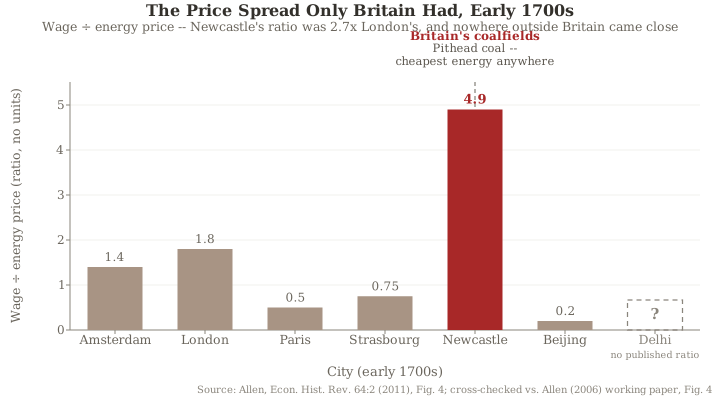
This is the cleanest economic claim in the divergence debate, and a falsifiable one: run the actual engineering specs, the actual coal prices, the actual spinner wages through a discounted-cash-flow calculation, and the machines pay for themselves in Lancashire and nowhere else.
The mechanism has a name: induced innovation. Technology is not manna; it gets invented where inventing it pays. Eighteenth-century Britain was the only place on earth where labor was expensive and energy was cheap at the same time. A spinning jenny that replaces costly hands pays off in Lancashire; the same device, facing French wages and French firewood, does not. Directed technical change, or how the factor-bias of innovation responds to relative prices, is the formal subject of Economics Ch.13 (Growth Theory). The wage and coal numbers Allen’s arithmetic actually runs on — the Crafts-Allen productivity series, the real-wage trajectories, the energy-transition record — live in Economic History Ch.7 (The Industrial Revolution).
Suppose a candidate technology saves labor at rate $a_L$ and consumes energy at rate $a_E$. With wage $w$ and energy price $p_E$, adoption is profitable when the saving net of the fuel it burns exceeds the per-unit fixed cost:
$$w \cdot a_L - p_E \cdot a_E > F$$Allen’s claim is that Britain was the only country where the ratio $w / p_E$ rose high enough to push the canonical industrial-revolution technologies across that threshold.
A machine that replaces a worker has to save more in wages than it costs in fuel. Britain was the only country where wages were high enough and fuel was cheap enough to make that math work. So the machine got invented where the math worked.
Allen at full strength
Take Allen’s claim in its hard form, which is where it bites. He runs the discounted-cash-flow calculation explicitly — for France, for China (Shanxi), for India — and shows that the canonical technologies of the early industrial revolution were profitable to develop and adopt in Lancashire and unprofitable everywhere else at the prices that actually prevailed. The spinning jenny, the water frame, the early steam engine: each penciled out in Britain and failed to pencil out on the continent, which lacked the price spread.
And the price spread itself was nobody’s policy. Trace it back and it is a chain of structural luck. The Black Death of 1348 killed off enough of England’s workforce to compress wages upward for three centuries, and London’s Atlantic-trade premium kept them high. Newcastle coal happened to sit on tidewater, so it could be shipped down the coast with almost no inland haul, holding energy cheap exactly where labor was dear.
The honest read
Allen’s mechanism is the most quantitatively defensible piece of the whole puzzle. It explains which technologies got developed, where, and when; it explains why imitation lagged on the continent, since the steam engine genuinely was not profitable there until coal prices fell. What it does not explain is why China, which had cheap-coal regions of its own in Shanxi, never developed labor-saving textile machinery. The standard reply is that Shanxi coal sat hundreds of miles from the centers of Chinese textile production, so the price spread that mattered in Lancashire never assembled in one place. It is plausible but not bulletproof. Call it real-but-partial: a theory of which technologies got built, leaving open why the building never stopped.
A theory of which technologies got developed isn’t yet a theory of why they didn’t peter out. Song China, Renaissance Italy and the Dutch Golden Age each ran a productivity burst for a century or two and then stopped. Britain’s didn’t. Why not?
A culture of growth
“What needs to be explained is not the Industrial Revolution proper, but its sustainability, the fact that, unlike all earlier efflorescences, it did not peter out but kept feeding on itself.”
— after Joel Mokyr, A Culture of Growth, 2016
Mokyr concedes the whole California-school comparison and pivots past it. Grant that the Yangzi in 1750 matched Suffolk; grant that Song China was as rich as Qing China; grant that Renaissance Italy was a marvel. None of those efflorescences kept going. The puzzle is why Britain’s burst, alone among them, never stopped.
Mokyr’s machinery is institutional economics married to the history of ideas. Sustained per-capita growth requires a process that keeps producing productivity-raising technologies, and a self-renewing process requires social institutions that select for, transmit, and recombine useful knowledge across generations. The formal framework for how inclusive institutions shape who can innovate, and whether the gains are secure, lives in Economics Ch.18 (Institutional Economics). The specific institutions Mokyr names are concrete: the Royal Society and its Continental analogues, the printer-publisher networks, the patent system, and above all the trans-national Republic of Letters that let a finding in Leiden reach a workshop in Birmingham.
The lineage is older than Mokyr. Adam Smith already understood that commerce and inquiry reinforce each other, that a commercial society widens the market, the wider market deepens the division of labor, and the deepened division of labor multiplies both the occasions and the rewards for improvement. Mokyr’s “culture of growth” is, in part, Smith’s commercial-society mechanism read forward through two centuries of institutional theory. The classical source — Smith on commercial society, and the discipline he founded around it — is History of Economic Thought Ch.3 (Classical Political Economy).
Two readings of sustainability
Read at strength, Mokyr’s argument is structural. China’s imperial examination system funneled the empire’s ablest minds into a single, unified bureaucratic career, where advancement rewarded mastery of the classics rather than discovery in nature. There was no Qing equivalent of the Newton-Hooke-Royal-Society path, in which contested findings circulated, accumulated, and compounded. And the very thing that made that path possible, the Republic of Letters (the Hartlib-Mersenne-Leibniz correspondence network that carried ideas across borders faster than any ruler could chase them), depended on Europe’s jurisdictional fragmentation. No single sovereign could suppress an idea continent-wide.
Deirdre McCloskey reads the same sustainability and locates the cause elsewhere. In her telling it was not institutions or coal but a change in talk: “A change in how people honored markets and innovation caused the Industrial Revolution, and then the modern world… It was ideas, or ‘rhetoric,’ that caused our enrichment, and with it our modern liberties.” (Bourgeois Dignity, 2010.) For McCloskey the decisive shift is that the merchant and the inventor stopped being figures of contempt and started being figures of dignity, a revaluation of the bourgeois life that no factor-price ratio can capture. McCloskey and Mokyr disagree sharply about the mechanism, honored rhetoric versus knowledge-transmitting institutions, but they agree on what needs explaining: sustainability, the burst that fed on itself.
Necessary, not sufficient
Mokyr cuts where Allen cannot reach. The factor-price story, on its own, has nothing to say about why earlier efflorescences petered out, and the epistemic-institutions story does. But Mokyr also overshoots. France had a Republic of Letters, an Académie des Sciences, and arguably a deeper formal scientific tradition than Britain, and France did not industrialize first. Neither did the Dutch Republic, the densest knowledge network in seventeenth-century Europe. The epistemic-institutions variable is plausibly necessary and clearly not sufficient. It tells you why the burst could sustain itself. Why Lancashire rather than Lyon is a question it cannot reach. That intra-Europe comparison — same continent, same century, same epistemic substrate, different rates of takeoff — is the load-bearing puzzle, and it has its own walkthrough: Britain vs. France: why one industrialized first.
Both Allen and Mokyr take Europe as the unit and ask why Britain inside Europe. There is an older question still, and it is the one a Cambridge biochemist who loved China spent his life on: why Europe at all?
Verdict, and the return of normal
“Why did modern science… take its meteoric rise only in the West at the time of Galileo, but had not developed in Chinese civilization? Why was it that between the first century B.C. and the fifteenth century A.D., Chinese civilization was much more efficient than occidental in applying human natural knowledge to practical needs… yet failed to give rise to modern science?”
— Joseph Needham, The Grand Titration: Science and Society in East and West, 1969
Needham is the hardest version of the question to deflect, because of who asked it. He was a Cambridge biochemist and a sinophile who spent decades cataloguing Chinese scientific priority, the man least likely to be smuggling in European triumphalism. When he asks why modern science rose in the West and not in China, the question cannot be waved off as Eurocentric prejudice.
Two structural variables sit underneath every serious version of the answer. The first is political fragmentation. Eric Jones’s 1981 argument is that Europe’s competitive states system let innovation and heterodoxy survive by exit: a ruler who suppressed an idea or a dissenter simply drove them to a neighboring court, where a rival was glad to host them. The unified Chinese empire could suppress by edict and have the edict hold from end to end. This runs straight through Mokyr’s Republic of Letters and into the Acemoglu-Robinson inclusive-institutions framework, the apparatus that connects who holds political power to whether economic life is open or extractive. The formal framework is Economics Ch.18 (Institutional Economics); the intellectual lineage that produced it (Veblen to Coase to Williamson to North to Acemoglu) is History of Economic Thought Ch.15 (The Institutional Tradition).
The second variable is ghost acreage: Pomeranz’s name for the calories, cotton, sugar, and timber that New World plantations supplied to Britain, relieving the land constraint that capped every earlier organic economy. The mechanism reaches directly into the slavery question — the plantation complex as a productivity system, and the Williams-thesis debate over how much industrial capital it actually financed — which is the spine of Economic History Ch.9 (Atlantic Slavery and After). The ghost-acreage thread is walked in its own right in Did the West get rich because of slavery? And the strong form of Pomeranz’s parity claim needs softening here: Broadberry, Guan, and Li’s quantitative reconstructions of output back to 980 have Italy overtaking China by around 1300 and England by around 1700, which pushes the gap’s opening back at least a century before the steam engine. The California-school move survives; the strongest timing claim does not.
The civilizational reading, at full strength and answered
“A product of modern European civilization, studying any problem of universal history, is bound to ask himself to what combination of circumstances the fact should be attributed that in Western civilization, and in Western civilization only, cultural phenomena have appeared which (as we like to think) lie in a line of development having universal significance and value.”
— Max Weber, The Protestant Ethic and the Spirit of Capitalism, 1920 (Author’s Introduction)
The civilizational reading was the academic mainstream for most of the twentieth century, and it still drives the public conversation. Weber’s claim is sharper than the popular versions: what emerged in the West and only in the West was “the rational capitalistic organization of (formally) free labour” — a calculable, methodical economic system — and it emerged on the substrate of an inner-worldly ascetic Protestantism that turned labor and accumulation into a religious calling. The Calvinist demonstrated election through worldly success; the Confucian demonstrated cultivation through ritual decorum and examination; the Hindu demonstrated accumulated merit through ascetic withdrawal. Same intelligence, same resource base, and a different soul-shape that selects for radically different economic behavior. David Landes’s 1998 The Wealth and Poverty of Nations revives the cluster on cultural rather than theological terms: Europe had the work ethic, the savings rate, the literacy, the curiosity, the discipline; Asia, on his reading, had brilliance but not the cluster. And the contemporary reanimation is Joseph Henrich’s The WEIRDest People in the World (2020): Western Europeans became unusually individualistic, analytical, and trusting of strangers under the medieval Church’s marriage and family policies, and it is that psychological cluster that makes the modern economy run.
The civilizational reading does not survive the data, and three things together replace it. First, parity: on the standard-of-living proxies in 1750, Suffolk peasants and Yangzi peasants lived comparable lives, with comparable calories, lifespans, and cloth. The civilizational reading needs a deep civilizational-difference signal that shows up somewhere in the eighteenth-century data, and it is not there; the divergence is post-1750. Second, priority: for most of recorded history Chinese civilization was the technology leader in printing, the compass, gunpowder, paper, cast iron, the seed drill, the moldboard plow, the deep-bore drilling rig, and the segmental-arch bridge. The Weberian or Landesian reading needs China to be the civilizationally incapable case, and the record overflows with evidence of the opposite. Third, the mechanisms that actually work: factor prices, epistemic institutions, ghost acreage, and political fragmentation are structural and contingent, and together they explain the divergence with no civilizational variable invoked at all. Jones’s fragmentation thesis is the sharpest of them. When the Yongle Emperor decommissioned Zheng He’s treasure fleets in 1433, the decision was made once and held across the entire empire; in Europe, when Rome condemned Galileo the Dutch printed him, and when France expelled the Huguenots the English took them in along with their skills and capital. Fragmentation guaranteed only that no single ruler could kill an innovation.
“England fueled the Industrial Revolution because its political and economic institutions were more inclusive than anywhere else in the world… By 1760 the combination of all these factors, improved and new property rights, improved infrastructure, a changed fiscal regime, greater access to finance, and aggressive protection of traders and manufacturers, was beginning to have an effect.”
— Daron Acemoglu & James A. Robinson, Why Nations Fail, 2012
Acemoglu and Robinson give the structural account its most influential contemporary voice. The Glorious Revolution of 1688 redistributed political power away from a narrow ruling elite toward a broader coalition; inclusive political institutions then generated inclusive economic ones, giving secure property rights, contract enforcement, open markets, and a state that could not arbitrarily expropriate. Their reading shares the whole structural case’s rejection of civilizational genius, but pushes the explanatory weight back to 1688 and earlier, centering the political-institutional variable. Whether AJR’s institutions-first ranking beats Pomeranz’s resource-and-contingency ranking is its own argument; a separate walkthrough runs it, Pomeranz vs. Acemoglu on the Great Divergence.
Branko Milanovic reads the present through the same fragmentation-and-institutions frame. For most of the last two thousand years, China was the largest economy in the world or among the largest; the two-hundred-year window of Atlantic dominance from 1800 to 2000 is the historical anomaly. On his framing the post-1980 Chinese rise, covered in Economic History Ch.17 (China’s Reform and the Asian Century), is the return of normal. The reframe is too strong as stated. The Chinese rise is partial catch-up inside a world economy still structured by Western institutions, currencies, and technologies, so “normal” smuggles in more than it earns. But the question it raises is the right one, and it stays open here. Is the divergence we have been explaining a one-shot historical event, or a temporary perturbation in a longer story?
The verdict
(The question here is the public framing one. Was the divergence a result of Western civilizational genius? The intra-Europe comparison, Britain vs. France, has its own walkthrough. The scholarly framework ranking — Pomeranz vs. Acemoglu, and the broader Allen-Mokyr-Pomeranz-AJR contest — has a walkthrough of its own.)
Britain did not have to industrialize first in any deterministic sense. The contingencies were each real and each could plausibly have failed to hold: Newcastle coal on tidewater, the Black Death’s three-century compression of English wages, the Atlantic reachable from Bristol, a political map fragmented enough to keep ideas in motion. Pull any one of them out and the British timing breaks. That some part of Europe industrialized first in the eighteenth or nineteenth century is, however, substantially overdetermined. Political fragmentation, epistemic institutions, and New World resource flows together pulled Europe onto a trajectory the static comparisons missed.
On the civilizational-genius reading itself, the joint structural reply (Pomeranz on parity, Needham on priority, Jones on fragmentation, Acemoglu on inclusive institutions, Allen on factor prices, Mokyr on epistemic institutions, Pomeranz again on ghost acreage) is enough to replace it without ever invoking a civilizational variable. The disagreement among Allen, Mokyr, Pomeranz, and AJR is a dispute over which factor weighs most inside a shared growth-theory frame, and ranking those accounts against each other is another walkthrough’s job. The answer the historical record now supports is closer to accident than to European civilizational genius.
Pomeranz’s “ghost acreage” is where this question reaches into a sibling one. The plantation calories and cotton that relieved Britain’s land constraint were produced by enslaved people, and how much of British industrial capital that system actually financed is its own fierce dispute. That argument runs in Did the West get rich because of slavery? Two other walkthroughs pick up the threads left aside here: Britain vs. France: why one industrialized first and Pomeranz vs. Acemoglu on the Great Divergence.