Is GDP a misleading measure of progress?
The world ranks nations by it. But GDP counts the cost of the oil spill and the clean-up as gains, and the parent raising a child as nothing. So what is it actually measuring?
Voir comme graphe de débatThe headline measure, at its strongest

“Here we are. Health up here, wealth over here. The whole world has moved… The world is improving, and you can see it in the data: as countries get richer, people live longer.”
— after Hans Rosling, 200 Countries, 200 Years, 4 Minutes (BBC / Gapminder), 2010
Rosling’s bubble chart is the most famous picture in development. Plot income against life expectancy for every country across two centuries, and the cloud marches up and to the right together. For the bulk of the income distribution, GDP-per-capita and the things we actually care about move in lockstep. That correlation is why, for half a century, GDP-per-capita has served as the operational headline of human progress.
Start with what the number is. Gross Domestic Product is the market value of all final goods and services produced inside an economy in a given period. It is an accounting construct, the spine of the System of National Accounts that every government on earth now keeps. Divide by population and you get GDP-per-capita, the figure that orders the world’s welfare rankings: the United States above France above Brazil above Ghana.
Why does that ordering command so much authority? Because the empirical correlation is overwhelming. Across the bulk of the cross-country income distribution, GDP-per-capita tracks life expectancy, years of schooling, child survival, and political freedom so tightly that it works as a single-number proxy for almost everything we associate with a good life. The relationship is steepest at low incomes, where another few hundred dollars of output buys clean water, vaccines, and calories.
The modern statement of the case is Betsey Stevenson and Justin Wolfers’ 2008 work on income and subjective wellbeing. The older folk wisdom — Richard Easterlin’s claim that once basic needs are met, more money stops buying happiness — turned out, in their data, not to hold. Richer people report higher life satisfaction than poorer people within every country; richer countries report higher satisfaction than poorer countries; and they found no income threshold at which the relationship flattens to nothing.
We do not have a better single number. Every alternative measure is either harder to compute, harder to compare across borders, harder to track consistently through time, or quietly smuggles GDP-per-capita back in as its main ingredient. The headline measure earns its slot by being available, comparable, and, across most of the income range, right.
GDP can be written from the expenditure side as the sum of consumption, investment, government purchases, and net exports:
$$Y = C + I + G + NX$$The cross-country relationship between welfare proxies and income is well approximated by a log-linear gradient, life expectancy rises roughly linearly in $\log(\text{GDP per capita})$, so each doubling of income buys a similar absolute gain, and the marginal return to a dollar therefore falls as countries get richer.
$$\text{LifeExpectancy} \approx \alpha + \beta \cdot \log(\text{GDP per capita})$$Picture Rosling’s bubbles. Down in the poor corner, a doubling of income moves a country a long way up the health axis, from dying young to living to middle age. Up in the rich corner, the bubbles are bunched together near the ceiling: doubling income still helps, but the gains are smaller and slower because the cheap wins (sanitation, basic medicine, enough food) have already been bought. GDP is a fantastic measure of progress while you are climbing out of poverty. The question is what happens once you are near the top.
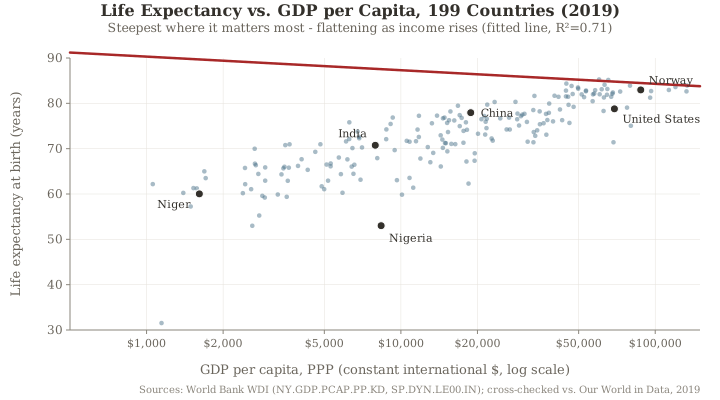
The formal apparatus of the measure — how GDP is defined, the national-income-accounting identities that tie output to income to expenditure — is the home of Ch 7 §7.1 (Gross Domestic Product) and §7.5 (National Income Accounting Identities). The link from GDP-per-capita to the growth-theory paradigm — convergence, the Solow accounting that treats per-capita output as the headline of catch-up — sits in Ch 13 §13.6 (Convergence and Growth Accounting).
This is the framing made operational: every country shaded by its output-per-head. In Stage 2 we read the same data through a different lens, and the ranking starts to wobble. Open the full GDP map to walk it across two centuries.
“The estimated income–wellbeing gradient is not only significant but large… and we find no evidence of a satiation point beyond which the relationship breaks down.”
— after Betsey Stevenson & Justin Wolfers, Brookings Papers on Economic Activity, 2008
Is GDP-per-capita just the best summary we have?
Critics say GDP misses what matters. Defenders say: fine, now name the single number that does better, computes everywhere, and compares across two centuries of data. That challenge is harder to meet than it looks.
The measure and its maker’s warning
“The relationship between subjective well-being and income… suggests that economic growth raises well-being. We find no evidence of a satiation point above which higher GDP per capita is not associated with greater well-being.”
— after Betsey Stevenson & Justin Wolfers, Brookings Papers on Economic Activity, 2008
Stevenson and Wolfers are making the empirical case at its strongest. They are reporting that, when you measure carefully, more income reliably comes with more of what people report wanting, and it keeps doing so at high incomes, where the older Easterlin pessimism predicted it would stop. This is the apparatus they inherit: the national accounts that Kuznets, Richard Stone, and the postwar quantitative-economics builders assembled into the System of National Accounts, the measurement tradition consolidated in History of Economic Thought Ch.9 (The postwar synthesis).
“The welfare of a nation can scarcely be inferred from a measurement of national income… Goals for ‘more’ growth should specify of what and for what.”
— Simon Kuznets, National Income, 1929–1932 (report to the U.S. Senate), 1934, and The New Republic, 1962
Kuznets did more than anyone to make national income measurable, and in the same breath he told the Senate not to mistake the measure for the thing. He is the apparatus’s own architect marking its boundary. The number is built to count production, and Kuznets knew the gap between production and wellbeing was real even if, for most of the world, it stayed small. Stage 2 is about the place where that gap stops being small.
Where this leaves us
The GDP-per-capita headline has earned its grip. Across the bulk of the cross-country income distribution, and especially in the development range, it correlates strongly enough with life expectancy, schooling, and political freedom to serve as a defensible first measure of welfare. The empirical correlation is the apparatus’s reason to exist. Stevenson and Wolfers showed it holds further up the income ladder than the skeptics expected. And yet even Kuznets, who built the measure, warned that it should never be confused with welfare itself. The question is where that warning bites.
We have inhabited the framing that treats GDP-per-capita as the headline of welfare progress, and it holds across most of the income distribution. But look at the rich-country tail of that distribution, and at the longitudinal record of the wealthy economies since 1970, and a divergence opens up. Output per head doubles while the typical paycheck stalls. Output rises while life expectancy plateaus — and for some, reverses. Output climbs while the natural capital it draws down is booked as if it were free. What if GDP measures something, call it activity, that runs alongside welfare while a country is poor, and starts to run away from it precisely where the rich world lives?
The flip: GDP measures activity, not welfare
“Economic growth… cannot sensibly be treated as an end in itself. Development has to be more concerned with enhancing the lives we lead and the freedoms we enjoy.”
— Amartya Sen, Development as Freedom, 1999
Here is the flip, performed by a Nobel laureate, from inside the discipline. Sen’s point is that it answers the wrong question. Income is a means. Welfare is what people are able to be and do, to be well-nourished, literate, healthy, free to take part in the life of their community. Income buys some of that, especially when there is little of it. But the moment you ask “capability to do what?” the headline number stops being the thing you wanted to measure.
Once you hold GDP up as a measure of activity, the value of final goods and services produced in a period, a whole family of alternative measures comes into focus, each surfacing something the headline number misses. The voices are Nobel laureates and state commissions and the founders of whole subfields.
1. Sen’s capability approach. Welfare is a matter of functionings (what a person actually is and does) and capabilities (the real freedoms they have to choose among lives). Income is one input among several; health, education, and political freedom are others, and they don’t reduce to a single budget line. Sen argues income is highly instrumental to capability where it is scarce. As a country gets richer, capability expansion increasingly runs on inputs income alone doesn’t buy. The lineage from Lewis through Prebisch to Sen’s capabilities turn is History of Economic Thought Ch.16 §16.5 (Development as Freedom: Sen and the capabilities turn).
2. HDI and the inequality-adjusted HDI. Sen’s framework was made operational by Mahbub ul Haq in the first UN Human Development Report of 1990: the Human Development Index folds longevity, education, and income into one composite, so a country can rank high on health and schooling even if its income is middling. The inequality-adjusted HDI, added in 2010, discounts each dimension by how unequally it is distributed. A country with high average income but a brutal distribution falls. This is where the inequality-of-welfare question enters the measurement debate; the policy version of “can economics solve inequality?” is the home territory of the walkthrough on inequality.
3. The Stiglitz-Sen-Fitoussi Commission. In 2008 the French government asked Joseph Stiglitz, Amartya Sen, and Jean-Paul Fitoussi to convene a commission on the measurement of economic performance. Their 2009 report, Mismeasuring Our Lives, called for a dashboard: governments should report a basket of welfare indicators — health, education, environment, insecurity, distribution — alongside GDP, because no single number can carry the weight.
4. The ecological-economics critique. Herman Daly and the ecological economists point at a structural error: the national accounts count environmental drawdown as positive output. A forest felled, a fishery exhausted, a coast cleaned after an oil spill, all register as additions to GDP, with no offsetting entry for the natural capital destroyed. John Hicks defined income as the most you can consume while leaving yourself as well off as before; GDP-as-practiced violates that definition by ignoring the depletion of the asset base. The cost-of-disservices objection rides along here too: GDP credits the commuting time, the spending on preventable disease, and the prison-building that a healthier society would not need.
5. The household-production critique. Nancy Folbre and Marilyn Waring name the largest unmeasured sector in any advanced economy: unpaid household and care work. Raising a child, nursing a sick parent, cooking the family meals, none of it counts, because none of it is transacted in a market. Hire someone to do exactly the same work and GDP rises; do it yourself for love and GDP records nothing. The omission is large, and it is not gender-neutral.
Put the five together and you have the empirical anchor for the flip: the post-1970 rich-country record, where the headline measure and the welfare measures come apart. In the United States, GDP-per-capita roughly doubled between 1970 and the 2010s while the typical worker’s real wage barely moved; the top decile’s income share climbed from around a third toward a half; life-expectancy gains slowed and, for some groups, reversed (the “deaths of despair” that Anne Case and Angus Deaton documented). The environmental picture is mixed. Air pollution from coal fell sharply even as carbon emissions rose, and the headline number cannot tell you which way welfare moved, because it was never measuring welfare. The era in which this divergence became politically unmissable is the spine of Economic History Ch.16 (Stagflation and the neoliberal turn) and the hyperglobalization decades that followed in Ch.18 (Globalization and the great moderation).
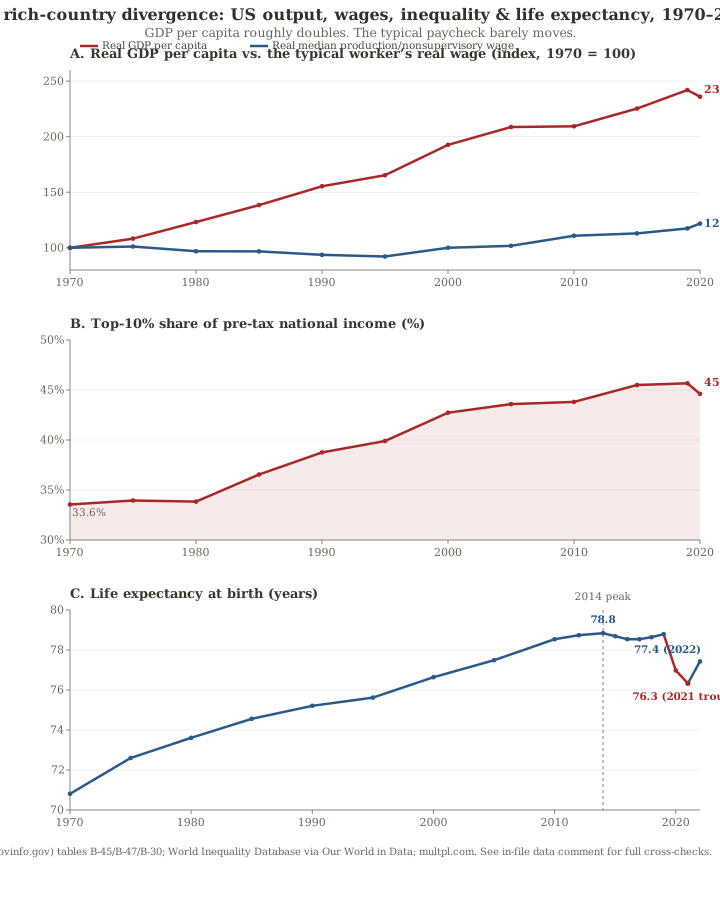
Hicks’s income definition makes the ecological critique precise. True income is the maximum a society can consume in period $t$ while leaving its wealth, including natural-capital stock, at least as high for period $t+1$:
$$Y_t^{\text{Hicksian}} = \max\{\, C_t : V_{t+1} \geq V_t \,\}$$where $V$ is the full wealth stock. GDP-as-practiced ignores the $V_{t+1} \geq V_t$ constraint, so consumption financed by drawing down natural capital is counted as income rather than as the asset liquidation it actually is. The inequality-adjusted HDI applies a parallel correction on the distribution side, discounting each achievement dimension by an Atkinson-style inequality penalty.
Imagine two households with identical incomes. One spends its money commuting four hours a day, paying down medical debt from a preventable illness, and replacing a flooded basement. The other works near home, is healthy, and lives on dry ground. GDP says they are doing equally well. In fact the stressed household, with all its extra spending, might score higher. Now scale that up to a whole rich country over fifty years: output keeps climbing, but a growing share of it is the cost of problems. That is the gap the alternative measures are built to see.
The textbook treatment of HDI alongside GDP-per-capita as the standard dashboard is in Ch 20 §20.1 (Facts of Development); the chapter’s closing survey of where development thinking stands is §20.8 (Contemporary Development).
“The expansion of freedom is viewed… both as the primary end and as the principal means of development. The usefulness of wealth lies in the things it allows us to do, the substantive freedoms it helps us to achieve.”
— Amartya Sen, Development as Freedom, 1999
Should we replace GDP, or supplement it?
The loud version of the critique says “ditch GDP, measure wellbeing instead.” The version that has actually moved policy is quieter and harder to argue with: GDP measures activity; build a dashboard for everything activity leaves out.
Different machines, or one machine and a footnote?
“What we measure affects what we do; and if our measurements are flawed, decisions may be distorted… If we measure the wrong thing, we will do the wrong thing.”
— Joseph Stiglitz, Amartya Sen & Jean-Paul Fitoussi, Mismeasuring Our Lives, 2009
This is the beyond-GDP position as a coordinated program. Sen and Stiglitz have Nobel prizes; the commission was convened by a head of state; Herman Daly founded ecological economics and Nancy Folbre helped found feminist economics. Their claim is methodological: GDP was built to count production, and counting production is not the same act as measuring whether lives are going well. When a country drains its aquifers, lets its median wage stagnate, and counts the medical bills of preventable disease as output, the headline number can rise while welfare falls, and no amount of careful regression inside the GDP framework recovers what the framework was never built to see. The full post-2008 measurement-critic cluster — Stiglitz, Daly, Folbre and the wider pluralist turn — is the territory of History of Economic Thought Ch.17 §17.4 (Institutions and inequality: the empirical turn), with Sen’s capabilities lineage rooted in Ch.16 §16.5.
“GDP is one of the great inventions of the twentieth century… The challenge is not to abolish GDP but to understand what it does and does not capture, and to supplement it where it falls short.”
— after Diane Coyle, GDP: A Brief but Affectionate History, 2014
Coyle carries the calibrated defense because she concedes the entire critique and still holds the headline. She agrees GDP mismeasures the digital economy, ignores natural capital and unpaid work, and grows unreliable at the rich-country margin. Her point is operational: every proposed replacement either reintroduces GDP as its dominant ingredient, buries a value judgment in an arbitrary weighting scheme, or sacrifices the cross-country and through-time comparability that makes GDP usable for the questions states actually face. Her position is GDP-plus: keep the headline because it does its narrow job better than any rival, and build the dashboard for everything it was never meant to do.
Where this leaves us
The activity-versus-welfare distinction is upstream of any fight about which measure to use. GDP counts the production of final goods and services, activity that tracks welfare closely across the bulk of the income distribution and increasingly poorly at the rich-country margin. Sen, Stiglitz, Daly, and Folbre are right that the measurement question is methodological. Coyle and the empirical defenders are right that GDP-per-capita still earns its operational slot for the development-range question, because no rival has matched it. The disagreement is about which framing fits which question. Which means the next move is administrative: what should governments actually count?
If the right answer is calibration by question, then state statistical practice, what governments actually count and report, has to do the calibrating. Both camps, the GDP-defenders and the beyond-GDP critics, have quietly converged on the same operational answer.
What the field actually does
“Success is about more than just economic growth… This is the first Wellbeing Budget. We are measuring the long-term impact of our policies on the quality of people’s lives, not just on the size of our economy.”
— after Grant Robertson, NZ Finance Minister, Wellbeing Budget speech, 30 May 2019
In 2019, New Zealand became the first developed country to write its national budget against an explicit wellbeing dashboard covering mental health, child poverty, indigenous outcomes, productivity, and the transition to a sustainable economy, all reported alongside the conventional fiscal and GDP aggregates. It was the most visible state-level adoption of the Stiglitz-Sen-Fitoussi recommendation: report a basket of welfare measures next to GDP, and let the basket discipline the headline.
Stage 1 and Stage 2 settled what there is to argue over. The framing choice determines which policy question a government foregrounds. The GDP-as-progress framing motivates growth policy across the board: raise output per head through productivity, capital deepening, structural transformation, trade. The flipped framing motivates multi-dashboard policy: report the basket, and govern toward the dimensions GDP cannot see.
The operationalization is a convergence:
- The multi-dashboard timeline.
- UN Human Development Reports (1990–present). Mahbub ul Haq and Sen institutionalize the capability framework as the HDI, the first sustained alternative ranking published every year against GDP.
- EU Beyond GDP (2007). A European Commission conference launches the formal program to develop indicators that complement GDP.
- Stiglitz-Sen-Fitoussi Commission (2009). The intellectual charter of the dashboard approach, report a basket, do not crown a single number.
- OECD Better Life Index (2011). Eleven dimensions of wellbeing, weighted by the user, published for every member country.
- Bhutan’s Gross National Happiness (1971–present). The longest-running operationalization, written into the constitution, with a periodic GNH survey driving policy screening.
- New Zealand Wellbeing Budget (2019). The dashboard moves from publication to the budget itself, with spending allocated against wellbeing outcomes.
The convergence is the field recognizing that the framing-flip, when you ask the operational question “what should a state actually measure?”, produces one answer: keep GDP for what it does well, and surround it with a basket for everything it cannot see. The same dashboard treatment is in Ch 20 §20.1 (Facts of Development); the institutional realization of Sen’s capability framework in the UN Human Development Reports carries the lineage forward in History of Economic Thought Ch.17 §17.5 (The expanding frontier), with the capability root in Ch.16 §16.5.
“GDP is a measure designed for the twentieth-century economy of physical mass production… The answer is not to throw it out but to be clear about what question we are asking, and to reach for the right tool for that question.”
— after Diane Coyle, GDP: A Brief but Affectionate History, 2014
So is GDP misleading, or not?
GDP is not the measure of progress, and it is not a fraud. It is the right tool for some welfare questions and the wrong one for others, and the discipline is knowing which is which.
Govern by the basket, or by the headline?
“We need to put people’s wellbeing at the heart of our policy-making… GDP alone does not guarantee improvement in our living standards, nor does it take into account who benefits and who is left behind.”
— after Grant Robertson, NZ Finance Minister, Wellbeing Budget, 2019
Robertson is making the operational case that the framing-flip cashes out in how a state spends. Once you accept that GDP measures activity, the budget should be written against the outcomes you actually care about. New Zealand, Bhutan, the OECD’s Better Life Index, the EU’s Beyond GDP program, and three decades of UN Human Development Reports are all saying the same thing: the dashboard is the form policy takes once the measurement question has been answered honestly.
“For all its faults, GDP per capita remains the single best summary statistic of an economy’s performance that we have. The dashboards complement it; they do not replace the work it does in policy and analysis.”
— Diane Coyle, paraphrasing the pragmatic-operational consensus, GDP, 2014
The pragmatic-operational position holds that the headline still carries the load. A finance ministry forecasting revenue, an institution assessing debt sustainability, a development bank comparing two countries’ trajectories, all of them need a single, comparable, time-consistent figure, and GDP-per-capita is the one that exists. The dashboards are right to surround it and wrong only if they are mistaken for replacements. Multi-dashboard reporting is the supplement the data demanded.
The calibrated verdict
So: is GDP a misleading measure of progress? The answer is calibrated, and it has three layers.
- Framing is upstream of measurement. GDP measures activity; capabilities, beyond-GDP indicators, and inequality-adjusted welfare measure something else. The disagreement is a methodological choice about what welfare is, made before any data is consulted.
- Each measure has a natural domain. GDP-per-capita is the best first measure of welfare across wide income ranges, strongest in the development range, where the cheap, life-changing wins of income are still on the table. It becomes increasingly misleading as a marginal measure in rich-country contexts, where output rises while wages stall, life expectancy plateaus, and natural capital is drawn down uncounted. “Is GDP misleading?” has real bite for rich-country longitudinal and cross-country welfare comparisons, and weak bite for cross-country development analysis. Calibration by question is the discipline.
- Multi-dashboard is the operational synthesis. Both camps have converged on reporting a basket of welfare measures alongside GDP, in the UN HDRs, the SSF Commission, the OECD Better Life Index, EU Beyond GDP, New Zealand’s wellbeing budget and Bhutan’s GNH. The convergence operationalizes the framing-flip without erasing it: GDP keeps its narrow job, and the dashboard does the rest.
The verdict is a rule: know which question you are asking, and reach for the measure whose domain it falls in.
Where this leaves us
We started with Rosling’s bubbles marching up and to the right, the most persuasive picture of GDP-per-capita as the headline of human progress, and a picture that is earned across most of the income distribution. Then we performed the flip: GDP measures activity. The moment you say so, five families of alternative measures come into view. Sen’s capabilities, the HDI, the Stiglitz-Sen-Fitoussi dashboard, the ecological-economics natural-capital critique, and the household-production critique each surface something the headline cannot see, and each is empirically anchored in the post-1970 rich-country record where output and welfare came apart. Finally we watched the field operationalize the flip by surrounding GDP with a dashboard, converged on by the UN, the OECD, the EU, New Zealand, and Bhutan alike.
The verdict lives in the calibration. GDP is the right first measure of welfare while a country is climbing out of poverty, and an increasingly poor one for the rich-country questions where the critique was born. The framing decision, activity or welfare, is upstream of any data. Each measure has a domain where it earns its keep, and multi-dashboard reporting is the operational synthesis the field has built. The next time someone tells you “GDP proves we’re better off” or “GDP is a lie that measures nothing real,” you have the tools to ask the question both slogans skip: better off at what, and measured for which purpose?