Energy and resources: organic to climate-as-constraint
For ten thousand years the economy ran on the sunshine that fell this year, and a Reverend named Malthus proved it could never escape. Then it escaped, by burning sunshine the planet had buried for three hundred million years. Ever since, the smartest people in the room have kept predicting we’ll run out, and they have kept being wrong. One question runs across four eras. Has the economy escaped its physical limits, or only changed which limit binds?
The organic economy and its ceiling
“Population, when unchecked, increases in a geometrical ratio. Subsistence increases only in an arithmetical ratio. A slight acquaintance with numbers will show the immensity of the first power in comparison of the second.”
— Thomas Robert Malthus, An Essay on the Principle of Population, 1798
The claim is bleak, and for almost all of human history before Malthus wrote it, it was true. A pre-industrial economy is a solar machine. Everything in it — the grain, the fodder for the draft animals, the firewood, the timber, the wool — is sunlight that fell on a field of finite size and was caught by photosynthesis at a fixed annual rate. Add the muscle of people and oxen as the only engines, and you have an economy whose total power is bounded by how much land you can farm. Malthus was describing the ceiling of a system that ran on this year’s sunshine and had no way to store more.
The historian Tony Wrigley named it the organic economy. In an organic economy, land does triple duty — it feeds people, fuels them, and clothes them — and the conversion of sunlight into all three happens at a rate the seasons fix and no effort can raise much. Output per head is capped because energy per head is capped, and the only route to more energy is more land, which is finite and already spoken for. Read physically, the Malthusian trap is an energy ceiling. The classical economists had the same intuition in a different vocabulary; Ricardo’s diminishing returns to land drive every economy toward a stationary state in which growth grinds to zero. Modern growth theory is the formal story of how that stationary state got escaped.
In Malthusian equilibrium, real wages return to subsistence. When wages rise above subsistence $\bar{w}$, population grows, the labour-to-land ratio rises, the marginal product of labour falls, and the wage is pushed back down to $\bar{w}$. Growth in output is absorbed by population, and living standards stay put.
Picture a solar-powered house with no battery. You can run exactly as many appliances as today’s sunshine allows, and you cannot save any of it for tomorrow. Every organic economy lived in that house. A good harvest let a few more children survive; it never let the survivors get permanently richer, because there was no way to store sunlight and spend it later. The battery, when it finally arrived, was coal.
The formal home of the escape, how an economy gets off the stationary-state floor and onto a path of sustained growth, is the growth-theory apparatus.
Take Malthus at full strength, because the modern habit of using his name as an insult hides how good his argument was. In 1798 the organic energy ceiling was the entire observed record of the human past. Every economy that had ever briefly flourished had hit the ceiling and fallen back. Song China grew rich, filled its land, and reverted toward subsistence. The Dutch Golden Age glittered on peat and wind and then stalled. Rome at its height fed a million people in one city by stripping grain from three continents, and when the logistics failed, the population collapsed. Malthus was running an induction over the only data set anyone had, and in that data set not one economy, anywhere, ever, had broken the ceiling and stayed above it.
You can watch the ceiling in the numbers. The welfare-ratio series, what a labourer’s wage actually bought in baskets of subsistence goods, lets you compare the leading cities of the world across three centuries before industrialization. London, Beijing, Delhi and Istanbul each oscillate around the same flat band, rising a little after a plague culled the population, sinking again as numbers recovered, but never climbing onto a permanently higher track. There is no secular escape anywhere in the data before roughly 1750. Malthus, writing at the end of that record, had every empirical reason to believe the band was a law of nature.
The historical baseline this rests on — the comparable picture of the leading economies just before the divergence, with the organic ceiling pressing on all of them — is the spine of Economic History Ch.6 (The Great Divergence). The classical lineage that gave the ceiling its theoretical form, Malthus on population and Ricardo on land and rent, runs through History of Economic Thought Ch.3 (Classical Political Economy).
Malthus was right about the organic economy and wrong about the future, and he was wrong for a reason he could not possibly have seen. His induction was sound on all the data that existed, but the data that existed described a world running on current sunshine, and the world was about to start running on stored sunshine instead. The ceiling he proved was real; it was about to be lifted by tapping a vast underground reservoir of ancient solar energy that no organic economy had ever touched. That is why the next stage of this thread is an energy story.
The escape, when it came, did not come from the land at all. It came from under it. And the first person to do the arithmetic on how much was down there, and how fast a growing empire was burning through it, got frightened by what he found.
The fossil-fuel escape and the scarcity fears
“It is the vegetation of geological periods that has been stored up... Day by day it becomes more evident that the Coal we happily possess in excellent quality and abundance is the mainspring of modern material civilization... We are spending what we cannot replace.”
— after William Stanley Jevons, The Coal Question, 1865
Jevons was a rigorous economist, the same man who, six years later, would co-found the marginalist revolution. The Coal Question was careful reserve-and-growth-rate arithmetic. Britain’s supremacy rested on coal, coal was finite, and compound growth in consumption would exhaust the cheap, accessible seams within a lifetime. The book frightened a Royal Commission and a young Gladstone into worrying about the national debt before the coal ran out. Jevons had seen what Malthus could not. The organic ceiling was already broken, and the economy was running on the buried sunshine of three hundred million years. His fear was that the reservoir, too, had a bottom.
Two pieces of apparatus carry this stage. The first is the Industrial Revolution as an energy transition. The steam engine’s trick was that it converted a stock — coal, a deposit of concentrated ancient solar energy — into mechanical work, and so decoupled an economy’s power from the annual flow of present-day sunlight. Wrigley calls this the move from the “advanced organic economy” to the “mineral economy.” For the first time, an economy could spend energy faster than the seasons supplied it, by drawing down a battery the planet had spent three hundred million years charging. Why this happened in Britain first, the coal-geography-versus-wages debate, is a question of its own, set aside here to keep the focus on energy rather than national character.
The second piece is Hotelling’s rule, the formal apparatus the discipline eventually built for thinking about a finite stock. Harold Hotelling showed in 1931 that, in equilibrium, the price of an exhaustible resource net of extraction cost should rise at the rate of interest, so that the owner is indifferent between pumping today and leaving the barrel in the ground to appreciate. The rule is the spine of resource economics, and it arrived sixty-six years after the question it answers.
A barrel of oil left in the ground is an asset, like a bond. If its price were going to stay flat, you would pump it all now and invest the cash at interest. So in a working market the price of what stays buried has to rise at roughly the interest rate, or nobody would leave any in the ground. Hotelling’s rule is just that no-free-lunch condition. It tells you how a finite stock should be spent over time, and it assumes the scarce thing has a price, which is the assumption that will fail, two stages from now, for the sky.
Start with Jevons. His reserve arithmetic was correct given the question he asked: when does cheap, accessible British coal run out at compound growth? The seams were finite and the growth rate was exponential, so the math did point at a wall within decades. He even discovered, and named, the effect that still carries his name, the Jevons paradox, that making an engine more fuel-efficient tends to raise total fuel use, because cheaper power summons more uses for it. His error was the boundary of his question. He asked about coal, and the answer turned out to be oil, a substitute he had no way to model.
Then take the modern heir, the 1972 Limits to Growth report for the Club of Rome. It ran the best systems-dynamics model of its era — the World3 model, real reserve data fed into a computer simulation of population, capital, food, pollution, and resource stocks — and projected overshoot and collapse in the twenty-first century if exponential growth continued against finite limits. It sold thirty million copies, and the 1973 oil shock that arrived a year later made it look prophetic. At its strongest, it was a serious attempt to take stock-finiteness on its own terms, and its core arithmetic, that exponential growth against any fixed stock ends badly, is unimpeachable. The flaw was in the modelled mechanism. The oil shocks that gave the book its backdrop, the macro convulsions of the 1970s, run through Economic History Ch.16 (Stagflation and the Neoliberal Turn), and the recession cycle those shocks touched off is traced in full in “Crises: Bardi-Peruzzi through 2008”.
Jevons’s place in the lineage, the marginalist who also feared the coal would run out, sits in History of Economic Thought Ch.5 (The Marginalist Revolution). Both pessimists were frightening and smart.
And the answer kept arriving. The exhaustion pessimists were repeatedly, systematically wrong. The cleanest dramatization is a wager. In 1980 the biologist Paul Ehrlich, a Limits-adjacent voice who had predicted mass famine, bet the economist Julian Simon that a basket of five industrial metals would rise in real price over the decade as scarcity bit. By 1990 every one of the five had fallen. Simon won. His confidence rested on a mechanism. A rising price on a scarce source calls forth substitution, new discovery, recycling, and efficiency faster than depletion bites. Britain never “ran out” of coal in any way that mattered, because oil substituted, and then gas. The pessimists kept asking “when does this particular stock run out?” and the world kept answering “it doesn’t matter, a different stock, or simply less of it per unit of output.”
The bet on its own proves little. One wager, five metals, one decade, a vivid illustration. Run it across a different ten years and some commodities would have risen; several did after 2000. The verdict rests on the mechanism the bet dramatizes, induced substitution, and on a track record far longer than one wager. On the exhaustion question specifically, this is close to a settled consensus in resource economics: source scarcity, for things with a price and a substitute, has repeatedly been a solvable problem.
Substitution kept winning, so the discipline built its apparatus around that move, and for fifty years it looked as if resource scarcity were a solved problem, even, strangely, as if the danger were having too much of a resource. Then the constraint changed shape.
Resource economics matures
“The ultimate resource is people, skilled, spirited, and hopeful people who will exert their wills and imaginations for their own benefit, and so, inevitably, for the benefit of us all.”
— Julian Simon, The Ultimate Resource, 1981
Simon states the cornucopian position at the exact moment it was winning the argument. His claim is radical. On a long enough horizon every physical resource gets cheaper, because people invent their way around scarcity faster than they exhaust it. Robert Solow had put the formal version more carefully a few years earlier, in his 1974 Ely Lecture: if substitution possibilities between natural resources and reproducible capital are good enough, the economy can, in effect, “get along without natural resources.” Coming out of the 1970s panic, this was the framing the discipline largely adopted.
The matured apparatus comes in two pieces. The first is the substitution-and-technical-change core. Harold Barnett and Chandler Morse, in Scarcity and Growth (1963), looked at a century of American resource prices and found them flat or falling in real terms despite relentless extraction, exactly the opposite of what a naive depletion story predicts. The resolution is the elasticity of substitution between resources and reproducible capital and knowledge. When a source gets scarce, its price rises, the price funds a workaround, and the workaround beats the scarcity. Induced, endogenous technical change is the growth-theory mechanism, pointed here at natural resources.
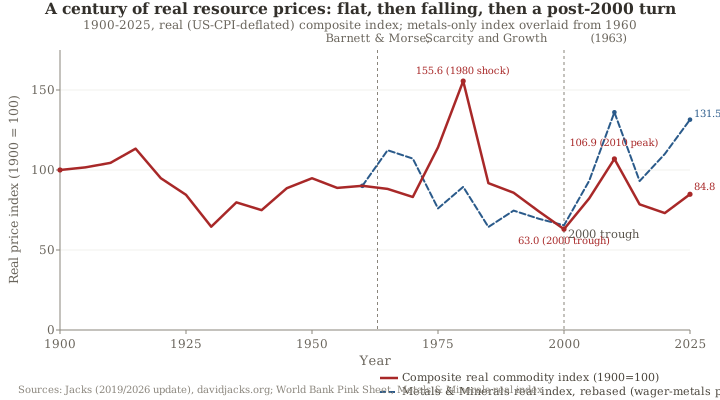
The second piece is the inversion that defines mature resource economics. By the late twentieth century the discipline’s worry had flipped. The problem was no longer “we’ll run out.” It was the resource curse, that resource abundance, badly governed, tends to make a country poorer. Dutch disease names one channel. A resource boom appreciates the currency and hollows out tradable manufacturing, so the windfall buys decline. Jeffrey Sachs and Andrew Warner found in 1995 that resource-rich economies systematically grew slower; Richard Auty had coined the term “resource curse” two years earlier. The underlying mechanism is institutional. Easy resource rents corrode the accountability between a state and its taxpayers, and a government funded by oil answers to no one. The formal homes are Economics Ch 20 §20.4 (Institutions and Development) for the curse itself and Ch 18 §18.4 (Extractive vs. Inclusive Institutions) for why governance is the binding variable.
You can see the inversion in the country trajectories. Norway found North Sea oil and got richer and cleaner-governed; Nigeria and Venezuela found oil and got poorer and more captured. Same commodity, opposite outcomes. The curse is in the institutions that meet it.
Here are the substitution optimists at full strength. Across the entire fossil era, every confident prediction of resource exhaustion failed, and it failed for a systematic reason. Simon and his allies were not ideologues who happened to win a coin toss. They had correctly identified that the price system is a scarcity-solving machine. A rising price on a substitutable source is a bounty posted for whoever can find a workaround, and across a century of data someone always collected it. The resource-curse literature even shows that the binding problem for resource-rich economies is usually too much resource meeting bad institutions, the exact opposite of running out. By the year 2000 the responsible mainstream view was earned and defensible. Source scarcity is a manageable, price-mediated, substitution-defeated problem.
“Substitution always wins” is true about sources and dangerous as a slogan
The claim earns its confidence honestly. Across the whole fossil era, every exhaustion panic was answered by a substitute the panic could not foresee. The danger is the word “always.” What actually wins is the price-summons-substitute loop, and that loop only runs on a scarce thing that has a price. Generalize it from copper to the atmosphere and the mechanism disappears.
Resource economics matured into a successful research program, for source problems: Hotelling for optimal extraction, substitution elasticities for long-run scarcity, the resource curse and institutions for the abundance paradox. Its verdict on the source question is settled and optimistic. The error to guard against is over-generalization. The law it established covers substitutable extractable stocks, and stops there. The only question that remains is whether its domain includes the atmosphere, and the answer is going to be no.
Everything in this apparatus assumes the scarce thing is a source, something you pull out of the ground, whose rising price posts a bounty for a substitute. But the constraint that defines the twenty-first century is a sink. And sinks do not have prices.
Climate as the binding constraint
“The economically efficient price of carbon dioxide emissions is around \$80 a ton. The actual global average price is closer to \$3. The gap between those two numbers is the size of the mistake the world is making.”
— after William Nordhaus, DICE model and 2018 Nobel lecture; figures from PNAS, 2024
Nordhaus did something audacious. He built the climate problem inside growth theory. His DICE model places climate damages on a Ramsey optimal-growth path, so that the same toolkit that handled accumulation and resources is asked to handle the sky. The discipline is trying, reasonably, to treat carbon as one more thing its apparatus already knows how to price. Whether it can is the question, and the “\$80 versus \$3” gap is the tell. For a finite source like oil, no economist has to compute the right price; the market does it. For carbon, the right price has to be calculated and imposed, because the market is producing a price of roughly zero.
Coal, oil, and copper were source constraints: finite stocks we extract, where scarcity shows up as a price, and the price summons the substitute. Climate is a sink constraint: the atmosphere’s finite capacity to absorb carbon dioxide, where overuse shows up as damage to third parties, a negative externality, in Pigou’s 1920 sense. The carbon externality and the Pigouvian apparatus that addresses it are the one place in the economics textbook where the climate problem has a direct formal home.
The social cost of carbon is the present value of the marginal damages from one extra ton of emissions along an optimal path, $SCC = \int_0^\infty e^{-\rho t}\, D'(t)\, dt$, where $D'(t)$ is the marginal damage at time $t$ and $\rho$ is the discount rate. The contested parameter is $\rho$: how heavily to weigh damages that land mostly on the future. Almost nobody disputes the form of this expression. The fight is entirely over the number you put in for $\rho$.
Running low on coal raises coal’s price, and you switch fuels automatically; the market does the work without anyone deciding to. Filling the sky with carbon raises nobody’s price. The cost lands on strangers and on the future, while the person striking the match pays nothing. So nothing switches automatically. The scarce thing has no price tag, and a price-summons-substitute mechanism with no price never starts.
The substitution loop that defeated every exhaustion panic needs a price on the scarce thing to even begin. The sink has no price until policy makes one. So the mechanism that answered Jevons is structurally absent for carbon unless it is built by hand. Nordhaus’s move of placing climate damages inside an optimal-growth path, the integrated-assessment approach, is the discipline’s attempt to do exactly that building, and it lives in the same growth-theory apparatus this thread peeked at in Economics Ch 13 (Growth Theory); the post-2008 and 2020s policy environment the constraint now sits inside is the territory of Economic History Ch.19 (The GFC and After).
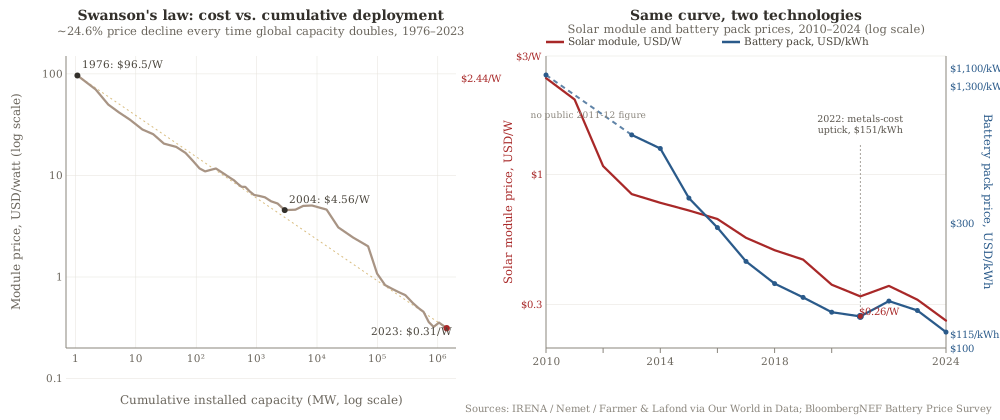
Now the hardest case, the one a smart reader feels. Climate is just Limits to Growth all over again, another doom prediction that substitution and technical change will dissolve, exactly as oil dissolved the coal panic. Solar costs have fallen roughly ninety percent in a decade, the induced-innovation curve the substitution story predicts. Battery costs are collapsing on the same kind of learning curve. The exhaustion pessimists have a terrible forecasting record stretching back to Malthus, and betting against human ingenuity has lost every time it has been tried. Have we not, the optimist asks, seen this movie? Why is the smart money this time not, once again, on the inventors?
“Climate is just the next exhaustion panic” is half-right in exactly the way that loses the argument
The analogy gets the technology right and the structure wrong. Induced innovation is making clean energy cheaper, just as the substitution story says, but that loop only fires because policy has put a thumb on the scale. Strip out the carbon prices, subsidies, and mandates and the sink stays free, the substitution never reaches the externality, and emissions keep rising on the cheapest available fuel.
It is half-right because induced innovation is real. The solar and battery learning curves are the substitution mechanism doing what it did against coal, finding non-carbon energy sources. But it is structurally incomplete because that mechanism only fires to the extent that policy has already put a thumb on the scale, carbon prices, subsidies, mandates. Left alone, the carbon sink stays free, and the substitution never reaches the externality at all, because there is no rising price to summon it. Simon was right about copper; he would be wrong to extend the same logic to the sink, because copper had a price, and the sky does not.
The frame is settled mainstream consensus. Carbon is a sink externality that requires a price or an equivalent policy to fix, and virtually no mainstream economist disputes that. What is live is the magnitude inside that locked frame. Nordhaus, with a discount rate near 1.5 percent, reads the optimal path as gradual; the Stern Review (2006), discounting the future at closer to 0.1 percent, reads it as urgent; Martin Weitzman argued that fat-tailed catastrophe risk should dominate the calculation however you discount. That dispute is about how much, how fast, not about whether. The exhaustion lesson was real; the climate problem is real and different; and the discount-rate fight is the honest remaining uncertainty.
The lineage of this pivot, Pigou’s externalities, Nordhaus and Stern on the social cost of carbon, and the ecological-economics tradition that questions the whole growth framing, sits in History of Economic Thought Ch.17 (Modern Pluralism).
This thread stops at the conceptual pivot, because the moment the question turns from what kind of problem is this to what should we actually do about it, carbon price versus industrial policy versus a degrowth-and-justice reframing, it becomes a different question with its own walkthrough. That debate is taken up in full by “How should we pay for climate change?”, which is where the discount-rate fight cashes out as policy. One endpoint is worth naming without pursuing. The ecological-economics tradition — Kate Raworth’s doughnut, the planetary-boundaries frame, the beyond-GDP critique — treats carbon as merely the first of several sinks (freshwater, phosphorus, biodiversity) and questions whether growth itself is the right frame. This tradition is the modern terminus of resource thought, and its depth belongs to “Is GDP a misleading measure of progress?”, which is where the beyond-GDP critique gets its own full argument.
The four rungs, and the turn only the thread shows
- The organic ceiling. For ten thousand years the economy ran on current sunshine, bounded by land and muscle. Malthus described that ceiling correctly; there was no counterexample in all of history.
- The fossil escape. Coal and the steam engine tapped a buried stock of ancient sunshine and broke the ceiling, and immediately Jevons and later the Club of Rome feared the new stock would run out too.
- Mature source-economics. Substitution and induced innovation defeated the exhaustion fears so reliably that the discipline’s worry inverted, from running out to the resource curse of having too much, badly governed. Simon won the bet, and the mechanism behind it is what holds.
- The sink constraint. Climate is a sink, an externality with no automatic price, so the substitution loop that beat every prior panic is structurally absent unless policy builds it by hand.
Read era by era, in the chapters that own each one, this looks like four separate stories: a great-divergence chapter, an industrial-revolution chapter, a development chapter on the resource curse, a market-failures chapter on externalities. The thread’s own contribution is the thing none of those chapters can show on its own, the turn between rung three and rung four. The discipline spent a century earning a hard-won and correct optimism about resource scarcity, and that optimism is the right tool for exactly the kind of problem it was forged on: a substitutable source with a market price. The trap is that the same optimism feels like it should apply to carbon, and it cannot, because a sink has no price for the optimism’s engine to run on.
So the answer to the question we opened with. Has the economy escaped its physical limits, or only changed which limit binds? It changed which limit binds. The photosynthesis ceiling was escaped, and the exhaustion fears that chased the escape were answered. The fossil escape created a constraint of a different shape, a sink we are filling for free. The discipline’s anti-pessimism is correct on its home turf and inapplicable on the new one.