Greece couldn’t devalue, couldn’t print, couldn’t exit, so what could it do?
For eight years one small country was trapped between a debt it couldn’t pay and a currency it couldn’t leave. The trap had a name fifty years before Greece fell into it.
The case as Athens saw it
“The deficit for 2009 will be in the region of 12 to 12.5 percent of GDP, not the six percent the previous government had reported.”
— after the incoming PASOK government’s revision of the Greek deficit, October 2009
One number, doubled overnight. A new government opened the books and found the deficit was twice what Athens had told Brussels. By the next morning the cost of insuring Greek debt against default had begun to climb, and it did not stop for three years. Everything that followed — the bailouts, the riots, the referendum — started here, with a revised statistic.
To follow what happened next you need three words the news used constantly and rarely defined. The theory that explains why Greece was trapped comes later.
A CDS spread is the price of insurance against a country defaulting on its debt, a credit default swap. When a country looks safe, that insurance is cheap. Over 2010 the cost of insuring Greek debt went from roughly ten basis points to well over a thousand: the market had moved from “Greece will obviously pay” to “Greece probably won’t.”
A bailout, in this story, is a loan package, from the eurozone governments, the European Central Bank, and the International Monetary Fund, the three lenders that came to be called the Troika, handed over in exchange for a signed program of austerity and reform. The money kept Greece paying its bills; the conditions attached to it set wages, pensions, and taxes for a decade.
A haircut, or in the jargon a PSI, private-sector involvement, is when the people who lent Greece money agree to take less back than they were promised. In 2012 private bondholders accepted roughly half. It was the largest sovereign-debt restructuring in history, and it still wasn’t enough.
The institutional machinery behind those words, who the Troika actually was, what a Memorandum of Understanding committed Greece to, how the eurozone crisis unfolded as an episode in financial history, is the spine of the history book’s treatment of the era.
Six years in real time
October 2009. The deficit is revised to roughly 12.7 percent of GDP. Within weeks the rating agencies start downgrading; the CDS spread starts its long climb.
May 2010. Locked out of the bond markets, Greece signs its first bailout, €110 billion from the eurozone and the IMF, against a Memorandum of Understanding mandating deep cuts to wages and pensions and a rise in taxes. The austerity begins. So do the protests. Syntagma Square, the plaza in front of the Greek parliament, fills with crowds that will return, year after year, in tear gas.
February 2012. The first bailout has not worked; the debt is still unsustainable. A second bailout, €130 billion, arrives bundled with the PSI, private bondholders take a haircut of about 53.5 percent on face value. Three successive IMF programs run through these years, each with new conditions, each missing its own targets as the economy contracts faster than anyone modeled.
2010–2014. The Greek economy shrinks by roughly a quarter. Unemployment passes 25 percent; youth unemployment passes 50 percent. Suicide rates rise. Hundreds of thousands of mostly young, mostly educated Greeks emigrate, a brain drain a small country does not recover from in a generation.
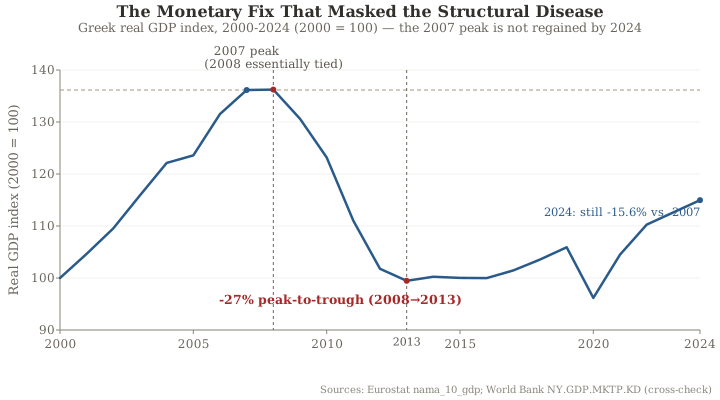
January 2015. Syriza, a left coalition that campaigned against the bailout terms, wins the election. Alexis Tsipras becomes prime minister. For six months his government negotiates with the creditors, and the negotiations go nowhere.
July 2015. Tsipras calls a referendum: accept the creditors’ latest terms, or not. The banks close. Capital controls cap withdrawals at sixty euros a day. On July 5, Greeks vote OXI, No, by 61.3 percent. Within a week the government capitulates and signs a third bailout, on terms harsher than the ones the voters had just rejected. Tsipras spends the next years administering the program he was elected to tear up.
The view from the finance ministry that lost
“The Eurogroup is not a forum of equals. It is a place where the powerful dictate and the indebted obey. We were not in a negotiation. We were in a debtors’ prison being told the terms of our sentence.”
— after Yanis Varoufakis, Greek finance minister Jan–July 2015, Adults in the Room (2017)
The eurosceptic-left case is largely right about the thing it describes. Varoufakis argued that the bailouts were a debt-collection operation: the first loans went out the door and almost straight back to the German and French banks that had lent recklessly to Greece in the boom, while the Greek public was handed the bill and the austerity. The conditions, on this reading, were there to enforce repayment and make an example; with the multipliers running as they did, they could not have restored Greek growth. And the Eurogroup, the room where eurozone finance ministers decide, has no treaty standing, keeps no minutes, and answers to no parliament; it is power without accountability. When Greeks voted No and got a worse deal six days later, Varoufakis took it as proof that the democratic verdict of a small indebted nation simply did not count. He resigned the night of the referendum rather than sign.
“On Sunday we are not just deciding to stay in Europe, we are deciding to live with dignity in Europe. The bailout deals must end. Vote No.”
— after Alexis Tsipras’s televised address before the referendum, July 2015
Did the OXI vote matter?
61.3 percent of Greeks voted No to the creditors’ terms. Six days later their government signed something worse. So was the most dramatic referendum in modern European history a turning point, or theater?
Where this leaves us
By 2015 Greece had voted No to a deal and then signed a worse one a week later. From inside the case, this looks like betrayal, the government turning on its voters, or like theater, a referendum staged to lose. The apparatus that makes it look like neither, that shows the capitulation as the only move left on the board, isn’t here yet. Before we reach for it, we owe the other side of the table the same hearing we just gave Athens.
From Frankfurt, from Brussels, from the IMF in Washington, the same six years looked completely different. The people on the other side of the table did not think they were running a debtors’ prison. They thought they were saving the eurozone from coming apart.
The case as the Troika saw it
“I offered my Greek colleague that Greece could take a time-out from the euro, an orderly exit, with debt relief, that we would help organize. The offer was serious. It was on the table.”
— after Wolfgang Schäuble’s account of the July 2015 Eurogroup time-out offer
The single most powerful finance ministry in the union was willing to let Greece go. On his telling the offer was serious policy. To understand why a creditor would propose expelling the patient, you have to see the case as the institutions saw it: as a fire that could burn down the whole building.
The institutions were reasoning from three constraints, and each one is real.
First: when does a debt become unpayable? Sustainability is arithmetic. The debt-to-GDP ratio moves according to a single equation that every creditor in the room had in front of them.
Let $b$ be the debt-to-GDP ratio, $r$ the real interest rate the government pays, $g$ the real growth rate, and $s$ the primary surplus (the budget balance before interest). The ratio evolves as:
$$\dot{b} = (r - g)\,b - s$$When $r > g$, debt compounds faster than the economy grows, and only a primary surplus can stop the ratio from exploding. In Greece around 2010 the gap between $r$ and $g$ was enormous — interest rates spiking, growth deeply negative — and the primary balance was a large deficit. Every term in the equation pointed the same way: without intervention, $b$ goes to the moon.
Picture a household whose credit-card interest rate is higher than the rate its income is growing, and which is already spending more than it earns before the interest even hits. The balance doesn’t just grow, it accelerates. There is no amount of “trying harder” that stabilizes it; either the interest rate falls, or income jumps, or someone forgives part of the balance. Greece in 2010 had all three pointed the wrong way at once.
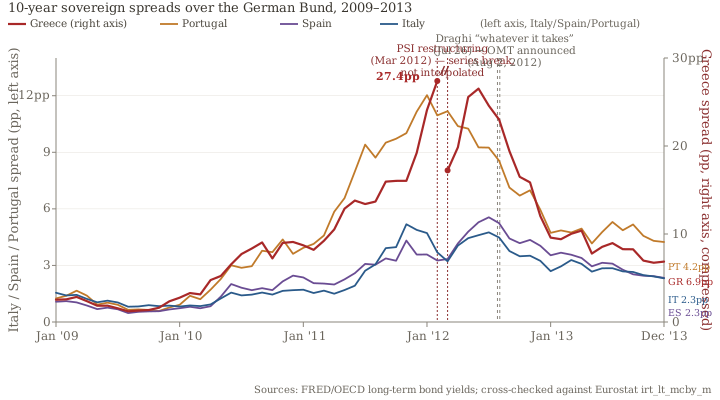
Second: contagion. Greece is small, about two percent of eurozone GDP. On its own it could default and the union would survive. But the creditors were looking past Greece, at what a Greek default would teach the market about Italy, Spain, and Portugal. If Greece restructures, the market reasons, then membership in the euro does not guarantee repayment, and it reprices every other vulnerable sovereign accordingly. Through 2010–2012 Italian and Spanish spreads moved in sympathy with Greek ones. Italy alone has a sovereign-debt market of roughly two trillion euros, far too large for any bailout fund. The institutions feared that the small fire in Athens would jump to a building no one could afford to lose.
Third: the constraint the ECB could not wish away. In 2008 the US Federal Reserve bought Treasury debt at scale, quantitative easing, and there was no legal question about whether it was allowed to. The ECB had no such freedom. Article 123 of the Treaty on the Functioning of the European Union prohibits the central bank from financing member-state deficits directly. The clause exists so that fiscally weak members cannot lean on the printing press of a shared currency. It meant the ECB could not, in 2010, do for Greece what the Fed did for America. Whatever the central bank wanted, the treaty stood in the way.
Two institutional voices, argued at strength
“The integrity of the monetary union rests on a single principle: no monetary financing of governments. Breach it once, for one country, under pressure, and the principle is gone forever. There is no ‘just this once’ with a constitutional constraint.”
— the doctrine of Jean-Claude Trichet, ECB President 2003–2011
Trichet’s position was institutional and it was coherent. The no-bail-out rule and Article 123 were the load-bearing walls of the whole construction. A monetary union of sovereign states with independent budgets only holds together if no member can force the others to monetize its deficits. The moment the ECB starts buying the debt of a government in trouble, every government in trouble expects the same, and the implicit fiscal-transfer commitment becomes infinite and unaccountable. From inside that logic, refusing to rescue Greece on easy terms was the defense of the only thing that made the currency credible.
“Rules are rules. If we abandon them for the country that breaks them most, we reward the breaking. A union held together by exceptions for the indisciplined is not a union; it is a transfer scheme nobody voted for.”
— the ordoliberal case associated with Wolfgang Schäuble
Schäuble’s case was moral and political, and it has more force than its critics allow. Greece had falsified its statistics to join and to stay; it had run deficits in good years; its tax collection was a national embarrassment. Moral hazard is real. If a member can overspend in the boom and be rescued in the bust with no conditions, the incentive to behave evaporates for every member, and the union dies of its own generosity. Schäuble’s “time-out” offer followed from this: only a credible threat of exit, costly but not impossible, could make the discipline bite. He was proposing the one mechanism he thought could keep the other nineteen members honest. The question Stage 3 will press is whether it named the main thing that was wrong.
The strongest critique came from inside
“Forecasters significantly underestimated the increase in unemployment and the decline in private consumption and investment associated with fiscal consolidation.”
— Olivier Blanchard & Daniel Leigh, IMF Working Paper, “Growth Forecast Errors and Fiscal Multipliers,” 2013
The most damaging verdict on the program was delivered by the IMF’s own chief economist. The 2010 Greek program had assumed a fiscal multiplier of about 0.5, meaning a euro of austerity would cost roughly half a euro of output, a manageable trade. Blanchard and Leigh went back and measured what the multiplier had actually been during the eurozone’s austerity, and found it was closer to 1.5 or even 2. Austerity had done two to four times the growth damage the models predicted. That is why every Greek program kept missing its targets: cutting the deficit shrank the economy so fast that the debt-to-GDP ratio, the denominator collapsing, often rose. The finding ports almost directly to the fiscal-multiplier debate at the heart of the government-spending walkthrough, there, multipliers this large are the case for fiscal stimulus when monetary policy is exhausted; here, the same large multipliers are why austerity inside a currency union was so much more destructive than its designers assumed.
“Greece could take a time-out from the euro, an orderly exit, with debt relief. The offer was on the table.”
— after Wolfgang Schäuble’s account of the July 2015 Eurogroup
Was the Grexit threat real or a bluff?
Germany’s finance minister put Greek exit from the euro on the table in the middle of a negotiation. Was he calling a bluff to force capitulation, or did he genuinely believe expulsion was the better policy?
Where this leaves us
From the institution side, the actions were defensible at the time and partly wrong in retrospect. The arithmetic of unsustainability was correct; the fear of contagion was rational; the treaty constraint was real and binding. And the IMF admitted its own multipliers were wrong, and that the austerity did far more damage than projected. Athens has a grievance and Frankfurt has a rulebook, and both are honest, and both are incomplete. What is missing is the frame that names why the architecture forced this shape on everyone in it, why neither the protest nor the discipline could have produced a good outcome.
What makes the case readable is naming the structural class it belongs to, the class of traps that follow from a currency union without a fiscal union. That class has four voices, and they were speaking decades before Greece. Put together, they compose into a single diagnosis.
The apparatus that names the case
“A system of flexible exchange rates is usually presented, by its proponents, as a device whereby depreciation can take the place of unemployment when the external balance is in deficit, and appreciation can replace inflation when it is in surplus. But the optimum currency area is not the world, and the argument for flexible exchange rates, pressed to its limit, is an argument for the Balkanization of every national economy into its own currency.”
— after Robert Mundell, “A Theory of Optimum Currency Areas,” American Economic Review, 1961
The apparatus that explains Greece was published in 1961, thirty years before the Maastricht Treaty and forty-eight before the deficit revision. From here on the voice that matters belongs to the theorist.
Four thinkers, four claims. None of them is sufficient alone; together they are the case.
Mundell and the optimum currency area. A region can share a currency without pain only if it can absorb a shock that hits one part harder than another, an “asymmetric shock”, without the safety valve of a separate exchange rate. Mundell’s 1961 answer named the conditions that make that possible: labor that can move from the depressed region to the booming one, capital that flows freely, wages and prices flexible enough to adjust downward, and, the one he and his successors stressed most, a fiscal mechanism that transfers resources from the prospering parts to the suffering ones. Score the eurozone against that list. Capital mobility: yes. Labor mobility: partial, throttled by language, culture, and pensions that don’t travel. Wage-price flexibility: weak. Fiscal transfer: almost none. A currency union that satisfies one and a half of four conditions is an accident waiting for an asymmetric shock, and Greece was the shock.
Eichengreen and the one-way door. Suppose Greece wanted to leave, to bring back the drachma, devalue, and inflate its way out, the prescription the eurosceptic left urged. Barry Eichengreen showed why that exit is barely an option at all. The moment exit becomes thinkable, every depositor races to pull euros out before they are forcibly converted into a drachma that will be worth less by morning; the bank run is not a risk of exit, it is the first event of exit. Contracts written in euros become instantly disputed. Trade seizes while the new currency finds a value. And politically, leaving is read as repudiation, locking the country out of markets for years. Eichengreen’s conclusion is that the costs are so high that a currency union, once entered, is effectively irreversible in practice, whatever the treaties permit.
de Grauwe and the missing lender of last resort. A country that borrows in its own currency — Britain, Japan, the United States — can never be forced to default, because its central bank can always create the money to make the payment. That guarantee is a circuit-breaker: markets know the payment will be made, so a panic about liquidity cannot snowball into an actual default. Paul de Grauwe showed that a member of a currency union has thrown that circuit-breaker away. Greece borrowed in euros, a currency it did not control. So if markets merely believed default was coming, they demanded higher rates, which raised the cost of servicing the debt, which made default more likely, a belief that manufactures the reality it predicts. Greece’s solvency problem was one the architecture turned into a liquidity panic with no one able to stop the spiral.
Reinhart and Rogoff and the long memory of debt. The fourth voice supplies the historical pattern. Carmen Reinhart and Kenneth Rogoff’s This Time Is Different catalogued eight centuries of sovereign-debt crises and found them rhyming: the distinction between debt a country owes in its own currency and debt it owes in someone else’s; the euphoria of the boom that always insists this cycle is the exception; the slow, grinding recovery path that follows a financial crisis. Greece sat where their pattern predicts the most danger, foreign-currency debt, in effect, since the euro was beyond its control. (One honest caveat: a separate 2010 paper by the same authors, Growth in a Time of Debt, claimed a sharp growth cliff above 90 percent debt-to-GDP, and a 2013 replication by Herndon, Ash, and Pollin found a spreadsheet error behind that specific threshold. The threshold claim did not survive. The broad pattern claims of the 2009 book, the ones that matter here, did.)
Separately the four are insights; together they are a trap. Greece could not devalue, it had no currency of its own to cheapen (Mundell). It could not print, the ECB was forbidden by Article 123 to finance it, and Greece had no central bank of its own (de Grauwe’s missing circuit-breaker). It could not default and restructure quickly, the PSI took three years to negotiate and was only a partial haircut even then. And it could not exit, the door was painted on the wall (Eichengreen). Four exit valves, all welded shut by the same architecture. Every previous sovereign-debt catastrophe — Argentina in 2001, Russia in 1998, Latin America in the 1980s — had at least one valve open: it could devalue, or inflate, or default and move on. Greece had none. The four impossibilities are one structural impossibility, viewed from four sides.
What the apparatus does to the two earlier voices
The apparatus adjudicates the two honest, incomplete positions from Stages 1 and 2.
Varoufakis was right about the thing he could see and wrong about the thing he proposed. He was right that the Troika package was a debt-collection operation harsher than any growth model could justify, right that the Eurogroup was power without accountability. But his prescription, that Greece should have exited and printed its own currency, runs straight into Eichengreen.
Schäuble was right that moral hazard is real and wrong about its rank. Greek profligacy, tax evasion, and the falsified statistics were all genuine. But none of that explains why a two-percent-of-GDP problem nearly broke the union, or why the same austerity that would have been painful for a monetarily sovereign Greece was catastrophic for a eurozone Greece. The discipline story is a real second-order effect sitting on top of a first-order structural impossibility. Schäuble was treating the symptom he found morally satisfying and missing the disease.
Both were arguing without the apparatus that names the case. Each had hold of a real piece; neither had the structure that a grievance and a rulebook both leave out.
“The optimum currency area is not the world.”
— after Robert Mundell, 1961, the warning, fifty years early
Was the eurozone always doomed to this?
Mundell described the trap in 1961. Feldstein warned the euro would fracture in 1997. The architects of Maastricht built it anyway. So was the Greek crisis a contingent failure, or was it written into the design from the start?
Where this leaves us
The case is a story about a currency-union architecture that violated three of Mundell’s four conditions and stripped its members of the central-bank-as-lender-of-last-resort circuit-breaker that protects every monetarily sovereign nation. The apparatus that diagnoses it was available in 1961. The architects knew, or should have known. The Greek crisis is what happens when an asymmetric shock hits an OCA-violating union with no fiscal integration: the four exit valves are already welded shut before anyone reaches for them. Everything in Stages 1 and 2 — the riots, the rulebook, the referendum, the time-out offer — was people improvising inside a trap whose shape none of them named out loud.
If the apparatus diagnoses correctly, two questions follow and the final stage answers them. Was there a cure once the case was underway? And what does the whole episode teach about how to build a currency union, if you must build one at all?
The cure, and the unfinished agenda

“Within our mandate, the ECB is ready to do whatever it takes to preserve the euro. And believe me, it will be enough.”
— Mario Draghi, ECB President, London, July 26, 2012
Spreads on Italian and Spanish bonds collapsed within hours of those three sentences, before the ECB had bought a single bond. The cure for the most dangerous part of the crisis turned out to be a sentence, two and a half years late.
The cure for the self-fulfilling component. Recall de Grauwe’s diagnosis: a eurozone member is exposed to self-fulfilling panic because it has no central bank standing behind it as lender of last resort. Draghi’s sentence, and the OMT, Outright Monetary Transactions, program that followed, created that backstop. The ECB committed to buying, in unlimited quantities if necessary, the bonds of any member under an agreed program. The genius and the contortion are the same thing: to stay inside Article 123’s ban on financing governments, the intervention was wrapped as restoring “the proper transmission of monetary policy,” not as fiscal rescue. But the effect was de Grauwe’s circuit-breaker, retrofitted. Once markets believed the ECB would not let a liquidity panic become a default, the panic became irrational, and so it stopped. The OMT was never used. The promise alone was enough.
What the cure did not touch. Draghi solved de Grauwe’s problem and left Mundell’s untouched. The self-fulfilling panic was the liquidity half of the crisis; the OMT dissolved it. But the structural half, the OCA violation itself, is where it was. Asymmetric shocks still hit eurozone members with no devaluation valve, labor still cannot move freely across the language borders of Europe, wages and prices are still sticky, and the one condition Mundell’s successors stressed most, a fiscal-transfer mechanism, was the cure that never came. There are no eurobonds, no permanent fiscal transfer from booming members to depressed ones, and no eurozone treasury. When the next asymmetric shock arrives, the structural trap will be waiting in the same shape it had for Greece.
What did get built. The crisis forced one real piece of integration into being: banking union. The Single Supervisory Mechanism (2014) put the ECB directly in charge of supervising the eurozone’s systemically important banks, breaking the “doom loop” in which weak national banks and weak national governments dragged each other down. The Single Resolution Mechanism (2016) created a common framework for winding up failed banks. The European Stability Mechanism made the bailout fund permanent. But common deposit insurance, the third leg of a complete banking union, still does not exist, blocked by the same north-south distrust that blocks fiscal union. The post-crisis architecture is a real but partial commitment: banking union landed, fiscal union did not, political union remains open. The deeper political-economy question of what the eurozone has chosen to become is the subject of the sibling walkthrough on whether the EU is fundamentally an economic or a political project.
The historical rhyme. The world has tried fixed exchange rates without a fiscal union before. The Bretton Woods order, the postwar system of currencies pegged to a dollar pegged to gold, was another attempt to hold exchange rates fixed across sovereign nations without a shared fiscal authority, and it collapsed in 1971 when the contradictions became unbearable. The eurozone is the same idea taken to its limit: it abolishes the exchange rate between members entirely, removing even the option of an orderly repeg. The deeper treatment of Bretton Woods as the precedent regime, and its collapse, belongs to the history of that order and to the sibling case on its end.
The unfinished agenda, in three voices
“Banking union is the most significant integration step since the euro itself. But it is a house with three walls. Without common deposit insurance, the doom loop between banks and sovereigns is weakened, not broken.”
— the assessment associated with Nicolas Véron, Bruegel / Peterson Institute
What was built is real and it matters: putting the ECB in charge of supervision broke the worst version of the bank-sovereign doom loop, where a government’s banks and its bond market pulled each other under. But the construction stopped one leg short. Without a common deposit-insurance scheme, a depositor in a weak member still has reason to believe their euros are safer in a strong member’s bank, which means in a real crisis money still flees south to north, and the union’s banking system is only conditionally single.
“A monetary union without a fiscal union is a fair-weather construction. It works until the first serious asymmetric shock, and then it asks its weakest members to bear the entire burden of adjustment.”
— the critique associated with Joseph Stiglitz and Jean Pisani-Ferry
The fiscal-union voice presses on the cure that never arrived. Eurobonds, jointly issued debt that would pool sovereign risk, and a genuine fiscal-transfer mechanism remain politically impossible, because creditor nations refuse to underwrite debtor nations’ spending without controls they cannot impose, and debtor nations refuse the controls. That impasse is why Mundell’s fourth condition went unmet. Its consequence is that when the next asymmetric shock lands, the entire weight of adjustment falls again on the member that was hit, exactly as it fell on Greece, austerity inside a currency it cannot devalue, backstopped by an ECB that can stop a panic but cannot transfer a single euro of real resources.
“The ECB could have simply bought the bonds. In the end, it did, it just had to call it something else.”
— the MMT-flavored reading of OMT
The heterodox-monetary claim that “a central bank issuing its own currency can always backstop its government’s debt” is, on the OMT evidence, directionally correct, that is what the ECB ended up doing. Right about the mechanism, wrong to treat the politics as a detail. The Lisbon Treaty’s Article 123 bound the ECB in fact: it forced the backstop to arrive two and a half years late and disguised as monetary-policy transmission rather than offered openly as fiscal support. The cost of the legal-political wrapping, measured in the Greek years the delay prolonged, is the part the slogan leaves out.
“A monetary union without a fiscal union is a fair-weather construction.”
— the fiscal-union critique of the post-crisis settlement
What did the eurozone learn, and what didn’t it?
The crisis forced banking union into being and gave the euro a lender of last resort. It did not produce a fiscal union. So is the post-crisis architecture durable enough for the next asymmetric shock, or just patched enough to fail later?
Where this leaves us
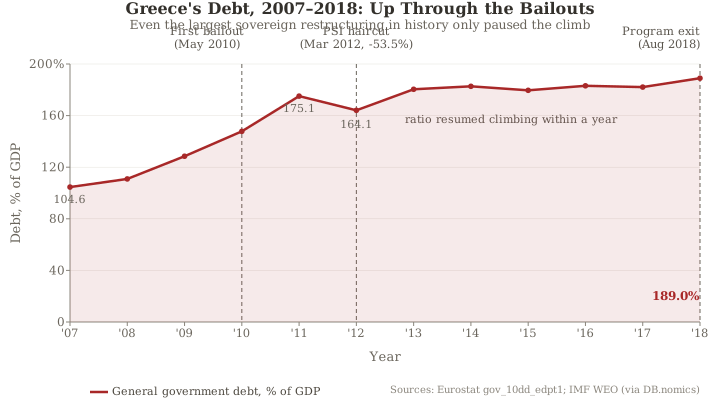
The fiscal-monetary mismatch was real and diagnosable. The cure for the self-fulfilling component arrived two and a half years late and worked. The cure for the structural component, fiscal union, never arrived at all. Greece exited its final program in 2018 with debt at roughly 180 percent of GDP, unemployment still high, and a generation of its young people emigrated. The case-record is observational; we cannot rerun it with earlier restructuring or an earlier Draghi. But the structural diagnosis is the apparatus’s strongest claim, and it does not depend on the counterfactuals: an OCA-violating union with no fiscal integration will expose its weakest member to exactly this trap when an asymmetric shock arrives. The lesson generalizes — currency unions need their fiscal architecture built in at construction — without prescribing “therefore no currency unions.” Whether the eurozone has truly learned it depends on whether the next asymmetric shock finds a fiscal union waiting, or another improvisation at the edge of the cliff.
The verdict
- The case as Athens saw it. A revised deficit, a spiralling CDS spread, three bailouts, a quarter of the economy gone, and a referendum that said No and changed nothing, betrayal and theater, from the inside.
- The case as the Troika saw it. Unsustainable arithmetic, the fear of contagion to Italy and Spain, a treaty that forbade the central bank from acting, and the IMF’s own admission that its austerity multipliers were badly wrong.
- The apparatus that names the case. Mundell, Eichengreen, de Grauwe, Reinhart and Rogoff, four voices composing into one structural impossibility: can’t devalue, can’t print, can’t default quickly, can’t exit.
- The cure, and the unfinished agenda. Draghi’s sentence cured the panic; banking union landed; fiscal union did not. The liquidity half was fixed and the structural half left in place.
The durable contribution of this case is the diagnosis itself. The Greek crisis is the cleanest demonstration economics has of what an optimum-currency-area violation does to a member state when an asymmetric shock arrives and there is no fiscal union to absorb it. Strip away the politics and the four impossibilities remain, welded shut by the architecture. That is why the apparatus, available since 1961, reads the case better than any account that stops at profligacy or cruelty.
If you build a currency union, you build its fiscal architecture at the same time, in calm weather, because a crisis is the worst possible moment to design institutions, and the eurozone proved it by trying. The open question, the one the next asymmetric shock will answer, is whether the rest of the union was listening.